How to Use Porcupine Boar Bristle Brushes for Thick Hair
- Editorial & Publishing Team

- May 18
- 12 min read
Updated: Jun 15


This article expands on concepts from the broader textbook – “Boar Bristle Brushes: The Definitive Guide to Naturally Shiny, Conditioned Hair – A Comprehensive Hair Care Textbook by Bass Brushes.”
Key Takeaways
· Thick hair often needs porcupine-style structure because pure boar bristle may smooth the canopy before reaching the deeper field.
· Longer pins help open a pathway into thick sections, while boar bristles support natural oil distribution and surface refinement.
· A porcupine boar bristle brush should still be used after detangling, on dry or nearly dry hair ready for conditioning passes.
· Sectioning remains essential because added access only works when each working area is manageable, reachable, and brushed root to end.
· The best results come from light pressure and complete strokes, not forcing the brush through thickness or treating it like a detangler.
Thick hair often exposes the limits of a brush faster than almost any other field. In the Bass system, a boar bristle brush belongs to the Shine & Condition category, which means its purpose is not vague smoothing or decorative polishing. Its real role is to help redistribute the scalp’s natural oils through the shaft, refine the outer field, and support a more coherent condition from roots to ends.
But thick hair changes how that function has to be delivered. A classic pure boar bristle brush may still carry the right logic, yet in a fuller, more resistant field it may not enter honestly enough to perform the route well across the whole shaft. That is why porcupine boar bristle brushes are often so useful for thick hair. They combine the conditioning value of boar bristle with a more penetrative structural element that helps the brush enter the field more truthfully.
That distinction matters because people with thick hair often get the wrong impression from the wrong brush. They use pure boar bristle that mostly polishes the canopy, then conclude that boar bristle only makes the top look nicer without really helping the whole field. Or they swing too far the other way and choose tools that enter aggressively but lose the conditioning and refining advantages that made boar bristle desirable in the first place. A porcupine brush often works so well for thick hair because it solves the right problem. It does not abandon Shine & Condition logic. It makes that logic physically possible in a fuller field.
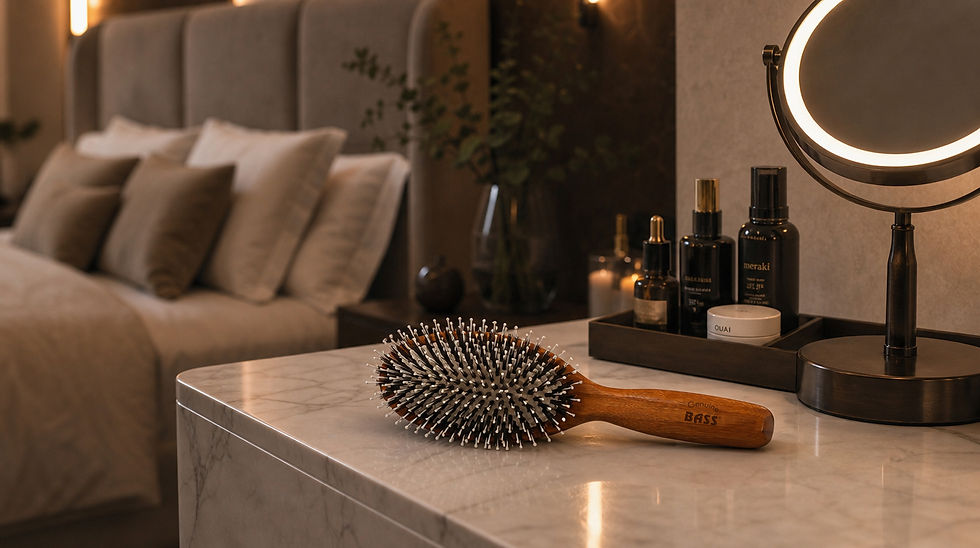
To use a porcupine boar bristle brush well for thick hair, the user has to understand that the goal is not simply to get through the hair. The goal is to let the route happen honestly through a field that would otherwise resist a more classic boar-only approach.
What a Porcupine Boar Bristle Brush Is Actually Doing
A porcupine boar bristle brush is not a random mixed-material novelty. In function, it is a conditioning brush that has been given extra structural help. The boar component still contributes the Shine & Condition role by helping move natural scalp oils through the shaft and refine the surface. The longer or firmer companion element helps the brush enter a fuller field more honestly so that the conditioning route does not stay trapped at the surface.
This is why porcupine brushes can be so effective in thick hair. They preserve the category’s real purpose while making the route more realistic in a denser field. The user is not abandoning conditioning for penetration. They are using enough penetration to make conditioning more truthful.
The right porcupine brush does not replace Shine & Condition logic. It extends it into a field that needs more help entering honestly.
Why Thick Hair Often Needs More Than Pure Boar Bristle
Thick hair often has enough fullness and resistance that pure boar bristle cannot always enter the field deeply enough to begin the route meaningfully across the whole shaft. The brush may still improve the outer surface, but the inner field and lower lengths can remain relatively excluded. The canopy begins looking calmer while the deeper field does not join the result with the same honesty.
This is why thick hair so often produces the complaint that boar bristle only polishes the top. The issue is not necessarily that Shine & Condition is wrong for the field. The issue is that the tool lacks enough entry support to make the route real. A porcupine design helps solve that by giving the brush a way to move through the fuller field so the boar bristle can do more than just skim the surface.
Thick hair often needs help entering the route before the route can be completed.
Why Porcupine Brushes Work So Well for Thick Hair
A porcupine brush works well for thick hair because it balances two needs that thick fields often have at the same time. First, the field needs enough structure for the brush to enter honestly and separate the route. Second, the field still benefits from the conditioning and refining function that boar bristle provides. If the tool has only conditioning softness, it may stay too close to the canopy.
If it has only structural aggression, it may stop behaving like a Shine & Condition brush altogether.
This is why the porcupine design is so intelligent for thick hair. It does not force the user to choose between field access and conditioning value. It lets the brush do both more honestly.
The best porcupine brushes make thickness workable without turning the whole routine into force.
Why Thick Hair Still Needs the Brush to Stay in the Right Category
Because thick hair can be resistant, users often start treating every brush as though its job were to conquer the field. In the Bass system, that is where the thinking usually starts going wrong. A porcupine boar bristle brush is still not a detangling labor brush, a harsh scalp-scrubbing tool, or a styling-force instrument. Its category remains Shine & Condition. The structural help exists so the conditioning route can happen, not so the brush can become something else entirely.
This matters because once the user forgets the category, the routine becomes too aggressive. The top gets overworked, the field becomes more managed than supported, and the user ends up with visible crown polish instead of a more coherent roots-to-ends condition.
Even in thick hair, the right brush is still supposed to support the field, not dominate it.
Why the Brush Should Not Be Used as a Detangler
This rule remains essential. A porcupine boar bristle brush may enter thick hair more honestly than pure boar, but that does not make it a detangling substitute. If the hair is carrying knots, compacted sections, or caught ends, the route still breaks down before true conditioning work can happen. The brush may move more impressively through the upper field than pure boar alone, but the routine still becomes a resistance routine instead of a Shine & Condition routine.
That is why detangling must still happen first whenever needed. Fingers, a comb, or a proper detangling tool should remove meaningful resistance so the porcupine brush can then perform its real work. Thick hair especially punishes category confusion because the field can make a partially wrong routine look almost right for a while.
The more resistant the field, the more important it becomes not to confuse entry with detangling.
Why Dry or Nearly Dry Hair Is Usually Best
A porcupine boar bristle brush generally works best on dry or nearly dry hair because this is when the field can be judged honestly. Thick hair can hide incomplete route work surprisingly well, especially when the outside layer improves first. On dry or nearly dry hair, the user can tell more accurately whether the scalp-origin support is actually reaching deeper into the shaft, whether the inner field is joining the result, and whether the crown is staying balanced instead of becoming the most finished-looking zone.
On wetter or unstable hair, the field may seem more manageable, but that can be deceptive. The surface shifts, the canopy smooths, and the user may think the route is improving when much of the change is only temporary control.
Thick hair needs honest feedback. Dry or nearly dry conditions usually provide it best.
Why Root Access Still Matters in Thick Hair
One of the biggest misunderstandings in thick hair is the idea that because the field is hard to enter, the user can settle for surface success. But in the Bass system, the route still begins at the scalp. If the brush never begins there honestly, then the support remains concentrated at the source while the lengths and ends remain less meaningfully included.
This is why a porcupine brush is so useful. It helps the user begin the route where it actually starts rather than only managing the visible outer field. But beginning at the scalp does not mean turning the routine into harsh root work. It means honest root-origin engagement followed by real travel through the shaft.
The right brush for thick hair should make scalp-origin conditioning more possible, not less important.
Why the Root-to-End Pass Must Be Complete
Thick hair often reveals route failure at the ends. The top improves, the mid-lengths look somewhat calmer, and the lower shaft still does not fully join the result. This is exactly why the root-to-end pass matters so much. If the pass never really reaches the ends, the whole routine becomes a partial win that masquerades as a full one.
A porcupine brush is valuable because it helps create more truthful route continuity in a thicker field. But that value is only realized if the pass is actually completed. The user cannot stop once the canopy looks better. Thick hair often needs the whole route to be honored before the result becomes genuinely balanced.
The canopy may be the first sign of improvement, but the ends are often the proof that the route was real.
Why Pressure Must Stay Controlled Even in a Resistant Field
One of the easiest mistakes with thick hair is assuming that because the field is fuller, the user should simply push harder. In the Bass system, that is still the wrong answer. A porcupine brush already brings more structural help to the field. The user does not need to add force on top of that.
Too much pressure still creates crown overwork, still turns the routine into surface management, and still risks making the top look more handled than supported.
The right contact should feel clear and substantial without becoming forceful. The user should feel that the brush is entering and traveling more honestly, not that it is being driven aggressively through the field. If more pressure seems necessary, the problem is usually not lack of force. The route may need better sectioning, the hair may still need detangling, or the session may be drifting into impatience.
Thick hair needs entry support, not brute pressure.
Why Sectioning Matters So Much More in Thick Hair
Sectioning is often what turns a porcupine boar bristle brush from helpful to excellent in thick hair.
Without sectioning, the outer field can absorb a disproportionate share of the routine while the deeper field remains under-supported. The user sees improvement and assumes the brush is doing the full job, when in reality much of the work is staying at the canopy.
Sectioning reduces the field to a size that lets the route happen more truthfully. It allows scalp access to be more honest, the shaft to participate more fully, and the lower lengths to stop being an afterthought. In thick hair, this is often the difference between a routine that looks good on the outside and a routine that actually conditions the field more deeply.
The thicker the field, the more sectioning becomes a tool of truth rather than ceremony.
Why Thick Hair Can Still Become Top-Heavy If the User Is Casual
Because the field is resistant, users often assume top-heaviness is less of a risk. But thick hair can absolutely become top-heavy if the brush is used casually. The canopy responds first, the crown looks smoother, and the user keeps spending the session there because it is the area offering the clearest visual reward. Over time, the outer field starts looking like the whole routine while the deeper route remains less complete than the user thinks.
This is why thick hair still needs crown restraint. A porcupine brush may help enter the field better, but it does not remove the need for route honesty. The top can still become the place where the routine gets spent if the user is not paying attention.
Even in thick hair, the canopy should reflect the route, not replace it.
Why Hair Length Changes the Experience Even More in Thick Hair
Thick hair becomes even more demanding when it is also long. The field is not only fuller. The route is longer. That means the older, drier ends need even more honest support, and the risk of the routine fading out before reaching them becomes greater. A porcupine brush may still be the right category choice, but technique matters even more. The user may need more sectioning, more route discipline, and more patience in completing the pass rather than celebrating early canopy success.
This is why some long thick hair users still feel underwhelmed by a good brush until they change their route habits. The brush may already be correct. The routine may not yet be.
The fuller and longer the field, the more truth the route demands.
Why Daily or Frequent Use Can Work Well When the
Sessions Stay Honest
Thick hair can often benefit from frequent Shine & Condition work because the field has enough substance that it does not usually overload as quickly as very fine hair. But that does not mean every session should become long or forceful. Daily or frequent use works best when the sessions remain honest, properly sectioned when needed, and focused on route completion rather than visible canopy reward.
This is why a porcupine brush can become an excellent maintenance tool for thick hair. It allows regular support without requiring the user to surrender conditioning logic in favor of force. The field can stay more coherent over time when the routine is steady and truthful.
Frequent use helps most when the brush remains a conditioning tool, not a struggle tool.
How to Know the Porcupine Brush Is Right for Your Thick Hair
The right brush usually makes the field feel more accessible without making the routine feel harsh.
The scalp is included more honestly, the lengths and ends join the result more clearly, and the canopy no longer feels like the only part of the field receiving the session. The hair looks calmer, brighter, and more coherent without turning the crown into the whole story.
If the brush still seems to glide mostly over the surface, it may not be sufficient for the field or the route may not be sectioned honestly enough. If the top starts looking too managed too quickly, the user may be pressing too hard or spending too much time at the crown. If the whole field participates more visibly and the result feels less surface-dependent, the match is probably right.
The correct porcupine brush for thick hair usually reveals itself through access with balance, not through struggle or spectacle.
Conclusion
To use a porcupine boar bristle brush well for thick hair, the first thing to understand is that the field does not need force so much as it needs honest entry. A porcupine boar bristle brush belongs to the Shine & Condition system because it combines the conditioning and refining value of boar bristle with the structural help needed to make that route more physically possible in a fuller field.
That means the hair should be ordered first, dry or nearly dry, and brushed with controlled scalp-origin contact, honest root-to-end continuity, and enough sectioning that the deeper field can actually participate.
That is why the routine depends on access with restraint. The brush should begin at the scalp, but the canopy should not absorb the whole session. The user should judge success not by whether the outer layer looks polished quickly, but by whether the whole field becomes more balanced, more coherent, and more honestly conditioned from roots to ends.
In the Bass system, a porcupine boar bristle brush for thick hair is not a compromise. It is often the most truthful way to let Shine & Condition logic reach a fuller field.
FAQ
Why are porcupine boar bristle brushes often good for thick hair?
Because thick hair often needs more honest field access than pure boar bristle alone can provide. A porcupine brush helps the boar component reach the field more truthfully.
Does a porcupine brush still count as a Shine & Condition tool?
Yes. It still belongs to the Shine & Condition category. The added structure helps the conditioning route happen more honestly in a thicker field.
Should you detangle before using a porcupine boar bristle brush on thick hair?
Yes. The hair should be reasonably ordered first so the brush can perform conditioning work instead of resistance work.
Should you use a porcupine boar bristle brush on wet or dry hair?
Usually on dry or nearly dry hair. That makes it easier to judge whether the route is actually being completed honestly.
Should the brush still start at the scalp for thick hair?
Yes. The conditioning route still begins at the scalp, so the brush should still begin there meaningfully before continuing through the shaft.
Should the pass still go from roots to ends?
Yes. Thick hair still needs the whole route to be completed if the result is going to be balanced rather than canopy-focused.
How hard should you brush thick hair with a porcupine boar bristle brush?
Use controlled, moderate pressure. The brush already provides more structural help, so force is usually the wrong answer.
Is sectioning important when using a porcupine brush on thick hair?
Often very important. Sectioning helps the deeper field participate instead of leaving most of the routine at the surface.
Can thick hair still become top-heavy with the right brush?
Yes. If the user keeps spending the session at the crown or canopy, the top can still absorb too much of the routine.
How do you know if the porcupine brush is right for your thick hair?
The field should feel more accessible without the routine becoming harsh. The scalp, lengths, and ends should all join the result more honestly, and the whole field should look more balanced instead of only the canopy improving.