Tight curls hair does not follow the same brushing rules as straight hair or even looser curl patterns. Curly, coily, and tightly textured hair behaves differently under tension, moisture, friction, heat, and daily handling, so the brush system must be different too. That is why Tight Curls Hairbrushes stand as their own category in the Bass system. They are not simply brushes for curls in a general sense. They are tools selected by function, hair state, and styling goal.
For the complete science, brush logic, and full educational framework, explore the Tight Curls Hairbrushes textbook.
Women with tight curls hair, including denser coils, tighter curl patterns, and softer mixed-heritage curl groupings, often share several important brushing realities. The hair is more prone to dryness through the lengths and ends, more vulnerable to friction and rough handling, and more dependent on preparation, sectioning, and brush role. This does not mean every woman in the category has the same hair. It means the category requires its own brushing logic.
At Bass, this category is understood through function. A brush may be used to detangle damp hair, organize dense sections, guide blow-dry stretching, soothe a set style, fluff natural bulk, or polish a prepared finish. These are different jobs. Once those jobs are understood clearly, brush choice becomes much easier and much more effective.
Why Tight Curls Hair Requires a Different Brush System
Tightly curled and coily hair follows a more curved path along the strand, which changes the mechanics of brushing. The hair is more likely to compact, intertwine, and resist careless brush entry. It may appear dense and full, but density should never be mistaken for durability. Tight curls hair can be highly vulnerable to breakage when brushed with too much force, too little preparation, or the wrong tool.
This is also why brushing in this category is not usually a generic daily habit. The most successful routines depend on moisture state, slip, sectioning, and the correct brush role. A brush should not be expected to do everything. In tight curls hair care, different brushes serve different purposes, and the routine works best when each brush is used within its proper role.
The Core Brush Roles in Tight Curls Hair Care
The working pin brush is the central brush of the category. It performs the greatest share of the real labor. It helps detangle prepared hair, organize dense sections, and support much of the practical work involved in styling. In most tight curls routines, this is the primary working brush.
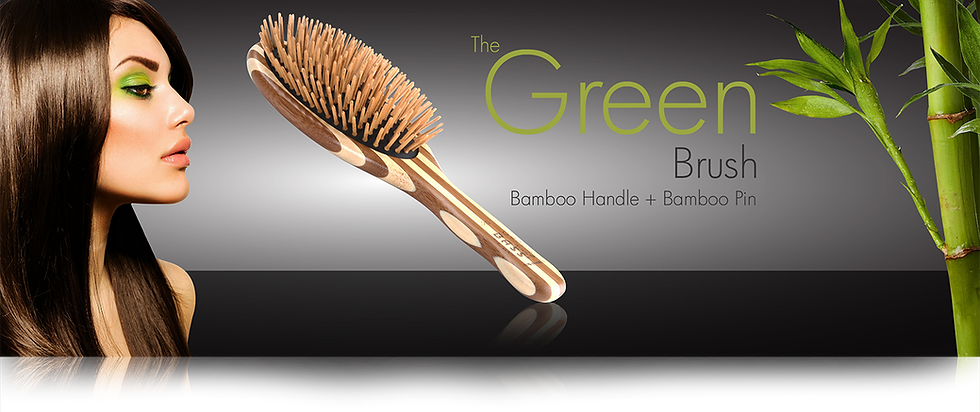
Bamboo and wood pin brushes are especially valued in this category because they offer firmness, spacing, and directional clarity without collapsing under dense textured hair. Stylists who specialize in tight curls hair have long appreciated these brushes not only for their ability to move through substantial density, but also for how well they hold up under repeated blow-dry stretching and heat-directed styling.
Pure boar bristle brushes serve a different purpose. They are not the primary detangling brush for tight curls hair. Instead, they are used for soothing, shaping, finishing, and in natural styles, helping fluff and refine the outer bulk of the hair.
Porcupine style boar brushes are more specialized still. They are most appropriate when the hair is already well detangled and slightly damp, and the goal is deeper polish and surface refinement. In the Bass system, this is a prepared-state brush, not a rescue brush.
Brush Function Depends on Hair State
One of the most important ideas in tight curls brushing is that the same hair does not always need the same brush in the same way. Damp detangling asks the brush to separate and organize. Blow-dry work asks the brush to guide tension and direction under heat. Natural-shape refinement asks the brush to lift, fluff, and balance the silhouette. Finished styling asks the brush to soothe, smooth, and refine the surface.
This is why the Bass system organizes the category by function rather than by broad marketing labels. The right brush is determined by what the hair needs in that moment.
Why Materials and Design Matter
Brush performance in this category depends heavily on construction. Pin spacing matters because dense curly and coily hair does not respond well to crowded geometry. Pin firmness matters because overly soft pins can bend away from the section and fail to create organized movement. Cushion response matters because comfort and control must be balanced. Brush size matters because large dense sections often need more deliberate handling rather than broad uncontrolled passes.
This is where thoughtful brushmaking matters. Every design decision, from spacing to firmness to brush head feel, affects how the tool enters the hair and how the hair responds.
Tight Curls Hair Exists on a Spectrum
Not all women in this category have the same pattern or the same routine. Some have tighter visible curls, some denser coils, some more elongated curl structures, and some softer mixed-heritage patterns that still share many of the same brushing realities. Fine strands, dense growth, shrinkage level, styling preference, and moisture habits all influence how the brush should be used.
But across that full spectrum, the same principle holds: brushing should be guided by function, preparation, and hair state rather than by one-size-fits-all assumptions.
A More Respectful Approach to Brushing
Tight curls hair has long required more specialized knowledge than mainstream brush education has often provided. That is why this category matters. It gives structure and clarity to a part of hair care that is too often oversimplified.
Bass publishes this category because brush education should do more than label a tool. It should explain the logic behind it. Tight Curls Hairbrushes are best understood not as a trend, but as a complete brushing system for curly, coily, and tightly textured hair.
Frequently Asked Questions
What are Tight Curls Hairbrushes?
Tight Curls Hairbrushes are brushes selected for curly, coily, and tightly textured hair based on function, hair state, and styling goal. In the Bass system, this category includes brushes used for detangling, section control, blow-dry stretching, natural shaping, finishing, and polishing.
Why does tight curls hair need a different brush system?
Tight curls hair behaves differently under tension, moisture, friction, and heat. The hair is more likely to compact, intertwine, and become dry through the lengths and ends, so brushing must be more intentional and function-specific than in straighter hair types.
What is the main working brush for tight curls hair?
The working pin brush is the core brush of the category. It performs the greatest share of the real brushing labor, especially in prepared detangling, sectioning, and styling support.
Why are bamboo and wood pin brushes useful for tight curls hair?
Bamboo and wood pin brushes are valued because they offer firmness, spacing, and directional clarity that help move through dense textured hair more effectively. They are also especially appreciated in heat styling because they hold up well under repeated blow-dry work.
Are boar bristle brushes used on tight curls hair?
Yes, but for different purposes than pin brushes. In this category, pure boar bristle brushes are generally used for shaping, soothing, fluffing, and finishing rather than primary detangling.
What is a porcupine style boar brush used for on tight curls hair?
A porcupine style boar brush is used for deeper polishing and surface refinement when the hair is already well detangled and slightly damp. It is a prepared-state finishing brush, not a rescue brush for resistant hair.
Can one brush do everything for tight curls hair?
Usually no. Tight curls hair care works best when different brushes are used for different roles, such as detangling, blow-dry stretching, natural-shape refinement, finishing, and polishing.
Does all tight curls hair need the same brush?
No. Tight curls hair exists on a spectrum. Pattern, density, strand thickness, shrinkage, and styling routine all affect which brush will work best and how it should be used.
Why does brush design matter so much for tight curls hair?
Pin spacing, pin firmness, cushion response, and brush size all affect how the brush enters the hair and how the hair responds. In this category, design is directly tied to control, comfort, and reduced breakage.
What makes Bass Brushes different in this category?
Bass approaches Tight Curls Hairbrushes as a functional brush system rather than a trend category. Our focus is on matching brush design, material, and role to the real needs of curly, coily, and tightly textured hair.