Ball-Tip vs Smooth-Tip Nylon Pins in Round Brushes


Key Takeaways
Ball-tip and smooth-tip nylon pins differ mainly in terminal geometry: ball tips broaden the contact area, while smooth tips keep a slimmer, streamlined endpoint.
Terminal shape and finish quality are separate; either design can be well or poorly finished, so smoothness should not be inferred from tip category alone.
Ball tips can make incidental scalp contact feel more cushioned, but they do not override pin stiffness, pressure, or the need for controlled technique.
Smooth tips may reduce terminal obstruction during penetration and release, especially in dense or heavily engaged sections, but they do not automatically glide better.
Tip geometry matters most when density, rotation, tangling, or scalp sensitivity make pin interaction demanding; otherwise, barrel diameter, pin design, section size, and technique matter more.
Two round brushes can use the same basic nylon pin material, similar barrel diameters, and comparable pin patterns yet feel noticeably different in the hair. One reason is easy to overlook: the geometry at the very end of each pin.
Some nylon pins terminate in an enlarged rounded ball. Others end in a smooth, rounded or radiused tip that remains closer to the diameter of the pin shaft. Both can be comfortable, effective, and appropriate for professional blow-dry shaping, but they do not create exactly the same interface with the hair or scalp.
The distinction is not primarily about which design creates more curl, more volume, or straighter hair. Those outcomes remain governed mainly by the round brush's cylindrical geometry and by the way the stylist coordinates tension, airflow, movement, heat, and cooling. Pin-tip design operates at a smaller scale. It can influence how individual pins enter a section, move among strands, make incidental scalp contact, maintain engagement during rotation, and leave the hair during release.
That makes ball-tip versus smooth-tip nylon an interface decision rather than a styling-result category.
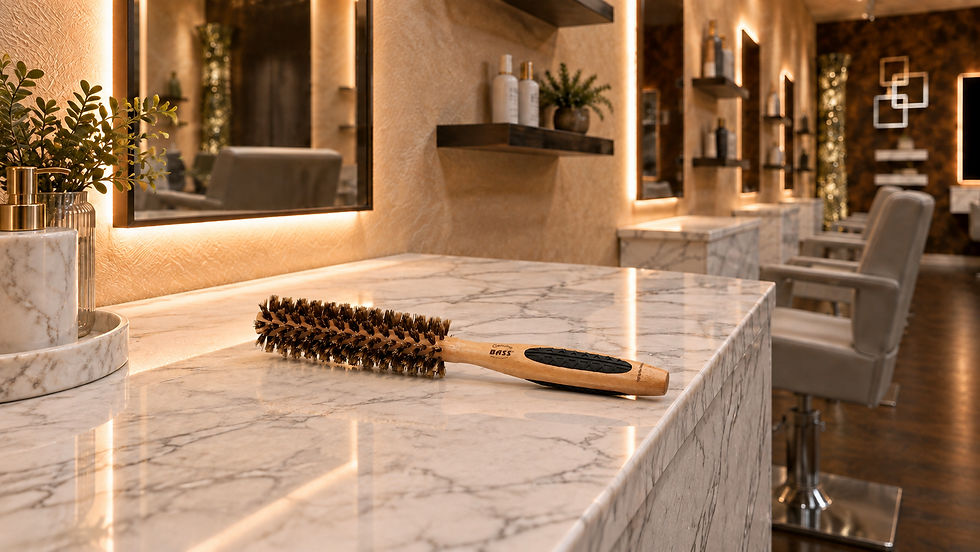
A ball tip increases the size and roundness of the pin's terminal contact area. A smooth tip preserves a more streamlined terminal profile while still providing a properly finished, non-abrasive end. Neither construction is inherently superior. The more useful question is what type of terminal interaction best suits the hair, section, and way the brush will be used.
Understanding the Actual Construction Difference
A nylon pin is a synthetic filament projecting outward from the barrel of a round brush. Its behavior depends on more than material alone. Pin length, diameter, stiffness, flexibility, spacing, density, projection angle, anchoring, surface finish, and heat tolerance can all affect how the brush engages with hair.
Tip geometry is one variable within that larger system.
A ball-tip nylon pin has an enlarged rounded terminal at the end of the filament. Depending on construction, that rounded end may be formed during manufacturing or created as a distinct terminal feature. The important characteristic is that the endpoint is wider than the shaft immediately behind it.
A smooth-tip nylon pin retains a more continuous profile. Its end is rounded, radiused, polished, molded, or otherwise finished so that it is smooth rather than abrupt or abrasive, but it does not have a substantially enlarged ball.
The difference therefore involves two separate ideas that should not be confused:
Tip geometry describes the shape of the endpoint.
Tip finish quality describes how smooth, consistent, and free of rough edges that endpoint actually is.
A ball tip can be well finished or poorly finished. A smooth tip can likewise be well finished or poorly finished. The category name alone does not determine manufacturing quality.
This distinction is important because many practical differences attributed to ball tips or smooth tips actually arise from the complete pin construction rather than from terminal shape alone.
Ball Tips Change the Nature of Terminal Contact
The most obvious mechanical characteristic of a ball tip is its increased diameter.
When the terminal end makes incidental contact with the scalp, a larger rounded surface distributes that contact across a broader area than the narrow end of the filament would. This can create a more cushioned sensation, particularly during work close to the roots.
Round-brush styling does not require aggressive pressure against the scalp. The brush's primary job is to shape hair around a cylindrical surface while controlled tension and airflow act on the section. Even so, scalp contact can occur around the hairline, crown, bangs, short layers, and during root-lift work.
In those situations, a well-finished ball tip may feel more forgiving.
The qualification matters.
A firm pin remains firm even if its end is rounded. Excessive pressure can still feel uncomfortable.
The ball changes the terminal contact surface; it does not neutralize pin stiffness, poor technique, excessive force, or inappropriate sectioning.
Ball tips should therefore be understood as one way of modifying contact geometry, not as a universal guarantee of softness or gentleness.
Smooth Tips Preserve a More Streamlined Pin Profile
A smooth-tip pin approaches the same terminal problem differently.
Instead of enlarging the endpoint, the end of the filament is finished so that it remains smooth while staying relatively close to the width of the shaft.
That more continuous profile can become relevant when the pin field must move through dense or resistant sections.
As a round brush enters the hair, the pins need to separate and move among many strands before the section can settle into the working surface of the brush. A terminal that is not substantially wider than the shaft may create less geometric obstruction during entry and exit, all else being comparable.
That does not mean smooth-tip pins automatically glide better.
Pin stiffness, length, spacing, density, surface quality, section dimensions, moisture state, hair condition, and the amount of rotation can easily have equal or greater influence. A smooth-tip brush with dense, rigid pins may create more resistance than a ball-tip brush with flexible, widely spaced pins.
The useful principle is narrower: when two pin systems are otherwise similar, a streamlined terminal may reduce one source of resistance during penetration and release.
That tendency can become more meaningful as the section becomes denser, more resistant, or more heavily engaged around the barrel.
Smooth-Tip Does Not Mean Sharp
One of the most important misconceptions in this comparison is the idea that a nylon pin requires a visible ball at its end to be comfortable.
It does not.
A properly made smooth-tip pin should itself have an appropriately finished endpoint. The end may be rounded, radiused, polished, molded, or otherwise shaped so that it does not present a sharp or rough edge to the hair or scalp.
The meaningful comparison is therefore not between a ball tip and an unfinished filament.
It is between two deliberately finished terminal designs.
This is also why finish quality deserves separate attention from shape. A smooth-tip pin that is evenly finished may interact with hair more cleanly than a ball tip with a rough seam or damaged terminal. Conversely, a well-made ball-tip system can move very comfortably through hair when the transition between the shaft and terminal is smooth and the surrounding pin architecture is appropriate.
A ball tip should not automatically be assumed smoother.
A smooth tip should not automatically be assumed sharper.
The condition and manufacturing quality of the actual terminal matter.
How Tip Geometry Can Influence Penetration and Release
Penetration and release are where tip geometry becomes most practically interesting.
When a round brush is positioned beneath a section, the pins must enter deeply enough for the hair to distribute across the usable surface of the barrel. If only the outermost strands engage, tension and directional control may become inconsistent.
In a dense section, each pin has to pass between a larger number of strands. An enlarged terminal may encounter more hair before the narrower shaft follows. A streamlined terminal may require less displacement at the endpoint.
This difference should be treated as a geometric tendency, not an absolute rule.
A well-designed ball-tip brush may penetrate thick hair effectively because its pins are long, firm, correctly spaced, and arranged to suit dense sections. A poorly matched smooth-tip system may penetrate less effectively because the pins are too short, too flexible, or too densely clustered.
The same caution applies to release.
Round brushing frequently involves partial rotation, wrapping, unwinding, repositioning, and repeated passes. Hair must therefore leave the pin field as predictably as it entered.
A smooth terminal with little change in diameter between the shaft and endpoint may offer a simpler exit path in heavily engaged sections. A ball tip introduces a small change in geometry that strands must move around as the pin leaves the section.
But ball tips do not inherently cause snagging.
Release problems are often dominated by other variables: oversized sections, excessive rotation, hair wrapped too many times around the barrel, damaged pins, poor brush orientation, inconsistent tension, or trying to pull a wrapped brush straight through the hair instead of unwinding it.
Tip design can influence release.
Technique and total brush architecture still govern it.
When Tip Geometry Matters Most—and When It Matters Less
One of the easiest ways to overstate this distinction is to treat tip shape as equally important in every brush and every head of hair.
It is not.
Tip geometry tends to matter more when the pins are being asked to work near the limits of the section they are controlling.
That can occur when:
hair density is high;
the section is relatively deep;
pins are penetrating close to the scalp;
substantial rotation is being used;
hair is prone to tangling;
the brush is repeatedly entering and leaving the same section;
or the user is especially sensitive to scalp contact.
By contrast, terminal differences may become much less important when hair density is low, the section is shallow, the pins are highly flexible, spacing is open, rotation is modest, and the pin field is not making meaningful contact with the scalp.
In those conditions, pin stiffness, length, spacing, barrel diameter, or technique may dominate the experience so completely that ball-tip versus smooth-tip construction becomes a secondary detail.
This is an important selection principle.
A buyer or stylist does not need to treat terminal design as a major specification unless the working conditions make that detail relevant.
Hair Density Changes the Importance of the Difference
Density can make terminal geometry more or less noticeable because it changes how much hair each pin must move through.
In fine or lower-density hair, there is generally more available space around individual strands. The pins may enter the section without encountering much resistance, so the geometric difference between a ball and a streamlined terminal may be modest. If the brush is being used close to the scalp, however, the broader terminal contact of a ball tip may still be appreciated.
As density rises, penetration becomes more demanding. Each pin must travel among more strands before the section settles into the brush.
In thick or high-density hair, a streamlined tip may therefore become more relevant when the goal is efficient entry and release. Even then, pin length, rigidity, spacing, and section size remain essential. A smooth terminal cannot compensate for a brush whose pins are too short to reach through the section or for a section that is simply too deep to control.
The most useful comparison is therefore always made between complete pin systems rather than tip shapes in isolation.
Hair Condition Changes the Interaction Too
Density is not the only variable.
Hair with a smooth, resilient surface may move easily around either terminal design. Hair that is weathered, highly porous, chemically altered, tangled, or rougher at the surface may behave differently because friction between strands is already elevated.
In those conditions, small geometric features can become more noticeable during rotation and release.
The useful test is behavioral:
Does the brush enter the section cleanly?
Does the hair distribute evenly?
Do individual strands repeatedly catch?
Can the brush unwind without extra force?
Does the same section resist release again and again?
If a particular ball-tip system repeatedly catches vulnerable hair, the terminal geometry may be contributing to a mismatch. If a smooth-tip brush moves freely through the section while remaining comfortable near the roots, its streamlined profile may be useful.
The opposite can also occur. A carefully finished ball-tip brush with flexible, appropriately spaced pins may glide through the same hair extremely well.
That is why the complete pin system matters more than the name of the tip alone.
Tip Shape Does Not Determine Tension
Another common simplification is to describe one tip style as creating more tension and the other as creating less.
Tension during round brushing does not work that way.
Functional tension arises from the interaction among section size, stylist pull, pin or bristle engagement, barrel position, rotation, hair resistance, brush movement, airflow, and the degree to which the section is supported around the barrel.
Tip shape can contribute to engagement, but it does not independently set tension.
A smooth-tip brush with long, rigid, closely spaced pins may engage more strongly than a flexible ball-tip system. A ball-tip brush with firm pins may generate substantial control despite its broader terminal shape.
The goal is not maximum grip.
It is enough engagement to shape the hair predictably while still allowing controlled movement and release.
Tip Geometry Does Not Change the Round Brush's Primary Styling Logic
Ball-tip and smooth-tip construction should also remain in proportion to what actually determines the finished shape.
Changing the tip design does not turn a large round brush into a small one or fundamentally change the curvature the barrel is capable of producing.
Barrel diameter remains foundational.
Larger diameters support broader, straighter lines, smoothing, softer movement, and wide curvature. Medium diameters support waves, bends, and moderate curvature. Smaller diameters create tighter turns and more concentrated curl.
The pin field helps deliver and control the section against that geometry.
Tip design refines how the pins perform that supporting role.
A user who wants tighter curl should first evaluate barrel diameter, section size, tension, rotation, airflow, heat, and cooling—not whether the pins have ball-shaped terminals.
A user whose brush repeatedly catches, penetrates poorly, feels uncomfortable near the scalp, or releases unpredictably has a stronger reason to examine the pin construction itself.
Heat Resistance Is a Separate Specification
Tip shape also tells the user very little about heat tolerance.
A ball tip does not automatically make nylon more resistant to blow-dryer heat.
A smooth tip does not automatically indicate a high-temperature filament.
Heat behavior depends on the nylon formulation, pin dimensions, construction quality, dryer distance, airflow, temperature, duration of exposure, and overall brush design.
During blow-drying, the dryer should remain in controlled motion rather than concentrating unnecessary heat on one area of the pin field. The concentrator nozzle should direct airflow along the intended path of the hair while the brush and dryer work together.
If heat resistance is an important selection factor, it should be evaluated independently from tip geometry.
Wear Can Change a Good Pin System
The condition of the terminal may eventually matter more than whether it began as a ball tip or smooth tip.
Ball-tip pins should be inspected for rough seams, cracked terminals, loosened ends, deformation, or damage at the transition between the ball and shaft.
Smooth-tip pins should be inspected for abrasion, melting, sharp edges, bending, roughness, or deformation.
Repeated heat exposure, mechanical loading, compression during storage, and ordinary use can change synthetic pins over time.
The practical question is whether the pin field still behaves consistently.
If one area begins catching hair, scratching the scalp, gripping more strongly than neighboring areas, or releasing unpredictably, the working surface has changed.
At that point, the original terminal design matters less than the present condition of the brush.
Choosing Between Ball-Tip and Smooth-Tip Nylon Pins
The best selection starts with the problem the brush needs to solve.
A ball-tip nylon system may be useful when close-to-scalp work is common and a broader, more cushioned terminal contact is desirable.
A smooth-tip nylon system may be useful when low terminal bulk, efficient penetration, repeated movement through dense sections, or streamlined release are higher priorities.
Then evaluate the variables that may matter even more:
How long are the pins?
How rigid or flexible are they?
How are they spaced?
How deeply do they reach into the section?
How dense is the hair?
How large are the working sections?
How much rotation will be used?
How easily does the brush unwind?
How sensitive is the scalp?
These questions help determine whether tip geometry will materially affect performance or remain only a minor construction detail.
A round brush is a system. Terminal design matters most when it meaningfully changes how that system interacts with the hair.
The Governing Distinction: Terminal Contact Versus Terminal Streamlining
Ball-tip and smooth-tip nylon pins are sometimes reduced to a simple comfort-versus-performance comparison.
That framing is too crude.
Both designs can be comfortable.
Both can perform effectively.
Both can be suitable for professional blow-dry shaping.
Their clearest distinction is geometric.
A ball tip creates a broader rounded endpoint that can make incidental scalp contact feel more cushioned.
A smooth tip retains a slimmer terminal profile that may reduce one source of obstruction during penetration and release.
Whether either difference becomes important depends on the rest of the brush, the density and condition of the hair, section dimensions, and the way the brush is being used.
The round brush still performs its primary Straighten & Curl function through cylindrical geometry, hair engagement, tension, airflow, movement, heat, and cooling.
Pin-tip design refines how the nylon field participates in that larger process.
The most useful question is therefore not whether ball tips or smooth tips are universally better.
It is whether the working conditions make terminal cushioning, terminal streamlining, or neither one especially important.
That is the level at which a small construction detail becomes a meaningful round-brush selection decision.
Frequently Asked Questions About Ball-Tip and Smooth-Tip Nylon Pins
Are ball-tip nylon pins better than smooth-tip nylon pins?
No. Ball tips provide a broader rounded endpoint, while smooth tips maintain a more streamlined profile. Either can be appropriate depending on hair density, scalp sensitivity, brush construction, and technique.
Are smooth-tip nylon pins sharp?
They should not be. A properly made smooth-tip pin has a finished rounded, radiused, polished, or molded endpoint. Smooth tip describes a streamlined terminal shape, not an unfinished or sharp filament.
Are ball-tip pins gentler on the scalp?
They can feel more cushioned during incidental scalp contact because the terminal surface is broader. Pin stiffness, pressure, spacing, and technique still strongly influence comfort.
Which tip design is better for thick or dense hair?
A streamlined smooth tip may become useful when penetration and release are difficult because it introduces less terminal enlargement. However, pin length, rigidity, spacing, and section size can matter more than tip shape.
Do ball-tip pins cause more snagging?
Not inherently. A well-finished ball-tip system can move through hair very cleanly. Snagging can also result from damaged pins, excessive rotation, unsuitable section size, rough hair condition, or poor release technique.
Does pin-tip style affect curl size?
Not directly. Curl size and the scale of curvature are determined primarily by barrel diameter and technique. Tip design affects how the pins engage and move through the section rather than the basic shape created by the barrel.
Are ball-tip pins more heat resistant?
Not necessarily. Heat resistance depends on the nylon formulation and overall construction rather than on whether the terminal is ball-shaped or streamlined.
When should tip geometry actually influence brush selection?
It becomes more relevant when working with dense sections, frequent rotation, close-to-scalp styling, tangle-prone hair, or situations where penetration and release are already demanding. In easier working conditions, other variables such as pin stiffness, length, spacing, and barrel diameter may matter much more.
Is terminal finish quality more important than whether the pin is ball-tip or smooth-tip?
It can be. Either design should have a smooth, consistent, undamaged surface. A poorly finished or worn terminal can create catching or discomfort regardless of its original geometry.