How to Detangle Hair After Swimming: Chlorine, Saltwater, and Mechanical Stress


Key Takeaways
· Swimming creates tangles through repeated strand movement, moisture exposure, and increased friction, making post-swim detangling a distinct mechanical challenge requiring careful preparation.
· Chlorinated pools and ocean water create different detangling conditions, with pool exposure affecting surface lubrication and seawater introducing salt residue, sand, and movement-related tangles.
· Freshwater rinsing should precede post-swim detangling, followed by gentle cleansing and conditioning for mild tangles or conditioner-assisted preliminary separation for severely knotted hair.
· Detangle from the ends upward using controlled tension and appropriate flexible pins, reserving more structured styling brushes for restoring direction after resistant knots are released.
· The safest detangling approach depends on hair condition, lubrication, and resistance, while preventive containment and prompt rinsing help limit tangles during repeated swimming.
Hair that was manageable before swimming can emerge from a pool or ocean feeling rough, compressed, interwoven, or unexpectedly difficult to brush. Long strands may collect into knots at the nape of the neck, fine hair may develop clusters of small tangles, and curly or textured hair may become difficult to separate without disturbing its natural formation.
These changes do not result from water exposure alone.
Swimming combines prolonged moisture exposure with repeated movement, friction, environmental substances, and changes in the way individual hair fibers interact. Chlorinated pool water and ocean saltwater introduce different conditions, while swimming motion, waves, wind, towels, and repeated wetting can create additional mechanical stress. The result is often a combination of altered surface behavior and physical entanglement.
This distinction matters because hair immediately after swimming may not be ready for brushing. It may be saturated with water, carrying residual substances, or already under tension from knots that developed during movement. Attempting to restore order before addressing these conditions can turn an ordinary detangling session into a source of unnecessary stretching and breakage.
The appropriate approach depends on identifying what is creating resistance. Pool-exposed hair may require attention to residual disinfectants, accumulated substances, and reduced surface lubrication. Ocean-exposed hair may carry salt residue or sand while also showing the effects of more extensive movement. Hair that has become severely tangled presents another challenge because compact knots require different handling from ordinary overlapping strands.

Effective post-swim detangling therefore begins before the first brushstroke. The goal is not merely to remove knots, but to restore manageable movement to hair that has experienced an unusual combination of moisture, surface friction, and mechanical disturbance.
Why Hair Becomes Tangled During and After Swimming
Hair tangles when individual strands cross, wrap around one another, or encounter sufficient friction to resist sliding apart. During ordinary grooming, these interactions can often be managed through controlled movement and consistent alignment. Swimming creates a less predictable environment.
As hair moves through water, strands are displaced repeatedly. Head rotation, diving, waves, and changes in swimming direction can cause sections to circulate, twist, and overlap. Long hair worn loose is especially exposed because its free lengths move independently before becoming entangled with neighboring strands.
Water also changes the mechanical behavior of the hair fiber.
The hair shaft consists primarily of keratin, with an outer cuticle that influences surface friction and protects the underlying structure. As hair absorbs water, it swells and becomes more extensible. Its internal bonding interactions change temporarily, allowing the fiber to stretch more readily under tension.
Greater extensibility, however, does not necessarily mean greater resistance to damage. Wet hair can still be overstretched, particularly when a knot concentrates pulling force across a small number of strands.
The condition of the cuticle is equally important. Hair with a relatively smooth, intact surface generally allows neighboring fibers to slide more easily. Hair with surface irregularities, accumulated wear, or chemical damage may develop greater resistance where strands cross.
Prolonged wetting and repeated physical contact can make these differences more consequential.
Swimming therefore produces two distinct but overlapping detangling challenges. The physical arrangement of the hair may become more complicated, while the surfaces that must slide apart may also become less cooperative.
A third factor is often introduced after leaving the water. Rough towel drying, vigorous rubbing, repeated handling, or allowing wet hair to move freely in the wind can compress existing tangles and introduce new ones.
The most difficult knots are frequently not created by a single event. They develop through a sequence of displacement, moisture exposure, friction, and subsequent handling. Recognizing that sequence makes it possible to intervene before loose tangles become tightly compressed.
How Chlorinated Pool Water Changes Detangling Conditions
Chlorine-based disinfectants are used in swimming pools to control microorganisms and maintain water quality. Their intended purpose is sanitation, but repeated exposure to treated water can also affect the condition of hair.
The relevant concern is not that chlorine directly causes strands to tie themselves into knots. Rather, exposure to chlorinated water can contribute to changes in the hair's surface properties, particularly when swimming is frequent or the hair is already compromised.
Hair naturally contains surface lipids that help moderate friction and support smoother movement between fibers. Repeated exposure to chlorinated water can contribute to the loss or alteration of protective surface components and, over time, oxidative changes in susceptible hair fibers.
As surface condition deteriorates, strands may feel rougher, less manageable, or more resistant to separation.
The effects depend on exposure frequency, water conditions, existing hair damage, and subsequent care. A single brief swim in a properly maintained pool does not necessarily produce meaningful damage. Repeated swimming without adequate rinsing and conditioning represents a different exposure pattern.
Why Pool Hair Can Become Harder to Brush as It Dries
Immediately after swimming, hair may feel slippery simply because it is saturated with water. That sensation can conceal tangles already present beneath the surface.
As water drains and the strands begin to dry, areas of overlapping hair may become increasingly resistant to movement.
Residual pool-water constituents, existing hair products, and the condition of the hair's surface can influence this transition. Hair that initially seemed easy to separate may become more difficult to brush once it is partially dry.
The critical distinction is between moisture and lubrication.
Water changes the internal moisture state and extensibility of hair, but water saturation alone does not guarantee low friction between strands. Conditioning agents, by contrast, can provide surface lubrication that helps neighboring fibers slide apart.
A section of hair can therefore be thoroughly wet and still difficult to detangle. Applying more brushing force does not correct the underlying friction.
For pool-exposed hair, the preferred starting point is a thorough freshwater rinse followed by an assessment of whether cleansing, conditioning, or preliminary knot separation is necessary.
When Pool Hair Needs More Than a Freshwater Rinse
Freshwater rinsing helps flush residual pool water and dissolved substances from the hair. For many occasional swimmers, this is an important immediate step.
However, repeated pool exposure, accumulated hair products, and persistent roughness may require shampooing to remove buildup more thoroughly.
The decision should be based on the condition of the hair rather than the assumption that every swim demands aggressive cleansing.
If the hair moves reasonably freely, gentle shampooing followed by conditioning can prepare it for final detangling.
If the hair is already severely knotted, however, vigorous shampooing may compress the tangles. In that situation, preliminary separation with conditioner may be necessary before cleansing.
This distinction is especially relevant for long, fine, curly, or chemically processed hair, where washing tangled strands without first assessing their condition can introduce additional mechanical stress.
Why Ocean Saltwater Creates a Different Detangling Problem
Ocean swimming introduces conditions that differ from those of a conventional chlorinated pool.
Seawater contains dissolved salts and minerals. While hair is submerged, these substances remain dispersed in the surrounding water. As seawater evaporates, however, salt-containing residue can remain on the fiber surface.
This residue can contribute to a rough, textured feeling and make neighboring strands less able to slide smoothly past one another.
The effect is often described as beach texture. Hair may appear fuller, more separated, or less uniformly aligned after exposure to seawater. These changes are not necessarily harmful after occasional exposure, but the same increased texture can become problematic when the hair is already tangled.
The challenge becomes more pronounced when saltwater exposure is combined with repeated drying.
A person may swim, leave the water, allow the hair to dry in the sun, and then enter the ocean again. Each cycle changes the moisture state of the fiber, introduces additional movement, and may leave more residue behind if freshwater rinsing does not occur.
Hair that has undergone several wetting and drying cycles may therefore become substantially more difficult to organize than hair rinsed and managed after a single swim.
Waves, Wind, and Sand Add Mechanical Resistance
Ocean conditions introduce physical forces that may be more significant than the salt itself.
Waves can move long hair across the shoulders, around the neck, or repeatedly over itself. Wind can separate wet lengths into moving strands that cross and twist as they dry. Hair left loose in turbulent water may develop substantial tangles even when its surface condition was relatively good before swimming.
Sand introduces another complication.
Small particles can become trapped between strands, particularly where hair is dense, curled, or already knotted. Attempting to brush through gritty hair can increase abrasive contact and create additional resistance.
A brush should not be used as the primary method of removing trapped sand. Instead, freshwater should be allowed to flow through the affected sections, carrying away loose particles before deliberate separation begins.
Where sand remains within a compact knot, gentle finger separation may be needed to expose the trapped material without grinding it against the surrounding fibers.
The distinction between pool and ocean detangling is therefore practical. Pool exposure places particular emphasis on reducing residual treated water and maintaining surface lubrication. Ocean exposure requires attention to salt residue, environmental debris, and potentially more extensive movement-related tangling.
Both environments may involve overlapping causes, but the immediate preparation should respond to the conditions actually present.
The Correct Post-Swim Detangling Sequence
Post-swim detangling should follow the condition of the hair rather than a fixed number of brushstrokes.
The essential process is to reduce environmental residue, establish adequate lubrication, identify resistance, and separate tangled strands before attempting to style them.
A Practical Post-Swim Detangling Routine
Rinse thoroughly with fresh water. Flush away residual pool water, seawater, and loose environmental debris without vigorously rubbing the hair.
Assess the degree of tangling. Determine whether the hair is lightly tangled and can be washed normally or contains compact knots requiring preliminary separation.
Choose the appropriate cleansing sequence. For mild tangles, shampoo gently if needed, then condition. For significant knots, apply conditioner and loosen the resistant areas first; shampoo gently afterward if needed, then recondition.
Locate remaining resistant areas. Use the fingers to identify concentrated knots, especially around the nape, ends, and areas compressed beneath a swim cap.
Detangle in controlled sections. Work from the ends upward with short, gentle strokes, using a suitable detangling tool and stopping whenever significant resistance occurs.
Restore alignment after separation. Once the hair moves freely, use an appropriate styling-capable brush or texture-preserving technique to organize the hair without unnecessary tension.
The sequence is deliberately simple, but the condition of the hair determines how each stage should be performed.
Rinsing Without Creating Additional Tangles
Immediately after swimming, allow clean water to flow through the lengths in their natural direction.
Avoid vigorously rubbing the hair against itself. This can redistribute existing tangles or compress loose knots into denser formations.
For ocean swimming, pay particular attention to areas where sand and salt residue may accumulate, including the nape and ends. For pool swimming, the immediate objective is to reduce residual treated water exposure before extended drying.
If freshwater is temporarily unavailable, the better approach is usually to contain the hair gently and postpone thorough detangling until rinsing is possible.
Forceful brushing through salty, gritty, or tightly tangled hair does not compensate for the absence of proper preparation.
Deciding Whether to Shampoo Before or After Preliminary Detangling
The appropriate cleansing sequence depends on whether knots will interfere with washing.
When hair is only lightly tangled, a gentle shampoo can remove accumulated substances before conditioner is applied. The conditioner then reduces friction and allows the hair to be detangled more comfortably.
When significant knots are already present, shampooing without preparation may worsen their structure. Manipulating the hair during cleansing can drive loose strands into existing entanglements and increase compression.
In that situation, apply a suitable conditioner or detangling preparation and gently loosen the most resistant areas first. Once the hair can be handled without excessive pulling, proceed with careful cleansing if necessary, followed by conditioning and final detangling.
This does not mean conditioner must always precede shampoo after swimming.
It means the cleansing sequence should be selected to avoid making the existing mechanical condition of the hair worse.
When Is Wet Detangling Safer Than Damp Detangling?
The safest moisture state is not determined simply by whether the hair is soaking wet, damp, or nearly dry. It depends on how readily the strands can separate, how much tension the technique creates, and whether sufficient surface lubrication is present.
Wet hair is generally more extensible, which means it can stretch farther under an applied force.
That characteristic requires restraint, particularly when the hair is chemically weakened or already contains compact knots. However, wet hair supported by a suitable conditioner may also offer substantially less resistance between neighboring strands than the same hair after partial drying.
For curly, coily, and densely textured hair, detangling while thoroughly wet and conditioned can therefore be preferable because the additional slip helps preserve curl groupings and reduce friction during separation.
For other hair types, including some fine or fragile hair, gently removing excess water before using an appropriate detangling tool may provide more predictable handling, provided the strands remain adequately lubricated and do not begin to catch.
The governing decision is mechanical rather than absolute. If a section separates smoothly with minimal tension, its moisture state may be suitable. If it stretches excessively, catches repeatedly, or requires force, the technique, lubrication, section size, or moisture condition should be reconsidered before continuing.
Neither thoroughly wet nor partially dried hair is automatically safe to brush. Low resistance, controlled tension, and appropriate tool engagement are the determining conditions.
Releasing Concentrated Knots Before Full-Length Brushing
Swimming-related tangles are rarely distributed evenly.
The nape frequently develops compact knots because strands move against the neck, shoulders, or swimwear. Long ends can become intertwined through repeated water movement. Hair beneath a swim cap may become compressed when it is arranged unevenly or the cap is removed abruptly.
Before introducing a brush, use the fingers to locate these areas.
A loose tangle may release through a few controlled movements. A tightly compressed knot may require progressive separation at its outer edges.
Pulling a knot apart from opposite ends often tightens its structure and concentrates tension.
Instead, isolate accessible strands and gradually create movement within the tangled area.
When the knot begins to loosen, introduce an appropriate detangling brush only where the hair can respond without substantial force.
The objective is to reduce resistance progressively rather than force the entire obstruction to move at once.
Working From the Ends Toward the Roots
Once the hair has sufficient slip, divide it into manageable sections.
Support each section above the area being detangled so that pulling force is not transmitted directly to the scalp. Begin near the ends, using short, controlled strokes to release the lowest accessible tangles.
As each portion moves freely, advance gradually toward the roots.
This approach is especially valuable after swimming because numerous small tangles may exist along the same length. Starting near the roots can collect separate points of resistance into a tighter obstruction farther down.
If the brush catches, stop the stroke. Reassess the section, use the fingers to loosen the resistance, and apply additional lubrication if necessary.
Hair should not be pulled repeatedly through the same resistant area in the expectation that the knot will eventually release.
A successful detangling stroke is defined by a reduction in resistance without unnecessary stretching, snapping, or scalp tension.
Choosing the Right Brush for Post-Swim Detangling
Post-swim detangling places particular demands on brush design because the hair may be both more extensible and more resistant to separation.
The important characteristics are controlled engagement, appropriate pin spacing, predictable pressure, and the ability to respond to resistance without transmitting excessive force.
The most suitable brush depends on which stage of post-swim management has been reached.
Flexible Pins for Initial Resistance
A brush with flexible pins may be useful during preliminary detangling, particularly when the hair is fragile, highly interwoven, or uncomfortable to separate.
Flexible pins can yield under resistance, moderating the force transferred from the hand to the hair.
This may be valuable when swimming has produced clusters of tangles rather than freely moving strands.
However, flexibility alone does not guarantee gentle treatment. Large sections, rapid strokes, and repeated pulling against compact knots can still cause damage.
Pin spacing also matters. A relatively open configuration may allow a tangled section to separate with fewer simultaneous contact points, whereas dense engagement can encounter too many interwoven strands at once.
For hair that remains gritty after ocean exposure, the priority is not selecting a more forceful brush.
It is completing the rinse and removing trapped particles before resuming mechanical separation.
Structured Pins for Control After Detangling
Once the knots have been released, the task changes from overcoming resistance to controlling direction.
A styling-capable pin brush can provide the structure needed to restore alignment and guide the hair into an organized arrangement.
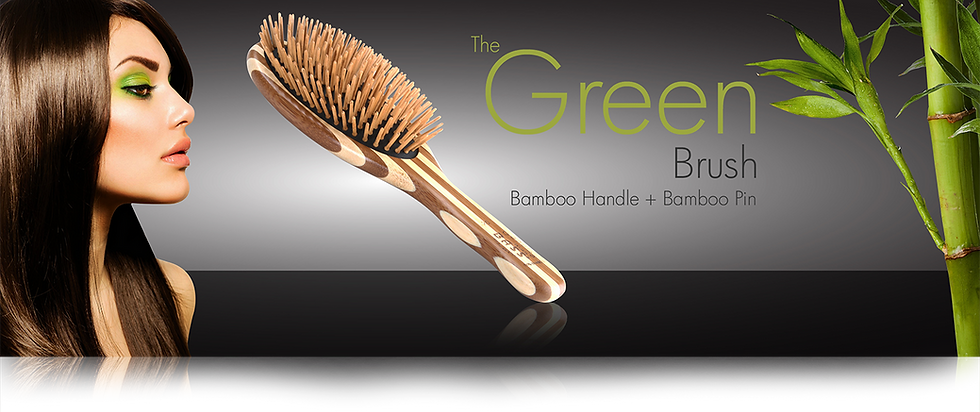
Bamboo, wood, alloy, and appropriately structured nylon pins can support styling functions when their geometry, rigidity, and construction are suited to the task.
The important distinction is between a tool that yields during resistance and one that maintains sufficient engagement to direct hair predictably.
A structured styling brush should not be forced through severely tangled wet hair simply because it performs well during ordinary brushing.
Similarly, a highly flexible detangling-only brush may release knots effectively without providing the control needed for subsequent styling.
The appropriate tool is selected according to the immediate function. After swimming, that function can change substantially between the first pass and the final arrangement.
How Cushion Response Influences Brushing Pressure
Cushioned brush construction can help moderate the transmission of pressure from the hand through the pins.
This can be useful when hair has become more difficult to manage after prolonged water exposure, particularly when the scalp is sensitive or the user is tempted to increase force.
However, a cushion cannot compensate for inappropriate pin rigidity, excessive tension, or brushing through compact knots.
Effective post-swim detangling depends on the combined behavior of the brush and the technique.
Pin material, spacing, rigidity, cushion response, section size, and movement all influence how force reaches the hair.
Brush selection should therefore support the detangling process rather than substitute for appropriate preparation.
How Hair Type and Condition Change Post-Swim Detangling
Chlorine and saltwater exposure introduce recognizable challenges, but the response of the hair depends strongly on its preexisting structure and condition.
Two people who swim in the same water for the same duration may experience very different levels of tangling.
Fine Hair and Long, Easily Interwoven Strands
Fine hair may develop numerous small tangles rather than a few large knots. Individual strands can become intertwined during swimming and resist separation when gathered together.
A common mistake is to interpret these small tangles as minor enough to brush through quickly.
In reality, resistance distributed across many fine strands can become considerable when they are handled as one large section.
Fine hair generally benefits from smaller sections, lightweight lubrication, and gentle pin engagement. Heavy conditioning products may weigh it down unnecessarily, while insufficient lubrication can leave neighboring strands catching against one another.
Long hair introduces another variable: greater freedom of movement.
The longer the free lengths, the more opportunity they have to circulate through water, cross neighboring strands, and collect at the nape or ends. Containing the hair before swimming can reduce this movement, while careful post-swim sectioning helps prevent multiple tangles from being drawn together during brushing.
Curly, Coily, and Highly Textured Hair
Curly and coily hair introduces a different physical arrangement because strands naturally bend, curve, or spiral around one another.
Swimming can disturb existing curl groupings, while movement from water and wind may cause neighboring strands to interlock.
For these hair types, the objective is not necessarily to separate every strand into an individually brushed alignment. Doing so may disturb curl formation and create unnecessary volume, frizz, or mechanical stress.
Detangling may be more effective while the hair is thoroughly wet and supported by adequate conditioning slip. Fingers, an appropriately spaced detangling tool, or a suitable flexible pin brush can be selected according to the curl pattern, density, and resistance.
Allowing highly textured hair to become partially dry before detangling is not always advantageous. If the conditioned wet state permits easier separation and better preservation of curl groupings, waiting may increase friction rather than improve control.
After resistant knots are released, curl groupings can be restored through careful sectioning and controlled handling rather than repeated full-length brushing.
The appropriate finishing result is organized hair that respects its natural structure, not necessarily uniformly separated strands.
Color-Treated, Bleached, and Mechanically Worn Hair
Hair that has undergone bleaching, coloring, repeated heat styling, or extensive mechanical wear may have a less uniform cuticle surface and greater porosity.
These characteristics can make swimming-related changes more noticeable.
Roughened or compromised fibers may generate greater friction, while weakened sections can tolerate less pulling before damage occurs.
Post-swim detangling should therefore emphasize adequate conditioning, smaller working sections, and minimal tension.
A brush that performs comfortably on relatively healthy hair may encounter substantially greater resistance when used on chemically weakened hair after swimming.
Conditioning can improve surface lubrication and manageability, but it cannot fully reverse structural damage already present within the fiber.
When hair stretches excessively without recovering, repeatedly breaks during gentle handling, or feels unusually fragile, continued brushing should be avoided until its condition can be assessed.
Extensions and Protective Styles
Extensions introduce attachment points that can experience pulling when wet lengths become tangled.
The hair should be managed in small sections, with brushing tension kept away from attachment areas. The requirements of the particular extension method must also be respected, since some bonds and attachment systems require specialized handling after water exposure.
Dense matting near attachment points may require professional assistance rather than forceful home detangling.
Braids and other protective styles reduce free strand movement, but they do not eliminate exposure to pool water, saltwater, or trapped residue.
Thorough rinsing and appropriate drying remain important, particularly where moisture can remain within tightly grouped hair.
Reduced movement can help prevent tangling, but it does not remove the need to manage the environmental effects of swimming.
What to Do When Hair Becomes Severely Tangled After Swimming
Occasionally, swimming produces tangles that cannot be released through ordinary section-by-section brushing.
This may occur after prolonged ocean exposure, several days of swimming without adequate detangling, or situations in which long hair has remained loose in turbulent water.
The correct response is not to increase brushing force.
Begin by rinsing away environmental residue and providing sufficient conditioning slip. If necessary, keep the area saturated with an appropriate detangling preparation while working.
Use the fingers to identify accessible strands around the outside of the tangled area. Separate small portions gradually rather than pulling the entire knot away from the scalp.
When the knot is compact, changing the angle of separation may allow individual strands to move without tightening the remaining structure.
A brush can be introduced when the knot has loosened enough for its pins to pass through without concentrated resistance.
If repeated attempts produce pain, scalp pulling, or significant snapping, stop. Continued force may damage hair without meaningfully reducing the obstruction.
Extensive matting, especially close to the scalp, may be better addressed with professional assistance.
The governing principle is straightforward: as mechanical resistance increases, the approach should become more precise and less forceful.
Preventing Tangles During Repeated Swimming
The most effective post-swim detangling routine begins with decisions made before entering the water.
Pre-wetting the hair with fresh water may reduce some initial uptake of pool water or seawater. A suitable leave-in conditioning preparation can provide additional surface lubrication when appropriate, although product suitability and pool requirements should be considered.
Containing long hair in a comfortable, secure braid or another controlled arrangement can reduce uncontrolled movement during swimming.
A properly fitted swim cap may further limit exposure and displacement, although it is not a completely waterproof barrier. Hair beneath the cap should be arranged without excessive tension, and the cap should be removed carefully to avoid catching or pulling strands.
Managing Hair Between Multiple Swims
For someone swimming several times in one day, the main decision is whether to perform a complete detangling routine after every session.
That is not always necessary.
A quick freshwater rinse between swims can reduce residual exposure, while gentle finger separation may prevent loose tangles from becoming compact.
If the hair remains reasonably organized and another swim is planned, repeated full-length brushing may create unnecessary mechanical handling, especially while the fiber remains wet for much of the day.
Conversely, allowing substantial knots to accumulate through several swimming sessions can make the final detangling process considerably more difficult.
The appropriate approach is to address developing resistance without repeatedly disturbing hair that is already manageable.
A more complete cleansing, conditioning, and detangling routine can then be performed when swimming has finished for the day.
Frequent pool swimmers may also benefit from periodic cleansing that addresses accumulated residue. Clarifying or swimmer-oriented shampoos can be useful when buildup is evident, but aggressive cleansing after every short swim may increase dryness rather than improve manageability.
The goal is to maintain sufficient cleanliness and lubrication while limiting unnecessary friction and repeated handling.
Avoiding Additional Friction After Leaving the Water
Several common habits can intensify tangling after swimming.
Vigorous towel rubbing can cause strands to cross and compress existing knots. Gentle squeezing or blotting is preferable.
Allowing long, loose hair to dry in strong wind can create additional tangles even after the original water exposure has ended.
Repeatedly pulling wet hair into tight arrangements may concentrate stress at the same locations, particularly where knots are already developing.
The period immediately after swimming is therefore an important part of prevention. Reducing uncontrolled movement and avoiding unnecessary tension can preserve the manageability gained through rinsing and gentle handling.
Common Misunderstandings About Post-Swim Detangling
Several assumptions about ordinary brushing become less reliable when applied to hair exposed to swimming environments.
One is that all swimming-related roughness requires stronger cleansing.
Some resistance comes primarily from physical entanglement rather than removable buildup.
Shampooing cannot untie a knot, just as brushing cannot reliably remove all environmental residue.
Identifying whether the problem is environmental, mechanical, or a combination of both determines which intervention is useful.
Another misunderstanding is that restoring the hairstyle should begin as soon as the hair has been rinsed.
Styling requires strands to move predictably under directional control. When resistant knots remain, attempts to create alignment or shape can introduce concentrated tension into hair that is not prepared to respond.
A styling-capable brush becomes most effective after the hair has regained sufficient freedom of movement.
This distinction preserves the functional relationship between detangling and styling without treating them as interchangeable operations. The completion of rinsing does not necessarily mean the hair is ready for styling; its mechanical condition must also support the intended brush movement.
Restoring Hair Order After Swimming
Swimming changes more than the appearance or moisture level of hair. It changes the conditions under which individual fibers encounter one another and the way those fibers respond to subsequent mechanical contact.
That is why two apparently similar post-swim tangles may require different approaches. A knot formed by vigorous ocean movement may persist even after salt has been rinsed away. Hair made rougher by repeated pool exposure may remain difficult to separate despite having relatively few physical entanglements. Previously damaged hair may respond differently from healthy hair exposed to the same environment.
The essential skill is recognizing which form of resistance is present and selecting an appropriate response.
Environmental residue calls for removal. Elevated surface friction calls for improved lubrication.
Physical entanglement calls for controlled separation. Styling begins only when the hair can move predictably without unnecessary tension.
These distinctions reveal the larger principle behind effective post-swim detangling: the mechanical condition of the hair determines how it should be handled, while the swimming environment helps explain how that condition developed.
Understanding both allows the hair to be managed with greater precision rather than greater force. The result is not simply easier brushing after swimming, but a more informed approach to protecting the hair while restoring its natural manageability and control.
Frequently Asked Questions About Detangling Hair After Swimming
Can you detangle hair after swimming if fresh water is not immediately available?
It is generally better to postpone thorough brushing until rinsing is possible, particularly after ocean swimming. Hair carrying salt residue, sand, or compact knots may resist separation. Keep it gently contained and avoid forceful brushing until the environmental material can be removed.
Do you need to shampoo after every swim?
Not necessarily. The need depends on swimming frequency, hair condition, product buildup, and the substances remaining after exposure. Freshwater rinsing is useful immediately after swimming, while gentle shampooing may be appropriate when more thorough cleansing is needed. Frequent swimmers should balance effective residue removal against excessive cleansing.
Is it safer to detangle hair while soaking wet or after it becomes damp?
Neither condition is automatically safer. Thoroughly wet, conditioned hair may offer better slip for some textures, especially curly or coily hair. Other hair types may be easier to manage after excess water has been gently removed. The safest choice is the condition that allows controlled separation with minimal pulling and without excessive stretching.
What should you do if sand remains trapped in a hair knot?
Rinse thoroughly and use the fingers to loosen accessible strands around the knot. Allow water to carry away exposed particles rather than brushing grit through the hair. Once the trapped material has been removed and sufficient slip is present, resume controlled detangling.
Why does hair sometimes tangle beneath a swim cap?
A swim cap limits free movement but can compress hair gathered unevenly beneath it. Friction during removal may also catch strands. Arranging the hair comfortably before putting on the cap and removing it carefully can reduce these problems.
Should you allow salty hair to dry completely before detangling?
Not when significant tangles are already present. As seawater evaporates, remaining salt residue can contribute to roughness and resistance. Freshwater rinsing and appropriate conditioning usually provide a better starting condition for separating tangled strands.
Can a flexible detangling brush also be used for styling after swimming?
Some brushes perform both functions, but their capabilities depend on construction. Highly flexible detangling-only brushes may release knots effectively without providing sufficient control for structured styling. A styling-capable pin brush may be appropriate once the hair has been detangled.
How do you know when a post-swim knot requires professional help?
Extensive matting near the scalp, persistent pain, significant breakage, or knots that tighten despite careful conditioning and finger separation are reasons to stop forceful attempts. Professional assistance may help prevent further damage when the hair cannot be separated safely through ordinary handling.
Is post-swim detangling different for curly or coily hair?
Yes. Curly and coily hair may be easier to separate while thoroughly wet and conditioned, with techniques that preserve natural curl groupings. Repeated brushing after the knots have been released may unnecessarily disrupt the hair's formation. The objective is controlled separation and manageability rather than uniform strand alignment.
Should hair be completely detangled between multiple swims on the same day?
Not always. Rinsing and gently addressing developing tangles may be sufficient between sessions. Complete cleansing, conditioning, and styling can often be reserved for the end of the swimming day, provided knots are not allowed to become increasingly compact.