


Zone-Based Round Brush Selection: Nape, Sides, Crown, Hairline, and Face Frame


Key Takeaways
Round-brush diameter should be chosen by the shape you want first, then refined for each zone’s hair length, working space, and section geometry.
A smaller diameter may be useful because a zone is shorter or more confined, because tighter curvature is desired, or because both conditions apply.
The sides, crown, hairline, and face frame each present different directional demands, so brush orientation, elevation, and path may matter as much as diameter.
Section width and depth should match the usable barrel area so tension, airflow, drying, and shaping remain controlled as working conditions change around the head.
One diameter can work across several zones when it still engages the hair effectively, but switching sizes can preserve continuity when local geometry changes.
A round brush that works beautifully through one part of the head can suddenly feel awkward, oversized, underpowered, or excessively shaping when it reaches another. The brush may not have changed, but the styling environment has.
At the nape, hair may be shorter and working space restricted. The crown may require greater root projection and broader shape. The sides must often connect the back of the hairstyle to the front without creating an abrupt change in movement. Hairline pieces can be short, resistant, delicate, or strongly influenced by natural growth direction. Face-framing sections may require a different balance of direction and curvature from the longer hair behind them.
These differences create an important principle of round-brush styling: diameter selection can be refined by zone.
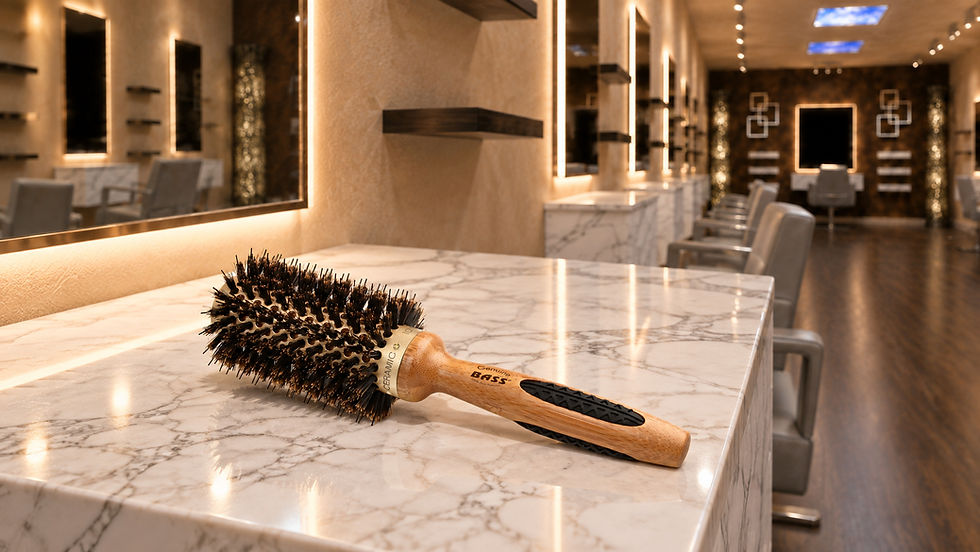
That does not mean every part of the head has a predetermined brush size. There is no universal “nape brush,” “crown brush,” or “face-frame brush.” Round-brush diameter is still selected primarily according to the shape being created. Large diameters favor broader, straighter lines, smoothing, and soft curvature. Medium diameters favor moderate bends, waves, and movement. Smaller diameters favor tighter turns and more concentrated curvature.
The zone modifies that choice by changing the conditions under which the barrel must work.
Hair length, section dimensions, available working space, desired lift, directional control, local curvature, and continuity with neighboring sections can all justify changing diameter during the same blowout. The goal is not to assign brush sizes to locations. It is to let the brush follow the architecture of the haircut.
Begin With Shape, Then Refine by Zone
The most common mistake in zone-based selection is starting with location instead of outcome.
A smaller barrel may frequently be useful at the nape because the hair there can be shorter and the working area compact. A larger barrel may frequently suit the crown when sufficiently long sections need broad body or smoothing. But neither relationship is absolute.
The desired shape remains primary.
If the nape is long and the objective is a broad, relatively straight line, there may be no reason to introduce stronger curvature simply because the section sits low on the head. Likewise, a crown section intended to carry concentrated bend may justify a smaller diameter even though large brushes are often associated with volume.
A useful decision sequence is:
desired shape → available hair length → working space → section geometry → direction or lift requirement → continuity with adjacent zones → diameter choice
This sequence prevents the zone from becoming a fixed rule.
First determine what the section should contribute to the finished hairstyle. Then ask whether the preferred barrel can engage the available hair length, fit comfortably into the working area, support the necessary section dimensions, and create the required movement without disrupting neighboring sections.
If it can, there may be no reason to change brushes.
If it cannot, another diameter may create a better relationship between the section and the intended result.
Why Different Zones Change the Brush-Hair Relationship
The head is not a single flat styling surface. Its curvature changes, hair lengths vary, growth patterns shift, and the amount of physical room available for brush and dryer movement changes from one area to another.
A barrel must engage enough hair to establish control. The section needs sufficient length to travel around the chosen radius if visible curvature is desired. The stylist needs room to position the brush, maintain tension, direct airflow, rotate or travel the barrel, and release the section without interference from the neck, shoulders, face, or surrounding hair.
Section geometry matters as well.
The width of the section should remain compatible with the usable barrel length. If the section is wider than the working surface of the brush, some hair may not engage the barrel evenly. Section depth also matters because overly deep sections can stack around the brush, restrict airflow, slow drying, and reduce control.
This is why a barrel that feels ideal through long, open sections can become difficult near shorter or more confined areas.
A very large barrel may create exactly the broad movement desired through the main lengths but fail to engage a short face-framing layer effectively. A small barrel may offer excellent control in a compact zone yet create more curvature than desired if carried unnecessarily through long sections.
Zone-based selection is therefore a response to changes in diameter, section, space, and shape working together.
The Nape: Compact Space and Shorter Working Length
The nape is one of the clearest examples of local geometry affecting brush choice.
Hair near the lower back of the head is often shorter than the sections above it, particularly in layered cuts, bobs, graduated shapes, and shorter hairstyles. The neck and shoulders can also limit the angles available for brush and dryer movement.
A large barrel that works easily through longer hair may therefore become cumbersome at the nape.
When hair length is limited, a smaller diameter may allow the section to establish more useful contact with the barrel. The purpose may simply be to capture, tension, smooth, and direct the shorter hair rather than to create a visibly tighter curl.
This introduces an important distinction that applies throughout zone-based work:
A smaller diameter may be chosen because the local geometry requires it, because stronger curvature is desired, or because both are true.
Those are different reasons for making the same tool change.
Controlling Nape Curvature
Because nape hair can be short, a small barrel can produce a strong undercurve or outward flip quickly. If the objective is only a clean perimeter or subtle bevel, excessive wrapping can exaggerate the bend.
The smaller brush can therefore be used with relatively shallow engagement. The section may contact only enough of the barrel to establish control before being released along the intended line.
When stronger curvature is actually part of the design, the ends can travel farther around the cylinder and cool in a more curved position.
The diameter provides the available radius. The amount of that radius imposed on the section depends on technique.
If the nape hair is long enough and the intended result is broad and elongated, the same diameter used elsewhere may remain appropriate. The location itself does not require a switch.
The Sides: Managing the Transition Between Back and Front
The sides have a distinctive role because they often function as a transition zone.
They must connect the shape established through the back with the movement that becomes more visually dominant near the face. That transition may be almost invisible in a broad, smooth blowout, or it may become progressively more directional as the stylist approaches the temples and front layers.
For this reason, the sides should not be treated simply as another location requiring its own brush size.
The important question is how the side sections should mediate between two neighboring design areas.
If the hairstyle carries broad, consistent movement around the entire head, maintaining the same diameter through the sides may preserve the cleanest visual continuity.
If the haircut becomes progressively shorter toward the front, a gradual reduction in diameter may allow those shorter sections to create a similar apparent scale of movement even though less hair is available to wrap around the barrel.
That does not mean the side should automatically become curlier as the diameter decreases. The stylist can limit wrap depth or rotation so that a smaller barrel compensates for shorter hair while preserving the visual character established through the back.
In other styles, the sides intentionally begin changing direction. The sections may travel backward toward the crown, forward toward the face, or outward from the head depending on the desired silhouette.
In those cases, changing brush orientation, elevation, or directional travel may solve the styling problem without changing diameter at all.
This is one of the most useful principles in zone-based selection:
Not every local styling problem is a diameter problem.
If the section needs more direction, change direction.
If it needs greater root projection, address elevation.
If the section is too deep for the brush to control effectively, adjust section geometry.
Change diameter when changing the radius genuinely improves the local relationship among hair length, working space, and intended shape.
The Crown: Lift, Projection, and Broad Shape
The crown strongly influences the silhouette of a blowout because relatively small changes in root position can change whether the finished style appears flat, rounded, elevated, or expansive.
Yet crown styling should not be reduced to the idea that a larger round brush automatically creates more volume.
Diameter and root lift perform related but different jobs.
The barrel determines the curvature available to the section. Root elevation determines the direction in which the hair leaves the scalp. Tension, airflow, moisture stage, movement, and cooling determine how successfully that position is established.
A larger diameter can create broad body through sufficiently long crown sections without introducing tight curvature. A medium diameter may create more visible bend through layered areas. A smaller diameter can become useful when crown layers are short or when more concentrated curvature is intentionally part of the design.
The smallest brush does not automatically create the greatest lift.
If the goal is height with soft movement, using too small a barrel may introduce unnecessary curl while addressing a problem that should primarily be solved through elevation and root positioning.
Matching Crown Diameter to Layer Length
The crown often contains shorter layers even when the overall haircut is long.
A barrel that works beautifully through lower lengths may become less effective near the top simply because the crown layer has less hair available to travel around the cylinder.
Reducing diameter can restore useful engagement.
However, a smaller barrel selected because of shorter layer length does not have to create a visibly smaller curl. Restrained rotation and shallower wrap can preserve the broader design of the hairstyle.
When more rounded crown movement is desired, the same smaller barrel can be used more fully.
Again, the reason for reducing diameter should remain clear: local geometry, desired curvature, or both.
The Hairline: Growth Direction Before Curvature
The hairline presents some of the most variable working conditions on the head.
Hair may be shorter, finer, denser, more fragile, or strongly influenced by natural growth patterns.
Cowlicks, directional changes, and persistent splits can become especially visible around the forehead and temples.
Because these pieces are often short, a smaller or medium round brush may provide better physical control than a very large barrel.
But hairline styling should begin with direction, not curvature.
A short section that grows away from its intended position may first need to be redirected at the base. Wrapping it more tightly around a smaller brush does not necessarily correct the root direction. It may simply add curvature while leaving the underlying directional issue unresolved.
Before changing diameter, identify what needs to change.
Does the root need redirection?
Does the section need more lift?
Does it need a soft bend?
Does it need to connect into the side?
Is the current barrel too large to engage the short section?
Or is the hair already traveling correctly and only needs refinement?
These questions lead to better brush choices than assuming every short hairline section needs the smallest available diameter.
Avoiding Excessive Curvature at the Hairline
Short hair can respond very quickly to compact geometry.
When a small barrel is deeply wrapped and allowed to cool with substantial curvature, the result may become more rounded than intended. A fringe can turn too tightly, a temple section can kick outward abruptly, or the front can disconnect visually from the rest of the blowout.
For a softer sweep, the smaller diameter can be used primarily for access and control while wrap depth and rotation remain restrained.
The advantage of the smaller brush is preserved without automatically imposing its maximum curvature.
The Face Frame: Separating Direction from Curvature
Face-framing sections are visually prominent and are frequently shorter than the main lengths.
They may also perform a different styling role from the hair behind them.
The back and sides may establish a broad silhouette while the face frame sweeps backward, opens away from the face, contours inward, or transitions progressively through several layer lengths.
A medium or smaller diameter can be useful when these shorter sections need a more workable radius. But choosing a smaller brush only because the hair is short overlooks the more important design question:
What path should the face frame follow?
Direction and curvature are separate controls.
Hair can travel strongly away from the face while remaining softly curved. It can contour toward the face with only a modest bend. It can form a pronounced curve without traveling far laterally.
The brush therefore has to provide both an appropriate radius and an appropriate path.
When a Smaller Face-Frame Brush Improves Geometry
Suppose the primary blowout uses a large diameter through long hair to create broad movement.
A shorter face-framing layer may not have enough length to establish useful contact with that barrel. Moving to a medium diameter may allow the section to wrap sufficiently for controlled shaping.
If the front layer becomes shorter still, another reduction in diameter may improve engagement.
The physical radius can change without forcing the apparent design to change.
By reducing wrap depth, adjusting orientation, or releasing the hair along a broader path, a smaller barrel can create movement that remains visually compatible with the larger sections behind it.
This is one of the clearest examples of zone-based refinement: different diameters can produce visually continuous movement when local hair length changes.
When the Face Frame Should Carry More Shape
Sometimes the front is intentionally more active than the rest of the hairstyle.
A medium-diameter blowout through the main lengths may transition into a smaller brush around shorter front layers because stronger curvature is part of the intended design.
Here the smaller diameter serves two purposes simultaneously: it improves engagement with shorter hair and increases the available curvature.
That is a deliberate design decision rather than a default rule for the face frame.
Section Geometry Must Change With the Working Area
Diameter selection cannot be separated from section dimensions.
A small barrel overloaded with a thick or deep section can become crowded. Hair may stack around itself instead of contacting the brush evenly, airflow can be obstructed, drying may slow, and release can become more difficult.
Section width should also remain compatible with usable barrel length.
If the section extends beyond the active working surface of the barrel, the outer hair may not receive the same tension, airflow, or shape as the hair positioned more centrally.
Different zones often justify different section geometry.
The nape may require narrower sections because working space is restricted.
The crown may support wider sections when barrel length allows it, though dense hair may still require shallower depth.
The hairline and face frame often benefit from smaller, more precise sections because direction and short hair length make control especially important.
Sectioning and diameter should therefore be considered together rather than as separate decisions.
Hair Length Refines Diameter Choice but Does Not
Determine It
A common simplification is:
short hair = small brush long hair = large brush
Hair length certainly matters, but the relationship is more precise than that.
Hair length determines which diameters can engage comfortably. The desired styling result determines which of those workable diameters is preferable.
Long hair can intentionally be shaped around a smaller barrel when stronger curvature is wanted.
Shorter hair can sometimes use a relatively broad barrel when enough length is available and the desired shape is soft.
This explains why professional diameter selection often appears more nuanced than a basic length chart.
The same haircut may use one brush throughout if the section lengths and styling objectives remain similar. Another may require several diameters because both the available length and the intended movement change around the head.
There is no ideal number of round brushes for a blowout.
The appropriate number is the number required to create the intended shape efficiently and coherently.
Maintaining Continuity When Diameter Changes
Changing brush sizes introduces one important risk: each zone can begin to look as though it was styled independently.
A large barrel may create broad movement through the back while a smaller barrel produces a compact curl at the front simply because its tighter geometry was used too fully.
Diameter changes should therefore preserve whichever aspects of the hairstyle are meant to remain continuous.
These may include:
apparent scale of movement
overall direction
root projection
flow between layers
curvature through the ends
transition from back to front
A smaller barrel can be moderated through shallower wrap, restrained rotation, broader release, or less concentrated setting.
A larger barrel can produce more visible movement when hair travels farther around its radius and is cooled in that position.
Technique determines how much of the barrel’s available geometry appears in the finished section.
This is what allows multiple diameters to function as parts of one design rather than creating a collection of unrelated shapes.
When One Diameter Is Enough
Zone-based selection does not mean every blowout should use several brushes.
If one diameter comfortably engages the available hair lengths, fits the working areas, supports appropriate section dimensions, and creates the intended movement throughout the haircut, changing brushes may add complexity without improving the result.
This is especially common with relatively uniform lengths or simple silhouettes.
The decision to keep using one diameter should be just as intentional as the decision to change.
If shorter pieces continually escape, the barrel may be too large locally.
If one area becomes more curved than intended, the barrel may be too small for that design or the technique may be imposing too much of its available curvature.
If the brush becomes physically awkward near the nape or hairline, local working space may justify another size.
If none of those problems appear, there may be no reason to switch.
A Practical Zone-by-Zone Selection Method
The most reliable way to choose a round brush around the head is not to ask, “What size belongs in this zone?”
Instead, evaluate each area through the same decision process.
Begin with the shape the section should contribute.
Then determine whether the desired diameter can engage the available hair length.
Check whether the brush fits the working space and whether the section width matches the usable barrel length.
Consider whether the local objective is primarily curvature, smoothing, direction, root lift, or some combination of these.
Finally, consider how the finished section must connect to the zones beside it.
Only then decide whether the diameter should remain the same or change.
This keeps the brush subordinate to the hairstyle rather than allowing the tool to dictate the design.
Conclusion: Let the Brush Follow the Architecture of the Haircut
Zone-based round-brush selection is not a map assigning fixed brush sizes to the nape, sides, crown, hairline, and face frame.
It is a method of responding to changing local conditions while preserving a consistent styling objective.
The nape may require more compact control because of shorter hair and restricted space. The sides often manage the transition between the back and front. The crown may emphasize root projection and broad shape. The hairline may require precise control of short sections and natural growth direction. The face frame may combine limited working length with highly specific directional and curvature goals.
These differences can justify changing diameter, but location never replaces the fundamental relationship between barrel size and shape.
Large diameters still favor broader curvature and straighter-looking movement. Medium diameters still favor moderate bends and waves. Smaller diameters still favor more concentrated curvature.
Zone, section geometry, hair length, available space, direction, and styling objective determine how that basic diameter logic should be refined.
The governing sequence is simple:
Choose the shape first.
Read the local conditions.
Change diameter only when another radius creates a better working relationship.
Then control wrap, direction, elevation, airflow, release, and cooling so every section contributes to the same overall design.
That is the real purpose of zone-based round-brush selection: not using more brushes, but making better decisions as the geometry of the haircut changes.
Frequently Asked Questions
Should I use a different round brush size for every area of my head?
No. Keep the same diameter wherever it comfortably engages the hair and creates the intended shape. Change sizes only when differences in hair length, working space, section geometry, desired curvature, lift, or direction make another diameter more useful.
What round brush size is best for the nape?
There is no fixed nape size. Shorter hair and restricted working space often make a smaller diameter easier to control, but longer nape sections or broader styling objectives may work well with a medium or larger barrel.
Should I always use a large round brush at the crown for volume?
No. Crown volume depends heavily on root elevation, tension, airflow, and cooling. A larger diameter can create broad body when the hair is long enough, but shorter crown layers or more concentrated shape may call for a smaller barrel.
Why does my regular round brush feel too large near my face?
Face-framing sections are often shorter than the main lengths, so they may not have enough length to engage a large barrel effectively. A smaller diameter can create a more workable radius without necessarily making the section much curlier.
Does a smaller round brush always create tighter curls?
It provides the potential for tighter curvature, but the finished result also depends on wrap depth, rotation, direction, release, and cooling. A small brush can be used mainly for access and control.
Can I use one round brush for an entire blowout?
Yes. If one diameter engages the different section lengths comfortably and creates the intended shape throughout the head, there is no reason to change brushes simply because you enter another zone.
Why do shorter layers keep slipping off a large round brush?
The available hair length may be insufficient to establish useful contact with the barrel. A smaller diameter may improve engagement, but section depth, section width, and brush positioning should also be checked.
Should face-framing layers always use a smaller brush?
No. They often benefit from a smaller diameter because they are shorter, but the desired direction and curvature remain more important than location alone. Longer face-framing sections may work well with the same brush used through the rest of the hairstyle.
How do I keep different brush sizes from creating mismatched sections?
Control more than diameter. Adjust wrap depth, rotation, direction, elevation, release, and cooling so each barrel creates the appropriate amount of movement for its zone while preserving continuity with neighboring sections.
How wide should a section be on a round brush?
The section should fit comfortably across the usable working length of the barrel so the hair can receive reasonably even engagement, tension, airflow, and shaping. If the section extends beyond the effective barrel surface, divide it into narrower sections.
Is zone-based round-brush selection only for professional stylists?
No. The same reasoning is useful at home whenever one brush works well in some areas but feels awkward or ineffective in others. Even switching between two diameters can make a blowout easier when shorter or more confined areas require different working geometry.









