Why Gray Hair Becomes Dry, Coarse, or Wiry—and May Still Be Fragile


Key Takeaways
Gray hair can feel firm or resistant because of diameter, curvature, or stiffness, yet those traits do not prove strong tolerance for repeated stress.
Dryness may result from reduced sebum, poor oil distribution, cuticle wear, or porosity, while surface residue can imitate coarse or wiry texture.
Coarseness describes strand diameter, whereas wiriness describes behavior; either can occur in healthy fibers or alongside localized damage, fragile ends, and chemical wear.
Before increasing pressure, identify whether resistance comes from geometry, dryness, buildup, tangles, or damage, then adjust sectioning, cleansing, lubrication, or preparation accordingly.
Boar bristle brushing can redistribute available sebum and reduce friction on dry, detangled hair, but it cannot repair splits, reverse damage, or change natural structure.
Gray hair creates a mechanical illusion.
A strand may resist bending, stand apart from neighboring hair, and feel substantial between the fingers. Those qualities suggest strength. Yet the same strand may split at the end, snap after repeated manipulation, or become rougher when brushed with increasing pressure.
The explanation is that resistance and resilience are different properties.
A strand can be difficult to bend but poor at surviving repeated bending. It can be thick but porous. It can have a rigid surface feel while containing weakened points beneath that surface. It can also be genuinely strong near the root and fragile toward the end.
This is why descriptions such as dry, coarse, wiry, and fragile should not be used interchangeably.
Each describes a different aspect of the fiber:
Dry refers to inadequate lubrication, excessive moisture loss, or a roughened surface.
Coarse usually refers to a relatively large strand diameter.
Wiry describes stiffness, curvature, projection, or resistance to lying with surrounding hair.
Fragile describes reduced tolerance for pulling, bending, friction, or repeated handling.

These conditions may overlap, but one does not prove another. Understanding which property is actually present is the first step toward handling gray hair without mistaking firmness for unlimited strength.
The Difference Between Resistance and Resilience
Hair can resist a single movement yet perform poorly under repeated stress.
This distinction is familiar in many materials. A rigid object may be difficult to bend, but once its tolerance is exceeded, it fails abruptly. A more flexible material may yield under the same force and return without damage.
Hair behaves according to several mechanical properties at once.
Bending stiffness describes how strongly a strand resists being curved. Tensile strength describes how much pulling force it can withstand. Extensibility describes how far it can stretch.
Toughness describes how much total stress it can absorb before breaking. Fatigue resistance describes how well it survives repeated cycles of bending, rubbing, and tension.
A gray strand may have high bending stiffness and therefore feel unusually firm. That does not reveal how much accumulated wear exists along its cuticle or cortex. It also does not reveal whether repeated brushing, tying, or styling has created a localized point where failure is more likely.
The practical lesson is important: a strand that pushes back against the brush is not necessarily asking for more pressure. It may be showing that the imposed path does not match its geometry—or that its ability to yield safely has already been reduced.
Why Diameter Can Make Gray Hair Feel Coarse
Coarseness is primarily a description of individual strand diameter, not the total amount of hair on the head.
A person can have low density and still possess thick individual fibers. Another can have high density made up of fine strands. Gray and aging hair often combine both conditions unevenly: several prominent thick silver hairs may appear around the temples while the crown or part becomes finer overall.
Diameter has a major influence on bending behavior. A thicker fiber generally resists curvature much more strongly than a thinner one. This is why a coarse gray strand may project away from the head, spring out of a smooth arrangement, or retain its own direction instead of following the neighboring hair.
Its behavior does not automatically indicate damage. The strand may simply require more force to bend because of its geometry.
The mistake occurs when that natural resistance is treated as a problem to overpower. Pulling harder may temporarily move the strand, but it also transfers more stress to the scalp, the shaft, and any weakened areas along the fiber.
Coarse hair may require better access, smaller sections, or a tool whose working surface can reach the relevant layer. It does not automatically require a heavier hand.
Why Surface Roughness Can Feel Like Coarseness
Not every strand that feels coarse is actually large in diameter.
A weathered cuticle creates friction. As the outer scales become irregular, neighboring hairs no longer slide smoothly past one another. The finger encounters more resistance along the shaft, and the hair begins to feel thick, dry, or abrasive even when its underlying diameter has changed very little.
Product residue can create a similar effect. Styling films, mineral deposits, oxidized oil, and dry shampoo may stiffen the surface and make the hair drag against itself. A coated strand can feel wiry because it no longer bends or separates naturally.
True coarseness tends to feel substantial through the length of the fiber. Surface roughness is often more uneven. It may become stronger toward the mid-lengths and ends, where the hair is older and has experienced more wear.
This distinction affects the response. A genuinely thick strand may need more effective section access. A roughened strand needs less friction. A coated strand may need cleansing rather than additional oil or brushing.
Why Gray Hair May Become Wiry
“Wiry” is not one structural diagnosis. It is a description of how a strand behaves.
A wiry hair may:
emerge at a stronger angle;
curve differently from neighboring strands;
resist lying flat;
spring back after being guided;
feel stiff when bent;
remain individually visible within the style.
Several mechanisms can create that behavior.
Follicular direction and curvature
The shape and orientation of the follicle influence the path of the growing strand. These properties may change over time, and neighboring follicles do not necessarily change in the same way.
One silver strand may become more curved while the hair beside it remains straight. Another may emerge at an angle that causes it to cross or lift away from surrounding fibers.
The resulting disorder is geometric. The strands are not necessarily unhealthy; they simply do not share the same path.
Increased bending stiffness
A thicker strand naturally requires more force to redirect. When several coarse silver hairs appear among finer fibers, their resistance becomes especially noticeable.
The surrounding hair may yield under brushing while the thicker strands retain their original shape.
This can make those few fibers appear unusually stubborn even when they are structurally sound.
Reduced lubrication
A naturally firm strand becomes more difficult to manage when its surface lacks lubrication.
Without adequate slip, it catches against adjacent hairs rather than moving with them. That friction makes the strand feel stiffer and more independent. Static can increase separation further, especially in dry conditions.
Lubrication may improve pliability and reduce resistance, but it cannot permanently change the strand’s diameter, curvature, or growth angle.
Surface deposits
A hair coated with residue may mimic the behavior of a naturally wiry strand. It can feel rigid, drag during brushing, and remain separated from surrounding hair.
In this case, more conditioning or repeated polishing may worsen the problem. The stiffness comes from material sitting on the surface rather than from a lack of oil within the routine.
Why Gray and Aging Hair Often Feel Dry
Grayness identifies a change in pigment production. It does not, by itself, reveal how much oil the scalp produces or how intact the hair surface remains.
Dryness often develops beside graying because several other changes may occur during the same period.
Less natural oil may be produced
Sebum output can decline with age and hormonal change. When less oil is available, the lengths receive less natural lubrication.
This becomes especially noticeable in longer hair. The ends are farthest from the scalp and have the oldest, most weathered surface. They may begin to feel rough even when the roots no longer appear oily.
A brush can move available oil. It cannot create oil that the scalp is no longer producing.
Existing oil may not reach the lengths
The scalp may still produce useful lubrication, but the route to the ends may be inefficient.
Length, density, curvature, frequent cleansing, and irregular strand direction all slow distribution.
The roots may therefore feel heavy while the mid-lengths and ends remain dry.
This is a movement problem rather than a simple shortage.
The surface may lose its ability to retain support
Hair that has become more porous may absorb water or conditioning material quickly but lose that support just as quickly.
Porosity can increase as the cuticle becomes weathered or chemically altered. The hair may feel soft immediately after conditioning and rough again soon afterward. It may also absorb products unevenly, leaving some sections heavy and others unchanged.
A strand can be porous and coarse at the same time. Thickness does not protect the cuticle from wear.
Where Fragility Develops
Hair rarely becomes equally weak along its entire length.
Breakage often begins at localized areas where stress and structural wear have accumulated.
These weak points may occur where:
the cuticle has been heavily eroded;
the hair has been lightened or repeatedly colored;
a tie, clip, or repeated style bends the shaft at the same location;
heat has been applied frequently;
split ends have begun to travel upward;
dry friction repeatedly acts on the same section.
The rest of the fiber may still feel firm. This is why tactile thickness can conceal fragility.
A strand can also contain several different conditions from root to end. New growth may be coarse, rigid, and intact. The middle may be dry but serviceable. The end may be porous, split, and mechanically exhausted.
One brushing method cannot assume that every part of the strand has the same tolerance.
Why Dryness Can Increase Breakage Risk
Lubrication does more than affect shine. It changes how stress travels through the hair.
When neighboring strands slide easily, tension is distributed more gradually. When surfaces are dry and rough, they catch. The force of brushing becomes concentrated at the point of resistance.
A flexible fiber can bend and move as stress passes through it. A dry, stiff fiber may resist movement until the force becomes concentrated sharply enough to create damage.
This is why repeated low-level stress matters. Hair does not always break during one dramatic event. It may fail after hundreds of smaller events:
brushing through the same resistant area;
tightening the same style;
rubbing against bedding or clothing;
repeatedly heating the same section;
pulling through ends that no longer release smoothly.
The strand may have tolerated each event individually. The cumulative cycle eventually exceeds its remaining fatigue resistance.
Chemical Processing Can Hide Beneath a Firm Surface
Gray hair is often colored, highlighted, toned, or lightened. These services may alter both the cuticle and the internal fiber.
The strand can remain thick after processing. It may therefore continue to feel substantial while becoming more porous, less extensible, or less resistant to repeated stress.
This is one reason a smooth finish should not be confused with restored strength.
Conditioning and surface alignment can make processed hair look calmer and feel softer. Those improvements are useful, but they do not rebuild missing cuticle or reverse internal chemical change.
A thick processed strand may look healthier after lubrication while still requiring reduced friction and fewer repetitions through the oldest sections.
Four Observations That Clarify What the Hair Needs
The most useful assessment does not begin by labeling all gray hair as dry or wiry. It begins by observing how the fiber behaves.
1. How does the strand slide?
Hair that feels rough, catches against neighboring fibers, or drags under light contact may have insufficient lubrication, surface weathering, or residue.
If the hair feels waxy or coated rather than simply dry, cleansing may be more appropriate than additional oil.
2. How does the strand bend?
A strand that strongly resists curvature but returns without visible damage may be naturally coarse or highly curved.
A strand that feels rigid and develops white stress points, fraying, or snapping may have limited flexibility and reduced structural tolerance.
3. Where does the condition change?
Firm new growth with fragile ends suggests accumulated length-related wear rather than one uniform strand condition.
Roughness concentrated in processed sections points toward chemical weathering. Heaviness near the roots with dry lower lengths suggests incomplete oil movement.
4. What happens after repeated handling?
A useful grooming method should make the hair easier to move.
If each pass produces more catching, static, separation, tenderness, or visible breakage, the problem is not being corrected. The repeated contact is becoming part of the stress.
What to Change First
The correct adjustment depends on the property causing the resistance.
When the strand is naturally thick or strongly curved, improve sectioning and directional control rather than increasing pressure.
When the surface is dry, reduce friction and improve lubrication.
When the hair feels coated or waxy, restore cleanliness before adding more conditioning.
When the ends are porous or splitting, shorten the contact through those sections and avoid repeatedly pulling them into the same path as stronger new growth.
When the hair is tangled, resolve the knots before attempting any polishing or conditioning stage.
When the scalp has become more exposed or sensitive, distribute contact more carefully rather than assuming the firmest silver hairs determine the correct pressure for the whole area.
The governing principle is not to treat every resistant strand as a strength problem. First determine whether the resistance comes from geometry, dryness, buildup, or damage.
The Role of Shine & Condition Brushing
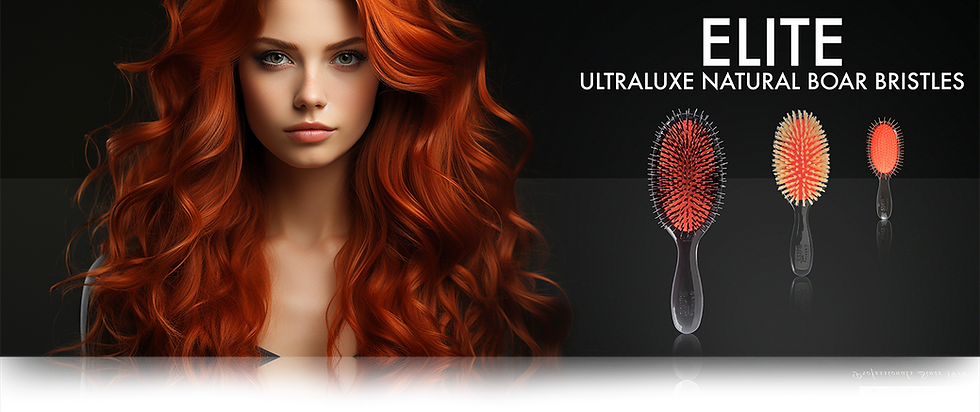
Boar bristle brushing is most relevant when the hair needs natural-oil distribution, reduced surface friction, light polishing, or calmer alignment.
On dry, detangled hair, the bristles can help move available sebum away from the scalp and through the lengths. This may improve pliability when dryness is intensifying a coarse or wiry feel.
Its limits are equally important.
A boar bristle brush cannot:
create sebum when little is available;
permanently alter strand diameter or curvature;
rebuild missing cuticle;
repair split ends;
reverse chemical damage;
safely resolve knots through force.
If a thick strand resists because of its geometry, brushing may improve how it cooperates with surrounding hair but will not remove its natural structure. If a strand is fragile because of accumulated damage, surface smoothing may improve appearance without restoring its original tolerance.
The purpose is to reduce avoidable friction, not to prove that every firm strand can be forced into uniformity.
Breakage and Shedding Are Different Signals
Breakage occurs when the shaft snaps. It may create short hairs, uneven lengths, frayed ends, or visible pieces without the complete root end.
Shedding occurs when the entire hair releases from the follicle. The strand is usually closer to its full length.
Brushing through roughness or tangles can contribute to shaft breakage. It does not fully explain sudden increases in full-length shedding, patchy density loss, or scalp symptoms.
This distinction prevents the wrong correction. Broken fibers call for lower mechanical stress and closer attention to surface condition. Abrupt shedding or visible changes in density may require evaluation beyond grooming technique.
When Texture Changes Need More Than a Routine Adjustment
Gradual variation in gray and aging hair is common. Abrupt changes deserve closer attention.
A rapid increase in breakage, full-length shedding, scalp pain, inflammation, scaling, or patchy loss should not be treated simply by changing pressure or purchasing another brush.
A grooming tool can influence lubrication, friction, alignment, and handling stress. It cannot diagnose an underlying change at the follicle or scalp.
Conclusion: Resistance Is Not Resilience
Gray hair may feel dry because too little oil is available, because available oil is not reaching the lengths, or because the cuticle has become less able to retain support.
It may feel coarse because the strand is genuinely thick or because surface roughness creates additional tactile resistance.
It may behave wirily because of diameter, curvature, growth angle, static, dryness, or residue.
And it may remain fragile because none of those outward qualities reveal how much repeated stress the fiber can still absorb.
A strand that is difficult to bend can still be easy to fatigue. A strand that looks smooth can still contain weak points. A strand that is thick near the root can still be damaged at the end.
That is the central distinction for gray-hair care:
Resistance is not resilience.
The safest and most effective response is to identify what kind of resistance is present before increasing pressure, repetition, or product. Gray hair does not need to be treated as uniformly weak, but its firmness should never be used as evidence that it can tolerate unlimited force.
Frequently Asked Questions
Is gray hair always drier than pigmented hair?
No. Pigment loss does not determine oil production. Some gray hair remains oily, while other hair becomes dry because sebum production has declined, oil distribution is incomplete, or the surface has accumulated wear.
Why can one gray strand feel much thicker than the surrounding hair?
Individual follicles may produce fibers with different diameters. A few coarse silver strands can therefore appear among finer pigmented or aging hairs, particularly around the temples and hairline.
Does wiry hair mean the strand is damaged?
Not necessarily. A healthy strand may appear wiry because it is thick, strongly curved, or growing at a different angle. Damage is more likely when stiffness is accompanied by roughness, splitting, white stress points, or breakage.
Why does thick gray hair still snap?
Thickness increases bending resistance but does not guarantee toughness or fatigue resistance. A thick strand may contain cuticle loss, chemical porosity, split ends, or localized weak points.
Can gray hair be coarse and porous?
Yes. Coarseness describes diameter, while porosity describes how readily the fiber takes in and loses water or conditioning material. The same strand can possess both qualities.
Can boar bristle brushing make wiry gray hair softer?
It may improve softness when dryness, static, or poor oil distribution is intensifying the wiry feel. It cannot permanently change the strand’s natural diameter, curvature, or growth direction.
Why do my gray roots feel strong while the ends break?
The roots are newer and have experienced less wear. The ends are older and may have accumulated years of friction, heat, chemical processing, and cuticle loss.
Should resistant gray hair be brushed harder?
No. Resistance may come from diameter, curvature, tangles, dryness, residue, or damage. The cause should be identified before pressure is increased. Sectioning or preparation is usually safer than force.
How can I tell whether gray hair needs oil or cleansing?
Dry, under-lubricated hair often feels rough and light. Coated hair may feel waxy, tacky, heavy, or resistant while lacking natural movement. Adding oil to coated hair may increase stiffness rather than relieve it.
Can smoother-looking hair still be fragile?
Yes. Lubrication and alignment can improve appearance without rebuilding damaged structure. A strand may look polished while retaining reduced tolerance for bending, pulling, or repeated friction.