

When Stylists Switch from Styling Brushes to Finishing Brushes
- Editorial & Publishing Team

- Jun 21
- 15 min read


Key Takeaways
· Stylists switch to finishing brushes when the hair’s structure is complete but the visible surface still needs polish, control, or refinement.
· Styling brushes build direction, lift, bend, or preparation, while finishing brushes quiet the surface without reopening the shape underneath.
· A finishing brush is most useful on dry, prepared hair when flyaways, uneven reflection, or surface scatter remain after styling.
· Direct-set finishing brushes create firmer surface control, while cushioned finishing brushes provide softer, broader polish with less compression.
· The right switch depends on service stage, hair type, product load, and whether the hair needs more structure or only final surface resolution.
The brush change near the end of a professional service often happens so quietly that a client may not notice it. The stylist may put down the brush that has been doing the obvious work and pick up a different one for only a few final passes. Nothing dramatic appears to change in the choreography of the service, yet the visual result can shift noticeably. The hair stops looking arranged and begins to look resolved.
That change is not about adding another tool for the sake of complexity. It reflects a professional reading of the hair’s condition in the moment. Earlier in the service, the brush may need to separate, organize, direct, lift, stretch, or shape. Later, those actions can become too active. Once the hair has already accepted its general form, the remaining work is usually smaller: a crown that needs calming, a hairline that needs settling, a canopy that needs more coherent shine, a perimeter that needs polish without being reopened, or a smooth style that needs surface discipline without added stiffness.
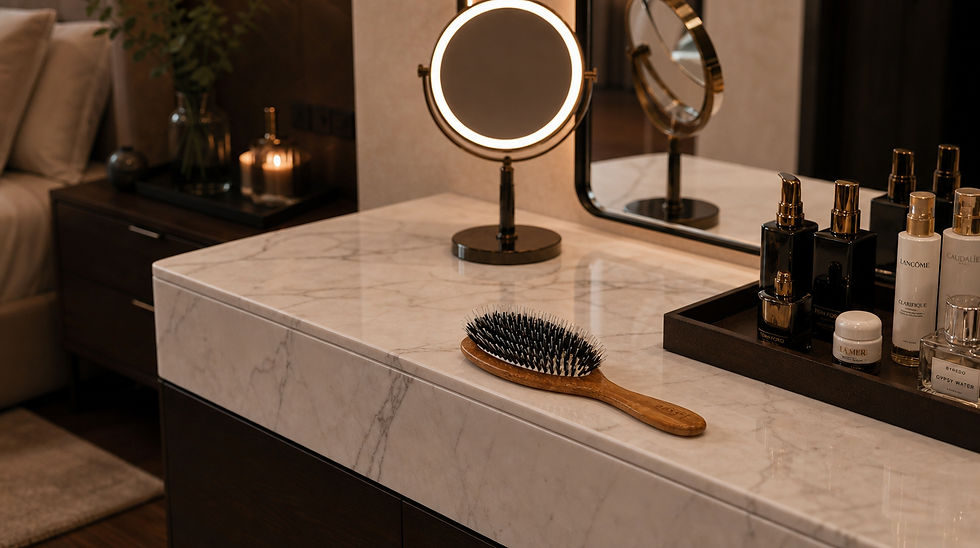
This is the point where a finishing brush becomes useful.
A styling brush is chosen for construction. A finishing brush is chosen for restraint. The professional decision is not simply which brush is “better,” but whether the hair still needs to be changed or whether it now needs to be completed. The switch marks that difference. It tells the stylist that the active work has done enough, and the final surface now requires a quieter kind of contact.
The Brush Handoff Is a Change in Job, Not a Change in Effort
Stylists do not switch from styling brushes to finishing brushes because finishing is easier or less important. They switch because the job has changed.
During the earlier part of a service, brushes often perform structural tasks. A pin brush may organize the hair before styling, release tangles, control sections, or support directional movement.
A round brush may shape the hair under airflow, creating lift, bend, curve, smoothing, or a straighter line depending on diameter and technique. These tools work because they can move hair decisively. They are meant to enter the hair, influence its direction, and help build the result.
A finishing brush enters when that level of intervention is no longer appropriate. The hair may already be detangled, dry, directed, shaped, or arranged. At that stage, the stylist does not need a brush that keeps penetrating, separating, or reshaping the full section. The stylist needs a brush that can refine the visible surface with minimal disturbance.
That is why finishing brushes are especially valuable in professional work. The final result is judged from the outside first. Clients notice the halo at the crown, the flyaways around the part, the dull area through the top layer, the uneven reflection near the face, or the perimeter that looks slightly brushed apart. These issues do not always require more styling. In many cases, more styling would be too much. They require surface correction.
The brush handoff is therefore a form of professional restraint. It prevents the stylist from using a construction tool to solve a finishing problem.
How Stylists Recognize That a Styling Brush Has Finished Its Role
The clearest sign that a styling brush has done its job is that additional passes no longer improve the main structure of the hair.
In preparation work, the hair may reach a point where it is fully detangled, organized, and ready.
Continuing to brush through with the same prep tool may only separate the surface further. The hair becomes orderly, but it does not necessarily become polished.
In shaping work, the intended line, lift, bend, or arrangement may already be present. Another active pass may not create a better shape. It may simply disturb the shape that has already been created. Ends can become too separated, volume can compress, or the surface can begin to look handled rather than clean.
In formal styling, the hair may already be placed into its final direction. At that point, a brush with too much entry into the hair can loosen the tension pattern, blur the parting, or pull small sections away from the intended shape. A finishing brush allows the stylist to refine only the visible layer while leaving the underlying placement intact.
This professional reading matters because hair does not announce the transition loudly. The shift from styling to finishing is often subtle. The stylist sees that the remaining concern is not direction, shape, or detangling. It is surface behavior. The hair is behaving correctly in form, but not yet presenting correctly in finish.
That is the moment to change brushes.
The Surface Problem: Why Finished Hair Can Still Look Unfinished
Hair can be structurally complete and still visually unresolved. This is one of the main reasons finishing brushes exist in salon work.
A style may have the correct outline, but the outer fibers may not be aligned. A smooth section may be dry enough and controlled enough, but the cuticle surface may still scatter light. A ponytail may be placed correctly, but the crown may show lifted fibers. A soft blowout may have movement, but the top layer may look slightly fuzzy under salon light.
These are surface problems.
Surface problems are different from structural problems. A structural problem means the hair still needs something fundamental: more detangling, more drying, more directional control, more lift, more bend, more security, or more placement. A surface problem means the foundation is already there, but the final visible layer has not been brought into order.
Finishing brushes are designed for that second condition. Natural bristle contact can gather small surface fibers into the larger direction of the style. It can reduce dry friction between strands, help distribute a controlled trace of natural oil, soften visual separation, and improve the way light reflects across the hair. This does not replace the work of styling brushes. It completes what styling brushes leave behind.
The distinction is practical. If the hair is still structurally unfinished, a finishing brush will not solve the service. If the hair is structurally complete but visually noisy, a styling brush may be too disruptive. Professional judgment depends on knowing which problem is present.
The Three Questions Stylists Ask Before Switching
A useful way to understand the switch is to ask three questions before reaching for the finishing brush.
First, is the hair prepared enough to accept finishing contact? If tangles, snags, or resistant areas remain, the finishing brush is being asked to do the wrong job. Natural bristle finishing works best on dry, prepared hair that allows the brush to glide. If the brush catches, the stylist should resolve preparation before finishing.
Second, has the intended form already been established? If the hair still lacks lift, bend, direction, smoothness, or placement, the stylist is not yet in the finishing phase. A finishing brush may make the surface look calmer temporarily, but it cannot create missing structure. It should not be used to disguise incomplete work.
Third, what exactly remains unresolved? If the remaining issue is flyaways, surface scatter, broken reflection, light static, section marks, or a hairline that needs quieting, the finishing brush has a clear purpose. If the remaining issue is hold, humidity resistance, curl formation, or incomplete drying, another tool or product decision may be needed.
These questions prevent the finishing brush from becoming a vague final step. They give it a defined role. It enters only when the hair is ready for refinement and when refinement is truly the problem.
Why Finishing Brushes Use a Different Kind of Contact
The reason a finishing brush behaves differently from a styling brush lies in contact pattern.
A pin brush contacts the hair through spaced pins. That structure is useful for detangling, preparation, brush-through control, and directional organization. It allows the tool to enter the hair and separate strands. At the finishing stage, however, separation can become a drawback. When the goal is a unified surface, too much separation can make the hair look piecey, airy, or less polished.
A round brush works through barrel shape, tension, and airflow. It is a shaping tool. It can create bend, smoothing, lift, and directional form while the hair is being dried or shaped. Once the form is complete, that same shaping power may be unnecessary. It can stretch movement, flatten root lift, or reintroduce brush marks.
A finishing brush, especially one made with natural bristles, contacts the surface through many fine points at once. It does not need to penetrate deeply to be effective. When used with light pressure, it can influence the outer layer while leaving the internal structure alone. This is why it can calm a crown without collapsing the full style, polish a perimeter without reopening the cut line, or smooth a hairline without disturbing the placement behind it.
The finishing brush works by distributing contact broadly and gently. Its purpose is not to create a new direction, but to make the existing direction read more clearly.
When the Switch Happens in Different Services
The timing of the switch changes depending on the service, but the logic remains consistent.
In a smooth blow-dry, the styling brush builds the movement and surface direction. The finishing brush may enter after the hair is dry, settled, and ready for surface polish. The stylist may use it through the canopy, face frame, or ends to unify reflection without reworking the shape.
In a sleek ponytail, the initial brush may gather and direct the hair into position. Once the ponytail is placed, the finishing brush may be used only on the surface: around the hairline, part, temples, crown, and outer layer. The goal is not to keep brushing through the full mass of hair. The goal is to refine the visible plane.
In an updo, the finishing brush may be used even more selectively. Once sections are placed, pinned, or arranged, aggressive brushing can loosen the architecture. A finishing brush can calm the surface of a panel, soften small flyaways, or prepare a visible section before it is secured.
In a bob or shaped haircut, the finishing brush may refine the outer layer without disturbing the line. This is especially important when the perimeter has already been set. Too much active brushing can separate the bevel or blur the clean edge. A finishing pass should make the line look clearer, not less defined.
In layered hair, the switch often depends on whether the stylist wants movement or unity. Layers should not be polished so heavily that they lose life. A finishing brush may be used over the top layer or ends to control scatter while preserving the movement created earlier.
Across these examples, the finishing brush is not doing the whole service. It is resolving the final visible relationship between shape and surface.
Finishing for Shine, Control, or Softness
The reason for switching brushes is not always the same. Sometimes the stylist wants shine.
Sometimes the stylist wants control. Sometimes the stylist wants softness.
When finishing for shine, the brush is used to improve reflection. The stylist follows the direction of the finished hair with light, even passes. The purpose is to reduce surface irregularity, calm friction, and help the hair reflect light more coherently. This is especially useful when hair looks dry or dull even though the shape is complete.
When finishing for control, the work is more targeted. The stylist may focus on the part, crown, hairline, temples, or perimeter. The brush may use slightly more deliberate surface tension, but not enough to disturb the style. The aim is to bring small fibers into the intended direction.
When finishing for softness, the brush must be even more restrained. The goal is not sleekness or compression. It is a cleaner surface that still keeps movement. This matters in soft blowouts, loose waves, fuller shapes, and natural-looking finishes where too much polish would make the result feel stiff or reduced.
This distinction helps stylists avoid treating all finishing as the same act. A finishing brush can create different effects depending on pressure, placement, construction, and number of passes. Professional finishing is not merely brushing at the end. It is choosing the kind of surface the finished style should have.
Direct-Set and Cushioned Finishing Brushes Create Different Results
The construction of the finishing brush influences the type of refinement it provides.
A direct-set natural bristle brush has bristles anchored into a firmer base. This gives the stylist more immediate surface authority. It is useful when the finish needs a cleaner line, closer surface control, a refined part, a disciplined hairline, or a smoother area near the scalp. The contact is more direct, so the stylist must be careful not to press too deeply or flatten areas that should retain volume.
A cushioned natural bristle brush softens the contact. The cushion allows the bristle field to adapt to the head shape and absorb some pressure. This can be useful for broader polishing, fuller hair, sensitive scalps, and finishes that need surface refinement without strong compression. It is often helpful when the stylist wants to keep air in the style while calming the outer layer.
The choice is not a hierarchy. It is a contact decision. If the hair needs precision and firm surface discipline, direct-set construction may be more useful. If the hair needs broad polish and softness, cushioned construction may be more appropriate.
This construction awareness helps prevent over-finishing. A stylist can choose the brush that solves the surface problem with the least necessary force.
Hair Type Affects How Early or Late the Switch Should Happen
Hair type changes the timing and intensity of the switch.
Fine hair often requires an earlier reduction in force. Once the shape is present, too much continued styling can collapse volume or make the hair look smaller. A finishing brush should be used sparingly, often away from the root area unless the hairline or part needs control. The goal is to quiet the surface without adding weight.
Medium-density hair often accepts a clear sequence. The stylist can prepare, shape, then finish with enough contact to improve reflection and surface unity. This hair type frequently shows the benefit of finishing because it has enough body to reflect light well but not so much density that the surface becomes difficult to influence.
Thick hair may need a more selective approach. The outer layer can look polished while the interior remains bulky or unfinished, so the stylist must be careful not to mistake surface refinement for total completion. Once the structure is truly complete, finishing may happen in zones: canopy, face frame, crown, perimeter, or ends.
Curly and textured hair require the most careful judgment. A finishing brush can be valuable on stretched styles, smooth updos, polished ponytails, and selected surface areas. But broad brushing through formed curl groupings can disrupt definition. In these cases, the switch may happen only in specific areas rather than across the full head.
Fragile or chemically lightened hair benefits from less repetition. A finishing brush can reduce surface friction, but repeated passes should not be used to force shine from hair that needs gentler handling. The stylist should use the fewest passes needed to calm the visible surface.
The switch is therefore not a fixed step. It is adjusted according to how much contact the hair can accept before refinement becomes disruption.
Product Decisions at the Finishing Stage
A finishing brush often helps the stylist decide whether product is actually needed.
At the end of a service, dullness, flyaways, and surface roughness can make it tempting to add serum, spray, cream, or oil. Product may be useful when the style needs hold, humidity protection, definition, or long-term control. But when the issue is only surface scatter, a finishing brush may resolve enough of the problem without adding weight.
This matters because product and brushing interact. If heavy product is applied too early, the finishing brush may collect and redistribute residue unevenly. The hair can begin to look coated rather than polished. Roots may darken, ends may separate, or the surface may lose movement.
A cleaner sequence is to finish with the brush first when the hair is ready, then decide whether any product is still necessary. If the brush improves reflection and calms the surface, less product may be needed. If the style still requires hold or environmental support, product can be applied more precisely.
The finishing brush should not be used to spread excess product through the hair. Its best role is to refine balance, not compensate for overload.
Client Education: Explaining the Tool Switch Without Overcomplicating It
The brush switch gives stylists a simple way to teach clients why at-home results often differ from salon results.
Many clients use one brush for every stage. They detangle with it, dry with it, smooth with it, and try to finish with it. This can work only up to a point. The problem is that each stage asks something different from the tool. Preparation requires separation. Styling may require tension or airflow.
Finishing requires surface refinement.
A stylist can explain this clearly: the first brush helped create or organize the style; the finishing brush is used only after the hair is dry and ready to be polished. It is not meant to pull through knots or rebuild shape. It is meant to complete the surface.
That explanation helps prevent common misuse. Clients are less likely to use a boar bristle finishing brush on wet or tangled hair. They are less likely to keep using a styling brush after the shape is already done. They begin to understand that the final polish they see in the salon is often the result of sequence, not simply product.
Good client education does not require a long technical lesson. It requires a clear distinction between preparing, shaping, and finishing.
When Not to Switch
A finishing brush is useful only when the hair is ready for it. There are times when the switch should not happen.
Do not switch if the hair is still tangled. The finishing brush should glide, not fight resistance.
Do not switch if the hair still needs form. Missing lift, unfinished bend, weak direction, or incomplete placement should be corrected before finishing.
Do not switch if the hair is still damp in a way that will affect the result. Surface polish on unstable hair will not last.
Do not switch if the finish already looks balanced. Unnecessary brushing can flatten, separate, or overwork the hair.
Do not switch after strong product has already set the surface unless the technique specifically allows it. Brushing through set product can create drag or visible marks.
These limits are part of the professional value of the tool. A finishing brush is not a universal final step. It is a precise answer to a precise condition.
Conclusion: The Switch Marks the End of Construction
The moment a stylist switches from a styling brush to a finishing brush is a sign that the service has entered its final phase. The hair no longer needs broad direction, active separation, heat shaping, or full-depth control. It needs the visible surface to match the quality of the work underneath.
That is why the switch matters. It protects the shape already created while allowing the stylist to improve the details clients notice most: flyaways, reflection, surface softness, hairline control, perimeter polish, and the overall sense that the style is complete.
Used too early, a finishing brush can polish an unfinished structure. Used too late, a styling brush can overwork a finished one. Used at the right time, the finishing brush becomes an instrument of restraint. It gives the stylist a way to stop constructing and begin resolving.
The best professional finishes often come from that judgment. Not from doing more, but from knowing when the hair no longer needs more force — only a quieter final contact.
Frequently Asked Questions
When should a stylist switch from a styling brush to a finishing brush?
A stylist should switch when the hair is already prepared, dry, shaped, or arranged, and the remaining issue is surface refinement. If the hair needs flyaway control, polish, shine, or a calmer visible layer rather than more structure, a finishing brush may be appropriate.
What is the difference between a styling brush and a finishing brush?
A styling brush helps prepare, organize, direct, or shape the hair. A finishing brush is used after that work is complete to refine the surface, reduce scatter, support shine, and settle small fibers without disturbing the finished form.
Can a finishing brush replace a styling brush?
No. A finishing brush should not replace tools used for detangling, preparation, blow-dry shaping, or structural control. It works best after those steps are complete and the hair is ready for surface polish.
Why can using a styling brush too long weaken the finish?
A styling brush can continue separating, tensioning, or reshaping hair after those actions are no longer needed. This can flatten volume, disturb bend, separate ends, or make the finish look overworked.
Why can switching to a finishing brush too early be a problem?
If the hair still needs structure, a finishing brush may make the surface look smoother without fixing the underlying issue. The result may appear polished briefly but lack lift, shape, direction, or lasting control.
Is a boar bristle brush a finishing brush?
A boar bristle brush is commonly used as a finishing brush on dry, prepared hair because natural bristles can polish the surface, distribute small amounts of natural oil, calm flyaways, and improve visible shine.
Should a finishing brush be used on wet hair?
No. Finishing brushes are best used on dry hair that has already been detangled and prepared.
Wet hair is more vulnerable to stretching, and natural oil distribution does not work properly on water-saturated strands.
How does a stylist know whether hair needs product or a finishing brush?
If the hair needs hold, humidity resistance, or long-term structure, product may be needed. If the main issue is surface scatter, dullness, light frizz, or uneven reflection, a finishing brush may resolve the problem before product is added.
Is direct-set or cushioned construction better for finishing?
A direct-set finishing brush provides firmer surface control for sleek areas, hairlines, parts, and close polish. A cushioned finishing brush provides softer, more adaptive contact for broader polishing, fuller hair, and finishes where movement should remain light.
Can finishing brushes be used on curly or textured hair?
Yes, but selectively. They can be useful on stretched styles, smooth updos, polished ponytails, hairlines, crowns, or surface zones. Broad brushing through defined curls may disrupt the curl pattern.
How many finishing passes should a stylist make?
Only as many as the surface requires. The goal is to correct visible scatter, flyaways, dullness, or uneven polish without flattening the style. If the brush begins changing the shape more than refining it, the stylist has gone too far.
What is the simplest way to explain the brush switch to a client?
The styling brush helps create or organize the hair. The finishing brush comes later, once the hair is dry and shaped, to polish the surface and make the result look complete.









