

When Should You Avoid Using a Boar Bristle Brush on a Sensitive or Irritated Scalp?
- Editorial & Publishing Team

- 6 hours ago
- 8 min read


Key Takeaways
Sensitive scalp does not automatically require stopping boar-bristle brushing; the key question is whether direct contact remains comfortable and appropriate in the scalp’s current state.
Use the modify, bypass, pause, or stop framework: reduce mechanical intensity on intact skin, avoid localized irritation, and end contact when reactions worsen.
Pain, burning, bleeding, increasing redness, raw skin, open sores, or infection-like warning signs mark the point where gentler brushing is no longer enough.
A softer brush, cushioned base, or fewer passes can reduce mechanical intensity, but none makes compromised or acutely painful scalp tissue suitable for brushing.
Resume boar-bristle brushing only when the intended area is intact and light contact feels comfortable, starting with fewer passes and stopping again if symptoms return.
There is a point at which the right sensitive-scalp adjustment is no longer less pressure, fewer passes, or a softer-feeling brush. The correct adjustment is to take direct boar-bristle contact off the irritated area—or to stop the session altogether. Knowing where that line falls is the central skill in condition-aware brushing.
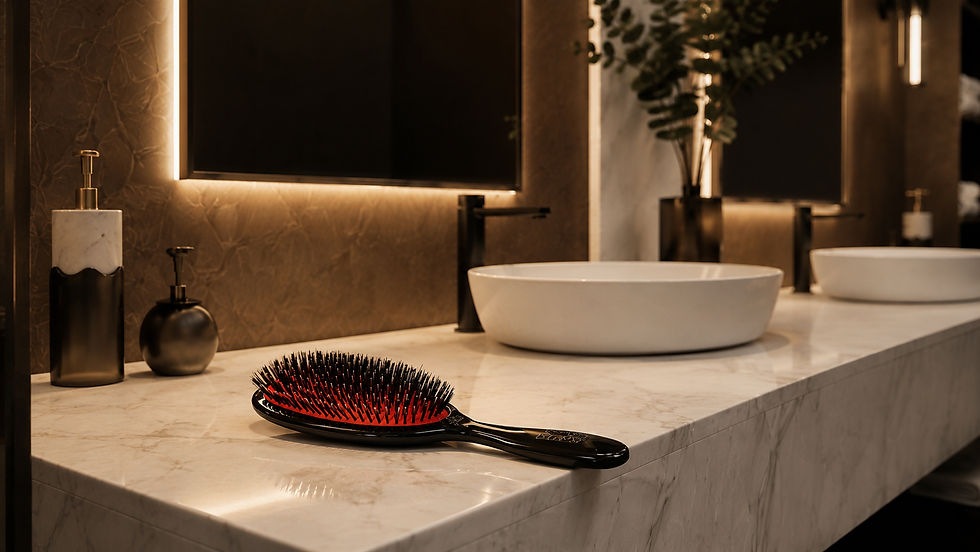
A Shine & Condition brush works through repeated mechanical contact. Natural boar bristles move across dry, detangled hair to support smoothing, polishing, and natural oil distribution. That same contact can be adjusted when the scalp is intact and merely sensitive. It should not be treated as something to optimize indefinitely when the scalp is painful, raw, bleeding, or clearly becoming more irritated as brushing continues.
The useful question is therefore not simply, “Is this scalp sensitive?” It is: “Is direct contact still appropriate right now?” That shifts the decision away from finding a supposedly gentler label and toward recognizing when modification has reached its limit.
The Avoidance Threshold Is Different From Ordinary Sensitivity
Ordinary sensitivity and active irritation are not the same grooming state. A person may normally notice bristle contact more readily than someone else and still tolerate light, controlled brushing on an intact scalp. In that situation, reducing mechanical intensity can be reasonable. The brush remains a grooming tool; the user simply changes how much contact is delivered.
Avoidance begins when the problem is no longer just “this feels stronger than I prefer.” Once brushing produces pain, burning, sharp discomfort, increasing redness, bleeding, or a distinctly worsening irritated feeling, continuing with a lighter version of the same contact does not solve the basic problem. The scalp is showing that the session itself is poorly tolerated.
This distinction is what separates this decision from general sensitive-scalp brush selection. Bristle firmness, construction, pressure, and frequency matter when the scalp is suitable for brushing. They become secondary questions once direct contact itself should be suspended.
Four Practical Decisions: Modify, Bypass, Pause, or Stop
Avoidance is not always an all-or-nothing decision. The most useful framework is to match the response to the scalp state rather than applying one rule to every form of sensitivity or irritation.
Modify when the scalp is intact and contact is merely too intense. Lower pressure, reduce repeated passes, or use sectioning so the bristles do not have to be driven through the hair. These are ordinary mechanical adjustments. Their purpose is to reduce contact intensity while preserving the brush’s normal conditioning role.
Bypass a clearly localized irritated area when the surrounding scalp is comfortable and intact. A small tender spot does not necessarily require abandoning the entire routine, but it does not need to be “tested” repeatedly with the bristles either. The area can simply be left out of the stroke path.
Pause the session when brushing itself creates a worsening reaction. Pain, burning, sharp discomfort, increasing redness, bleeding, or escalating irritation are stop signals rather than cues to experiment with another pass or another pressure level. More sensation is not evidence that a boar bristle brush is working better.
Stop direct contact over compromised skin or concerning warning signs. Open or raw skin, pain, rapid spread, fever or illness with a rash, and signs of infection such as pus, crusting, swelling, warmth, and pain are among rash warning signs that warrant medical attention. From a grooming standpoint, the conservative implication is straightforward: a bristle field does not belong on an open, bleeding, raw, or acutely painful surface.
When Brushing Itself Becomes the Reason to Stop
One of the easiest mistakes in a fixed grooming routine is to decide in advance that the session must be completed. That reverses the correct order of judgment. The scalp’s response should determine whether the session continues; the routine should not determine what the scalp is expected to tolerate.
If the first strokes feel neutral and later strokes begin to sting, burn, or create increasing soreness, cumulative contact may be the practical problem. Repeated passes add friction even when each individual stroke is light. At that point, “gentler” can still mean more contact than the scalp wants.
Stopping is a mechanical decision, not a failure to finish the routine.
The same principle applies when discomfort appears suddenly. A boar bristle brush does not need to scratch, sting, or hurt to distribute surface oils through the hair. The conditioning function is achieved through controlled movement, not through forcing the scalp to acclimate to an unpleasant sensation.
A Known Scalp Condition Does Not Create One Permanent Brushing Rule
A diagnosis by itself does not determine whether a boar bristle brush should be used every day or avoided indefinitely. The relevant grooming question is the current condition of the scalp and whether repeated contact is appropriate in that moment.
For scalp psoriasis, scratching, rubbing, and picking can worsen the condition and can cause bleeding. That does not establish a special boar-brush treatment rule. It establishes a mechanical boundary: the brush should not be used to scrape, scratch, pick at, or forcibly dislodge plaques or adherent scale. If the affected area is bleeding, highly irritated, or uncomfortable under light contact, direct brushing over that area should be avoided.
Seborrheic dermatitis can involve a scaly scalp rash as well as itching or burning. The diagnosis alone does not answer the brushing question. A comfortable, intact scalp presents a different mechanical situation from an area that is burning, painful, raw, or becoming more irritated with contact. The brush remains a grooming tool, not a treatment for the underlying condition.
Folliculitis is an infection of hair follicles that can be itchy or painful, and repeated rubbing can damage hair follicles. Because bumps can have more than one cause, their appearance should not be used for self-diagnosis. Painful, pus-filled, crusted, or otherwise concerning bumps are not an appropriate surface for routine boar-bristle contact, and pus, crusting, pain, swelling, warmth, and rapid spread are among rash warning signs that warrant medical attention.
These examples all lead back to the same narrow principle: the condition name supplies context, but the avoidance decision is governed by whether the scalp surface is intact, whether light contact is tolerated, and whether brushing is making the situation worse.
A Softer Brush Is Not a Substitute for Avoidance
When an intact scalp simply finds a particular brush too assertive, changing pressure, firmness, flexibility, or construction can change the mechanical experience. Those are legitimate selection questions. They should not be confused with permission to keep brushing a compromised area.
A soft boar-bristle field still creates friction. A cushioned base still allows repeated contact. Fewer passes are still passes. Those differences matter on a scalp that is suitable for modified grooming; they do not convert open, bleeding, raw, acutely painful, or clearly worsening skin into an appropriate brushing surface.
This is why “Which brush should I use?” is sometimes the wrong next question. If the scalp has crossed the avoidance threshold, the more useful decision is whether direct brushing belongs in the routine at all at that moment. Brush-selection details can wait until ordinary light contact is appropriate again.
Avoid One Area or Stop the Whole Session?
Localized irritation and widespread irritation create different practical choices. If one small area is clearly identifiable and the rest of the scalp is intact, comfortable, and easy to navigate, it may be reasonable to leave that spot completely untouched while brushing elsewhere with low mechanical intensity. The important point is to bypass the area rather than repeatedly testing whether it has improved during the same session.
Pausing scalp contact altogether is cleaner when the irritation is widespread, difficult to see through the hair, moving beyond one obvious spot, or producing symptoms that make the cause uncertain. In those situations, a user cannot reliably separate comfortable scalp from compromised scalp with each stroke, so continuing to search for “safe” paths through the area defeats the purpose of avoidance.
This localized-versus-widespread distinction is useful because “avoid using the brush” does not always mean the same thing. Sometimes it means omit one area. Sometimes it means stop the current session. Sometimes it means keep the brush away from the scalp until the situation has settled or been appropriately evaluated.
When Can You Start Using the Brush Again?
There is no universal waiting period after scalp irritation because the cause, severity, and recovery pattern can differ substantially. A fixed number of hours or days would be less useful than a mechanical return test.
The area you plan to brush should be intact, ordinary light contact should be comfortable, and the session should not recreate pain, burning, bleeding, or increasing irritation. If a known medical condition is involved, treatment-specific or flare-specific instructions from the appropriate clinician take priority over a general grooming routine.
When brushing resumes, do not use the first session to make up for missed brushing. Begin with fewer passes and lighter contact. The purpose is simply to see whether normal grooming is again tolerated. If the same concerning reaction returns, stop again rather than trying to train the scalp to accept the brush.
The Line to Remember: Do Not Optimize Past the Point of Avoidance
A boar bristle brush is a maintenance tool. Its job is to support smoothing, polishing, conditioning, and natural oil distribution through controlled contact. For an intact scalp that is merely sensitive, that contact can often be adjusted. For a localized irritated area, the area can sometimes be bypassed. For a scalp that is painful, burning, bleeding, raw, or clearly worsening with contact, the correct decision may be to remove direct brushing from the routine rather than continue optimizing it.
That is the practical boundary to remember. Sensitive-scalp brushing is not a contest to find the lowest pressure that still permits contact under every circumstance. Good grooming judgment includes knowing when the brush should not touch the scalp at all.
Comfort is useful information. Worsening discomfort is a stop signal. The most appropriate boar-bristle routine is the one that preserves the tool’s grooming function without asking the scalp to endure contact it is not tolerating.
Frequently Asked Questions
Should I stop using a boar bristle brush if my scalp feels a little tender?
Not automatically. If the scalp is intact and the tenderness is mild, reduce mechanical intensity first.
If tenderness increases during brushing, becomes painful, or persists despite lighter use, stop direct scalp brushing rather than continuing out of habit.
Can I brush around one irritated spot?
If the irritated area is small, clearly identifiable, and the surrounding scalp is comfortable and intact, you may be able to avoid that spot completely while brushing elsewhere very lightly. If the irritation is widespread, difficult to see, or worsening, pausing scalp contact altogether is more prudent.
Is a soft boar bristle brush always safe for an irritated scalp?
No. Softer bristles can reduce mechanical intensity, but they still create contact and friction.
Softness does not make active bleeding, open sores, raw skin, or infection-like signs appropriate surfaces for brushing. Open or raw skin and signs such as pus, crusting, pain, swelling, and warmth are among rash warning signs that warrant medical attention.
Should I keep brushing if my scalp starts burning or hurting during the session?
No. Burning, pain, sharp discomfort, bleeding, increasing redness, or clearly worsening irritation are reasons to stop the session rather than simply reduce pressure and continue. The reaction of the scalp is more important than completing a planned number of strokes.
Does having a diagnosed scalp condition automatically mean I must avoid boar bristle brushing?
No single diagnosis creates one permanent grooming rule. The current scalp state matters: whether the area is intact, whether ordinary light contact is comfortable, whether brushing worsens symptoms, and whether condition-specific medical instructions place limits on grooming.
When should I resume boar bristle brushing after irritation?
Resume when the area you plan to brush is intact and ordinary light contact is comfortable. Start with fewer passes and lighter pressure. If pain, burning, bleeding, increasing irritation, or another concerning reaction returns, stop again rather than pushing through it.









