What Does a Hairbrush Actually Do? The True Function & Purpose of Hair Brushing

Updated: Jun 3


This article expands on concepts from the broader textbook – “Hairbrushes: The Definitive Encyclopedia of History, Types, Materials, and Functional Systems – A Comprehensive Educational Textbook by Bass Brushes.”
Key Takeaways
• A hairbrush is a mechanical grooming tool that restores order to hair by organizing many strands at once through controlled contact, friction, and tension.
• Unlike a comb, which works on narrow sections, a brush manages hair as a collective structure, helping improve alignment, movement, volume distribution, and overall appearance.
• Different brush types serve different functions, including detangling, smoothing, oil distribution, scalp stimulation, directional control, and shaping hair during blow-drying.
• Effective brushing depends as much on technique as tool design, with controlled force and proper sequencing helping reduce unnecessary stress, pulling, and resistance.
• A hairbrush cannot permanently change hair structure or replace proper hair care, but it can improve manageability, surface coherence, and styling results when matched to the right task.
A hairbrush is one of the most familiar tools in daily grooming, which is exactly why it is so often misunderstood. Because the motion is ordinary, the tool can appear ordinary. The hand moves through the hair, resistance softens, the surface settles, and the reflection in the mirror becomes more orderly. The result feels immediate and simple, so the deeper function is easy to overlook.
But a hairbrush is not merely something that “makes hair neat.” It is a mechanical grooming instrument designed to influence how groups of hair fibers behave together.
That distinction matters because hair is not a fixed surface. It is a living-fiber system growing from the scalp, constantly affected by sleep, moisture, oil, static, humidity, friction, movement, styling, washing, and time. Strands overlap, compress, lift, cling, separate, twist, flatten, expand, and tangle. The visible disorder of hair is rarely caused by one strand alone. It comes from the changing relationship between many strands.
A hairbrush exists to bring structure back to that relationship.
Through repeated, controlled contact, a brush can separate fibers, reduce resistance, align the surface, distribute tension, guide direction, move natural scalp oils, stimulate the scalp, prepare hair for styling, or shape hair under airflow. Different brush systems accomplish these tasks in different ways, but the central principle remains consistent: a hairbrush translates the movement of the hand into organized physical contact across many hair fibers at once.
The true purpose of hairbrushing is not one isolated action. It is the restoration of order.
That order may look like detangled hair. It may look like smoother shine. It may look like a cleaner part, better volume distribution, a more controlled silhouette, or a finished blow-dry shape. The visible result changes depending on the tool and technique, but the foundation is always mechanical. Hairbrushing works because hair responds to contact, friction, direction, tension, pressure, and repetition.
To understand what a hairbrush actually does, it is necessary to look beneath the familiar gesture and examine the function behind the motion.
A Hairbrush Organizes Hair as a Collective Structure
The most basic function of a hairbrush is organization.
Individual hair strands do not behave in isolation during daily life. They gather into sections, wrap around neighboring fibers, catch at the ends, compress during sleep, separate in humidity, or flatten under hats, hands, collars, and pillows. What appears in the mirror as “messy hair” is usually a loss of collective order.
A brush works across that collective structure.
This is one of the clearest differences between a brush and a comb. A comb uses a single row of teeth to separate hair in a narrow, linear path. It is excellent for precision parting, sectioning, and working through smaller bands of hair. A brush, by contrast, uses a broader field of bristles or pins to engage many fibers at once. That field may be flat, cushioned, curved, dense, widely spaced, compact, vented, or cylindrical, but the functional principle is the same: a brush manages hair as a larger mass.
Where a comb isolates, a brush integrates.
This integration is why brushing can change the overall appearance of hair quickly. A few controlled passes can redistribute volume, open compressed areas, align the outer surface, reduce random crossing, and encourage the hair to fall in a clearer direction. The brush is not changing the identity of the hair. It is reorganizing the fibers into a more coherent relationship.
Hair that is aligned reflects light more evenly. Hair that is separated with control moves more freely. Hair that is directed consistently creates a more intentional silhouette. Hair that has been brushed according to its condition and goal becomes easier to manage because the fiber mass has been returned to structure.
This is the first truth of brushing: a hairbrush restores order to a moving fiber system.
Brushing Works Through Contact, Friction, and Tension
Every brush stroke applies force. That force may be gentle or excessive, controlled or careless, well distributed or concentrated. The quality of the brushing experience depends on how that force moves through the tool and into the hair.
Three forces matter most: contact, friction, and tension.
Contact is where the brush meets the hair and scalp. The nature of that contact depends on the brush’s design. A dense natural bristle field creates broad surface engagement. Flexible pins enter the hair mass with more separation and movement. Firmer pins transmit direction more directly. A round brush creates curved contact while the hair is held under tension during blow-drying.
Friction is the resistance created as the brush moves through or over the hair. Some friction is necessary. Without it, the brush could not grip, guide, smooth, separate, polish, or shape the hair.
The question is not whether friction occurs, but whether it is managed. Controlled friction helps organize hair. Abrupt friction can roughen the surface, tighten tangles, create discomfort, or increase stress on vulnerable areas.
Tension is the pulling or stretching force placed on the fiber. Like friction, tension is not automatically harmful. Controlled tension helps guide hair into alignment and is essential for round-brush shaping under airflow. Sudden or excessive tension, however, concentrates stress. This is why forcing a brush through tangled hair from the roots downward often feels uncomfortable. The brush pushes resistance ahead of itself until knots tighten and strain gathers below the tool.
Good brushing is not aggressive brushing. It is governed brushing.
A brush performs best when contact is distributed, friction is moderated, and tension is applied in a direction that matches the goal. Tool design matters, but technique matters just as much. A high-quality brush used with poor sequence or excessive force can still create unnecessary stress. A simple brush used with patience and correct direction can restore order with remarkable efficiency.
The brush is the instrument. Technique determines how intelligently the instrument is used.
A Hairbrush Does Not Have One Universal Job
One of the most common mistakes in understanding hairbrushes is assuming that all brushes are variations of the same tool.
They are not.
The word “hairbrush” names a broad category, but within that category are distinct functional systems. These systems exist because hair has different needs at different moments. Sometimes hair needs to be separated. Sometimes it needs to be polished. Sometimes it needs to be directed.
Sometimes it needs to be shaped under airflow. These are not the same job.
A brush designed to polish the surface is not automatically designed to remove dense tangles. A brush designed to detangle gently is not automatically designed to create strong directional control. A brush designed to shape hair during blow-drying is not the right tool for routine dry conditioning. Each system has its own relationship to the hair fiber.
Within the Bass framework, the broad hairbrush category can be understood through major functional roles.
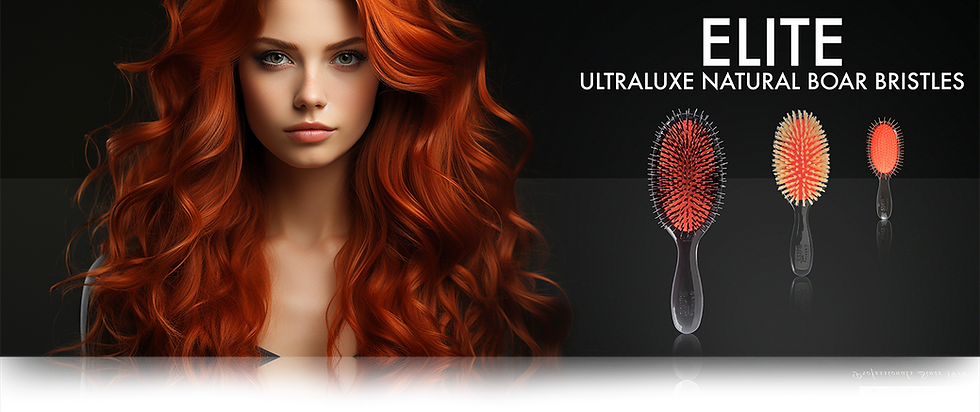
Shine & Condition brushes, centered on natural boar bristle, are designed primarily for surface refinement, polishing, smoothing, and helping distribute sebum from the scalp area through the lengths of the hair. Their work is largely surface level. They are not primarily deep-detangling tools.
Style & Detangle brushes, centered on pin-based systems, are designed to separate, organize, direct, and manage the hair more actively. Depending on pin material, rigidity, spacing, and cushion response, they may support gentle detangling, daily grooming, directional styling, and scalp stimulation.
Straighten & Curl brushes, centered on round-brush geometry, are designed to shape hair under airflow and tension. Their cylindrical form allows the hair to smooth, lift, bend, wave, or curl depending on diameter, section size, tension, and drying technique.
These systems are related, but they are not interchangeable. The broad purpose of brushing is order. The specific purpose depends on which kind of order the hair needs and which brush system is being used to create it.
This is why the better question is not simply, “What is the best brush?”
The better question is, “What do I need the brush to do?”
Brushing Can Detangle, But Detangling Is Only One Function
For many people, brushing begins with tangles. That is understandable. Tangles create immediate resistance. They make hair harder to manage, harder to style, and often uncomfortable to handle.
When a brush removes knots, the benefit is obvious.
But detangling is not the whole meaning of brushing.
Detangling is the process of separating hair fibers that have crossed, looped, compressed, twisted, or caught on one another. To do this well, a brush must enter the hair mass, locate resistance, and release it gradually. Pin brushes are especially important in this role because their structure allows them to move between strands rather than only glide across the surface.
The best detangling is progressive. It usually begins near the ends and works upward in controlled stages. This prevents resistance from being pushed into a tighter knot. When someone starts at the roots and forces the brush downward through tangled hair, the tool often gathers all the resistance into one stressed area. That is when brushing becomes painful, inefficient, and potentially damaging.
Detangling should remove resistance, not overpower it.
Once resistance is removed, the purpose of brushing changes. The hair may then need directional control, surface refinement, oil distribution, or shaping. This is where many routines fail. A person may ask one brush to do every job, or use the right brush at the wrong moment. A boar bristle brush used before detangling may meet too much resistance. A round brush used before the hair is organized may catch. A styling brush used with detangling pressure may flatten or strain instead of directing.
Detangling is often the first stage of brushing because order must begin with separation. But once separation is achieved, brushing becomes capable of more refined work.
Brushing Aligns the Hair Surface
Hair looks smoother when its surface behaves coherently.
Each strand has an outer cuticle layer. When the surface is relatively organized and the fibers lie in a more unified direction, light reflects more evenly. When the surface is disrupted by friction, dryness, static, rough handling, or tangled crossing, hair can appear dull, frizzy, or uneven even when the strands themselves are not severely damaged.
Brushing influences this surface behavior mechanically.
A controlled brush stroke encourages the fibers to lie in a more parallel orientation. It reduces random crossing and helps the outer surface settle into a cleaner plane. This is why hair can look more polished after brushing without anything being added to it. The brush has changed the arrangement of the fibers, and the improved arrangement changes how the hair reflects light.
This effect depends on both tool and technique.
A dense bristle field can create broad surface engagement. A cushioned pin brush can reduce abrupt pressure changes while guiding the hair. A brush with appropriate spacing can separate without excessive drag. A round brush can smooth the surface while applying controlled tension under airflow. Each design produces a different kind of surface influence.
But more brushing is not always better. Repetition magnifies both benefit and error. Gentle, structured brushing can improve surface coherence. Excessive force, repeated scraping, or brushing through resistance without preparation can create the opposite effect. The purpose is not to punish hair into smoothness. It is to guide fibers into order.
In this sense, brushing is not cosmetic in a superficial way. It changes visible appearance by changing physical organization.
Brushing Can Distribute Natural Scalp Oils
The scalp produces sebum, a natural oil that helps protect and condition the scalp and the hair near the root area. But sebum does not always travel evenly down the hair shaft on its own. This is especially true for longer hair, textured hair, dry lengths, or hair that is frequently washed or exposed to environmental stress.
Certain brushes assist this movement through mechanical distribution.
This is the primary purpose of Shine & Condition brushing. Natural boar bristles are used in conditioning systems because their structure can help collect small amounts of oil from the scalp area and carry it gradually along the hair shaft through repeated, controlled strokes. The effect is not the same as applying a product. It is physical redistribution.
This helps explain why boar bristle brushes have such a distinct role. They are not designed mainly to force through knots or shape hair under heat. Their strength is surface engagement: polishing, smoothing, and moving natural oils through the hair after the hair has already been prepared.
The result is often cumulative rather than instant. With appropriate use, the lengths may appear less dry, the surface may look more refined, and the hair may show more natural shine because the oil is no longer concentrated only near the scalp. The visible result depends on hair type, oil production, length, brushing frequency, and whether tangles have first been removed.
This also clarifies a common misconception. Brushing does not create shine from nothing. It creates the conditions that allow shine to appear better surface alignment, more even oil distribution, and reduced visual disorder.
Brushing Creates Direction
Hair often needs more than separation and polish. It needs direction.
Directional control is the act of guiding hair into a preferred orientation. This may involve establishing a part, moving hair away from the face, controlling bulk, smoothing one area into place, encouraging flow with the growth pattern, or creating a more intentional silhouette.
This is where brushing becomes structural.
Pin brushes play an important role here because they can enter the hair with enough separation to move strands while still giving the hand meaningful control. Softer pins may be useful when the goal is gentle detangling or lower-stress brushing. Firmer pins may provide more directional authority when the goal is styling support, cleaner organization, and shape control within a planar brushing system.
Directional brushing is not the same as detangling. The motion may look similar, but the intention is different. Detangling removes resistance. Directional brushing establishes where the hair should go.
This distinction matters because pressure, pace, and tool choice should change with the goal.
Detangling requires patience and resistance management. Directional styling requires clarity of movement. Once the hair is free of knots, the brush can be used to guide the fiber mass into a more composed structure.
This is part of what gives brushing its daily value. Even when no elaborate styling is involved, a brush can restore the line, flow, and balance of the hair. It can take hair from disordered to intentional.
Brushing Can Shape Hair Under Airflow
Round brushing introduces a different kind of function because the brush is no longer only organizing hair across a flat or broad surface. It is shaping hair around a cylinder.
This is the foundation of the Straighten & Curl system.
A round brush uses curvature, tension, sectioning, and airflow to influence form. When hair is wrapped or guided around the barrel while warm air moves across it, the fibers can be temporarily shaped into smoother lines, lift, bend, waves, or curls. The brush does not create heat on its own. It provides geometry and tension so that airflow can help set the hair into a controlled shape.
Diameter determines much of the result. A large barrel creates broader, smoother lines and can help elongate the appearance of the hair. A medium barrel introduces more curve, movement, and body. A small barrel creates tighter bends and more compact curl patterns.
This is why round brushes should not be understood as ordinary brushes with a different shape.
Their geometry changes the function. Flat and paddle formats guide, align, and organize. Round brushes transform direction into curvature.
The technique also changes. Round brushing requires clean sectioning, controlled tension, coordinated airflow, and careful release. If the section is too large, the hair may not dry evenly. If the brush is over-rotated, hair can wrap too tightly and catch. If tension is inconsistent, the result may look uneven. If the hair is released before cooling into shape, the result may fall quickly.
A round brush is a shaping instrument. It belongs to the part of brushing where order becomes form.
Brushing Interacts With the Scalp
Although hair receives most of the attention, brushing also interacts with the scalp.
The scalp is living tissue. It contains follicles, oil glands, blood vessels, and sensory nerve endings.
When a brush contacts the scalp, it creates pressure, movement, and sensation. Depending on the brush design and the user’s pressure, that sensation may feel soft, stimulating, grounding, firm, relaxing, or uncomfortable.
This scalp interaction is not separate from brushing’s value. It is part of why brushing feels personal and rhythmic rather than purely technical.
A brush that feels comfortable is more likely to be used consistently and thoughtfully. A brush that feels harsh may encourage rushed grooming or avoidance. Pin brushes with rounded or smooth tips may provide a more stimulating scalp feel when used with moderation. Natural bristle brushes create a different kind of surface sensation near the root. Compact brushes can offer close control for shorter hair and more direct contact.
Scalp stimulation should never be confused with force. Pressure does not need to be aggressive to be effective. The goal is controlled contact, not abrasion. Brushing should awaken and organize, not scrape or irritate.
This sensory dimension helps explain why brushing has endured as a daily ritual. It produces visible order, but it also gives the body a tactile signal of preparation. The rhythm of brushing can mark a transition from rest to readiness, from disorder to composure, from private ease to public presentation.
A hairbrush is mechanical, but the act of brushing is also human.
Brushing Establishes Sequence in a Grooming Routine
A hairbrush often serves as the first instrument of order in a grooming routine.
Before hair can be polished, it usually needs to be separated. Before it can be shaped, it usually needs to be organized. Before it can reflect light evenly, its surface must be aligned. Before a style can appear intentional, the fiber mass needs direction.
This creates a logical sequence.
Detangling removes resistance.
Directional brushing organizes the hair.
Conditioning or finishing brushing refines the surface.
Round brushing shapes the hair when airflow and tension are involved.
Not every person needs every stage every day. Short hair may require more surface control than detangling. Long hair may require careful preparation before any finishing step. Curly hair may need selective brushing depending on whether the goal is definition, elongation, or expansion.
Fine hair may need gentle handling to avoid collapse. Dense hair may need stronger structure and more patient sectioning.
But the sequence itself remains useful because it clarifies the purpose of each action.
If hair is tangled, begin with separation. If hair is directionless, guide it. If the surface looks dull or dry, consider whether a conditioning brush belongs after detangling. If the goal is bend, lift, smoothing, wave, curl, or straighter lines during blow-drying, move into a round-brush system designed for shaping.
When brushing is treated as one vague motion, results become unpredictable. When brushing is understood as a sequence of mechanical intentions, the routine becomes clearer and more effective.
What a Hairbrush Does Not Do
Understanding what a hairbrush does also requires understanding what it does not do.
A hairbrush does not permanently change the structure of the hair through ordinary use. It can temporarily smooth, align, stretch, bend, lift, polish, or shape the hair, but it does not alter the fundamental fiber. Even round brushing with airflow produces temporary form based on moisture, heat, tension, cooling, and technique.
A hairbrush does not replace washing or proper care. If the hair contains heavy product buildup, excessive oil accumulation, environmental residue, or debris, brushing alone cannot correct that condition. In fact, a dirty brush can redistribute residue back into the hair and reduce the quality of the result.
A hairbrush does not make all hair behave the same way. Hair density, strand diameter, curl pattern, porosity, length, scalp oil production, moisture state, and styling history all influence how brushing feels and what it accomplishes. A brush that works beautifully for one person may feel too soft, too firm, too dense, too flexible, or too shallow for another.
A hairbrush is not automatically gentle simply because it is a brush. Gentleness depends on design, pressure, sequence, condition of the hair, and whether the brush matches the task. A finishing brush used on tangled hair can create unnecessary resistance. A detangling brush forced too quickly through knots can still strain the fiber. A round brush used without proper sectioning can catch and pull.
Most importantly, a hairbrush is not universal. The right brush is the brush whose structure matches the job being asked of it.
The True Function of Hairbrushing
The true function of hairbrushing is controlled mechanical order.
That order can take several forms. It may be the separation of tangled fibers. It may be the alignment of the surface. It may be the movement of natural oil from root toward length. It may be the directional control that creates a cleaner silhouette. It may be the curvature created by a round brush under airflow. It may be the sensory rhythm of scalp contact and daily grooming.
Brushing is simple in appearance because the motion is familiar. But beneath that motion is a sophisticated interaction between hand, tool, scalp, and fiber.
A hairbrush manages friction.
It distributes tension.
It organizes strands.
It refines surfaces.
It guides direction.
It supports shape.
It connects the physical act of grooming with the visible result of order.
This is why the brush remains foundational even in a world filled with styling products, heated appliances, and complex routines. Before hair can be transformed, it must be understood. Before it can be polished, it must be organized. Before it can hold a style, it must be brought into workable structure.
The brush is the original instrument of that structure.
Conclusion: A Hairbrush Turns Motion Into Order
A hairbrush does far more than pass through hair.
It translates the movement of the hand into structured contact across many fibers at once. It helps manage the physical realities of hair: friction, tension, resistance, surface alignment, oil movement, scalp sensation, directional control, and shape. Depending on its design, it may prepare hair, refine hair, organize hair, condition hair, stimulate the scalp, or help transform hair under airflow.
The deepest purpose of hairbrushing is coherence.
Hair that is brushed with the right tool and intention becomes easier to understand, easier to manage, and easier to present. The brush does not replace skill, care, or judgment. It gives the hand a disciplined way to work with hair rather than against it.
That is what a hairbrush actually does.
It restores order to hair through controlled contact. And from that order come polish, control, confidence, and readiness.
FAQ
What does a hairbrush actually do to your hair?
A hairbrush organizes groups of hair fibers through structured contact. Depending on the brush type, it can separate tangles, smooth the surface, distribute natural oils, guide direction, stimulate the scalp, or help shape hair under airflow.
What is the main purpose of brushing hair?
The main purpose of brushing is to restore order. Hair shifts, tangles, compresses, separates, and loses direction through daily life. Brushing helps bring the hair back into a more coherent structure.
Is brushing only for detangling?
No. Detangling is one important function, but brushing can also support surface refinement, oil distribution, directional styling, scalp stimulation, and blow-dry shaping. Different brush systems are designed for different functions.
Why does brushing make hair look smoother?
Brushing can make hair look smoother by aligning strands into a more consistent direction and improving surface coherence. When the hair surface is more organized, light reflects more evenly and the hair appears more polished.
Does brushing make hair shiny?
Brushing can support shine when it improves surface alignment and helps distribute natural scalp oils. Shine is not created by the brush alone; it becomes more visible when the hair surface is smoother and more coherent.
What is the difference between a brush and a comb?
A comb separates hair through a single row of teeth and is useful for precision parting, sectioning, and narrow control. A brush works across a broader contact area and manages hair as a larger fiber mass.
Why are there different types of hairbrushes?
Different brushes exist because hair has different mechanical needs. Boar bristle brushes support polishing and oil distribution. Pin brushes support detangling and directional control. Round brushes support shaping with airflow and tension.
Can the wrong brush damage hair?
A brush can create unnecessary stress if it is poorly matched to the task or used with too much force. For example, forcing a finishing brush through tangled hair or using a round brush before the hair is organized can increase pulling and resistance.
Should hair be brushed wet or dry?
It depends on the goal. Wet or damp hair is more elastic and should be handled with extra care, usually with a brush suited to gentle detangling. Dry hair is often better suited for finishing, polishing, oil distribution, and surface refinement.
What should a good brushing routine accomplish?
A good brushing routine should match the condition and goal of the hair. If hair is tangled, brushing should remove resistance. If it lacks direction, brushing should guide it. If the surface looks dull, brushing may refine alignment or distribute oils. If shape is desired, brushing may work with airflow and tension to create form.
Do I need to brush my hair?
Not everyone needs to brush their hair on the same schedule. Brushing is a functional tool, not a universal ritual: use it when hair needs detangling, direction, surface refinement, oil distribution, or styling preparation, and adjust frequency to the hair’s condition and the result you want.