The Ritual of Brushing: Fine Hairbrushes as Daily Self-Care

Updated: Sep 12


This article expands on concepts from the broader textbook – “Hairbrushes: The Definitive Encyclopedia of History, Types, Materials, and Functional Systems – A Comprehensive Educational Textbook by Bass Brushes.”
Key Takeaways
• Hair brushing can become a meaningful self-care ritual when the brush, technique, and pace match the hair’s actual needs.
• The value of the ritual comes from useful grooming, sensory comfort, and consistency—not from exaggerated claims about growth, circulation, or wellness.
• Different brushes support different moments: detangling and directional control, surface conditioning and shine, or shaping during styling.
• A good ritual is responsive. It uses only the pressure and number of strokes needed to accomplish the task comfortably.
• Morning and evening brushing can serve different purposes, and frequency should be adapted to texture, condition, moisture state, and styling routine.
Hair brushing is one of the oldest and most familiar acts in personal grooming. It can be quick and purely practical, but it can also become something more deliberate: a small transition between sleep and readiness, work and evening, styling and rest. The ritual is not created by adding more steps. It comes from giving an ordinary step enough attention to make it useful, comfortable, and repeatable.
That distinction matters. Brushing does not need to be presented as a treatment or a wellness cure to have value. A well-designed brush moving through the hair with controlled pressure can organize strands, release light tangles, smooth the surface, distribute natural oils with the appropriate bristle system, and create a familiar sensory rhythm. Those practical and sensory effects are enough to explain why brushing can feel restorative.
Why Brushing Naturally Becomes a Ritual
A ritual is simply a repeated action that carries a recognizable purpose. Brushing fits naturally because it combines touch, movement, visual feedback, and routine. The hand repeats a familiar motion. The hair gradually becomes more orderly. The scalp may receive gentle contact. The person can see and feel the change as it happens.
The calming quality is often less mysterious than it sounds. Repetition and predictable sensory input can make a familiar grooming task feel settling. The Core Lesson Relaxation & Stress Reduction Through Hairbrushing explores that experience directly and places it in a practical rather than medical context.
The Brush Still Has to Do the Right Job
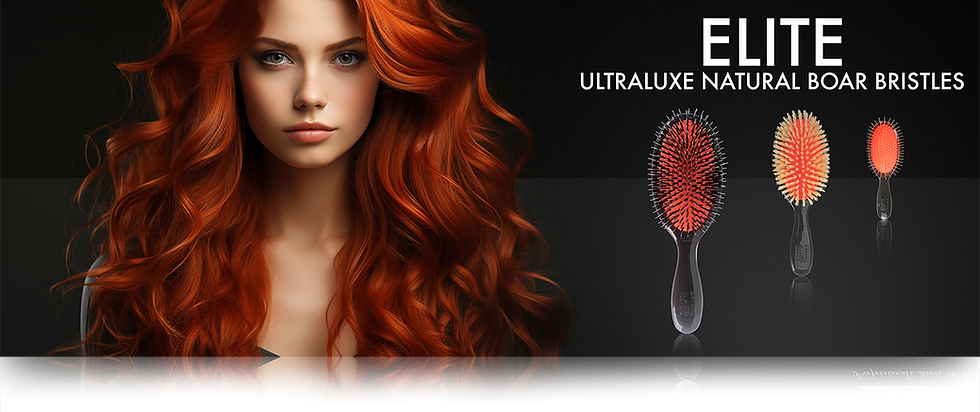
Self-care does not replace function. The brush should still be chosen according to what the hair needs. A pin-based brush may be appropriate for detangling or directional control. A boar bristle brush may be used on dry, prepared hair for surface refinement and natural-oil distribution. A round brush belongs to blow-dry shaping, where barrel geometry, tension, and airflow determine the result.
This function-first approach is explained in How to Choose the Right Hairbrush for Your Hair Type & Goal. The ritual becomes more satisfying when the tool is doing the job it was actually designed to do.
Technique Is What Keeps the Ritual Comfortable
A brushing ritual should feel controlled, not forceful. If the hair is tangled, resistance should be released gradually rather than pushed downward into a tighter knot. If the hair is already detangled, longer directional or conditioning strokes may be appropriate. If the brush catches, the useful response is to slow down, reduce the section, or change the angle—not simply pull harder.
For a complete explanation of sequence and direction, see Hair Brushing Technique & Routine: Sequence, Direction & Best Practice. The central idea is simple: remove resistance first, establish direction second, refine the surface third, and shape only when the hair is prepared.
Morning and Evening Brushing Can Feel Different
Morning brushing often has a preparation goal. Hair may need light detangling after sleep, directional control, surface smoothing, or preparation for styling. The session can be brief and purposeful: assess the hair, choose the appropriate brush, perform the needed task, and stop when the result is reached.
Evening brushing may have a softer purpose. It can release minor tangles, remove the structure of a daytime style, smooth dry hair, or simply return the hair to a comfortable state before rest. On suitable hair, a conditioning brush may also help move natural scalp oils toward the lengths. There is no required number of strokes. The useful measure is whether the task has been completed without unnecessary friction or tension.
Scalp Contact, Comfort, and Wellness Claims
Scalp contact can be one of the most pleasant parts of brushing. Rounded pins or bristle tips may create a gentle tactile sensation, and some people naturally associate that sensation with relaxation. But comfort should not be confused with proof of a larger biological effect. Brushing can mechanically stimulate the scalp; it should not be described as a guaranteed method for increasing hair growth or correcting scalp conditions.
The same discipline applies to hair-health language. Hair Health & Hairbrushing: Benefits, Myths & Mechanical Reality explains why brushing is best understood as mechanical maintenance rather than biological repair. Good technique can reduce avoidable stress, improve manageability, and support smoother-looking hair without turning the brush into a cure-all.
Brush Design and the Experience of Care
A well-designed hairbrush can make a daily brushing routine more comfortable and predictable. A well-made brush can improve the experience through balance, smooth finishing, appropriate pin or bristle behavior, comfortable handle geometry, and materials chosen for the task. Those details can make a daily object feel more intentional because the tool is pleasant to hold and predictable in use.
Craftsmanship does not make brushing inherently healthier, and luxury alone does not create better technique. The value comes when design and use align. A brush that feels comfortable, performs its function well, and is maintained over time can become a familiar personal object—one that naturally earns a place in a repeated routine.
The Ritual Should Adapt to the Hair
Not every hair type benefits from the same brushing frequency or the same dry-brushing routine. Straight and loosely textured hair may tolerate frequent dry brushing well. Curly and coily hair often requires more selective brushing so the natural pattern is not unnecessarily disrupted. Fragile, aging, chemically processed, or highly tangled hair calls for lower tension and more deliberate sectioning.
A useful ritual therefore changes with the day. Sometimes the hair needs detangling. Sometimes it needs polishing. Sometimes it needs no brushing at all. Self-care is not measured by repetition for its own sake; it is measured by whether the routine responds intelligently to the condition of the hair and scalp.
Care for the Brush as Part of the Routine
A brush used regularly should also be maintained regularly. Loose hair should be removed before it compacts around pins or bristle bases. Cleaning should match the materials and construction of the brush, with unnecessary soaking avoided when it may affect wood, cushions, adhesives, or finishes. The brush should be allowed to dry fully before storage.
This is a natural extension of the ritual. Caring for the tool keeps it comfortable to use and makes the routine more consistent. A clean, well-maintained brush is easier to regard as a personal grooming instrument rather than a disposable accessory.
A Small Moment of Order
The strongest case for ritual brushing is also the simplest. Hair brushing is useful. It is tactile. It produces immediate feedback. It can be repeated without requiring elaborate preparation. When it is done with the right brush and sensible technique, it creates a small moment in which appearance, maintenance, and attention meet.
That is enough. The ritual does not need promises of transformation. It can remain what it has long been: a familiar grooming practice that helps bring the hair into order while giving the person a brief, deliberate moment of care.
FAQs: The Ritual of Brushing
How can brushing become a self-care ritual?
Brushing becomes self-care when it is done with a clear purpose, appropriate pressure, and enough attention to how the hair and scalp respond. The ritual comes from consistency and comfort, not from a required number of strokes.
Why can hair brushing feel calming?
The motion is repetitive, tactile, familiar, and easy to observe. That predictable sensory pattern can make brushing feel settling, especially when the brush is comfortable and the hair is not being pulled or forced.
Does brushing the scalp make hair grow faster?
Ordinary brushing should not be treated as a proven hair-growth treatment. It can create mechanical scalp stimulation and may feel pleasant, but claims of reliably increasing growth go beyond what brushing itself can establish.
What type of brush is best for a brushing ritual?
There is no single best brush. The right choice depends on the task. Detangling, surface conditioning, directional grooming, and blow-dry shaping require different brush structures and techniques.
Should I brush my hair every day?
Daily brushing works well for some hair types and routines, but it is not a universal requirement. Frequency should reflect texture, condition, moisture state, styling goals, and how easily the hair tangles.
How many brush strokes should be part of the ritual?
Use only as many controlled passes as the task requires. A fixed stroke count is unnecessary. Stop when the hair is comfortably detangled, directed, smoothed, conditioned, or otherwise prepared for the next step.