Professional Brush Maintenance for Boar Bristle Brushes
- Editorial & Publishing Team

- Jun 18
- 17 min read


Key Takeaways
· Professional boar bristle brush maintenance protects both hygiene and performance by keeping the bristle field clean, open, dry, and responsive.
· Old oil, trapped hair, product film, and powder residue can interfere with sebum transfer and change the quality of the finished polish.
· Cleaning, functional maintenance, and professional sanitation serve different purposes, so salon brush care must address appearance, performance, and client-to-client readiness.
· Boar bristle brushes should be reset after use, cleaned without soaking, dried bristle-side down, and rotated by professional service role.
· A brush should be retired from client-facing use when bristles remain clumped, odors persist, construction weakens, or glide becomes unreliable.
A professional boar bristle brush carries two kinds of evidence after a service. One is visible in the hair: the softened surface, the quieter flyaways, the more coherent shine, the final polish that makes a finished style look resolved rather than merely styled. The other remains inside the brush itself: shed hair, scalp oil, fine debris, product film, powder residue, and the faint trace of every finishing decision made during the service.
In a home routine, that evidence builds slowly. In professional work, it can build quickly. A stylist may use a boar bristle brush on freshly blow-dried hair, then on second-day hair, then through a product-supported finish, then near the hairline where oil concentration is higher, then across the canopy of another client whose hair holds dry shampoo or finishing spray. By the end of the day, the brush may still look acceptable from a distance, but its working surface has changed.
That change matters because a boar bristle brush is not a passive grooming tool. It is designed to interact with the hair’s natural oil system. The bristles help collect sebum from areas where it gathers, move it along dry hair, reduce surface friction, and encourage a smoother, more reflective cuticle arrangement. When the bristle field is open, clean, and responsive, the brush can polish without overburdening the hair. When that field becomes coated or compacted, the same brush may begin to drag, dull the finish, separate fine hair, or transfer stale residue into a style that should feel fresh.
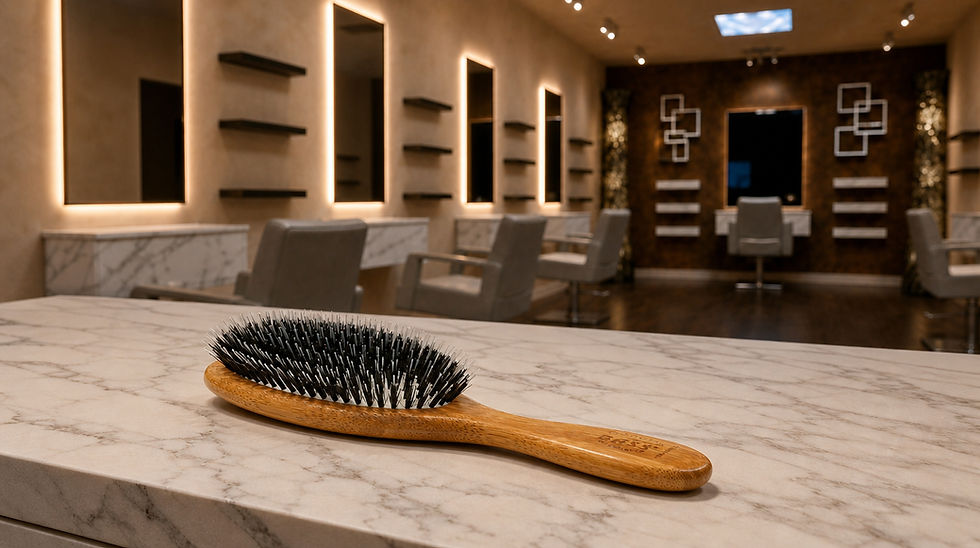
Professional brush maintenance is therefore not a cosmetic afterthought. It is part of the service standard. It protects hygiene, preserves performance, supports client trust, and keeps a natural-material tool eligible for professional use.
Why Professional Maintenance Is Different from Home Brush Care
Home brush care is usually organized around personal use. The brush touches one scalp, one pattern of oil production, one product routine, and one general hair history. Professional brush care has to account for repeated use across different clients, textures, densities, product habits, and service contexts. That difference changes the maintenance standard.
A boar bristle brush used at home can often be cleaned according to a simple rhythm: remove hair regularly, refresh the bristles periodically, avoid soaking, and allow the brush to dry properly. In the salon, the same principles still apply, but the timing becomes more demanding. The brush may need to be reset between clients, inspected during the day, separated by service role, and removed from rotation before buildup becomes visible to the client or detectable in the finish.
The professional question is not only, “Is this brush clean enough for me?” It is, “Is this brush clean, dry, open, and responsive enough to touch the next client’s finished hair?”
That distinction is important because boar bristle brushes are often introduced at a delicate moment in the service. They are used after the larger work has already been completed. The blow-dry has created shape. The sectioning has established direction. The finish is nearly complete. The boar bristle brush is brought in to refine the surface, distribute natural oil, reduce static, or settle small fibers. At that stage, a compromised brush does not simply fail to improve the finish. It can disturb work that is already complete.
Professional maintenance protects that final margin.
Cleaning, Sanitation, and Functional Maintenance Are Not the Same Thing
A common mistake in professional tool care is treating all cleanliness language as if it means the same thing. For boar bristle brushes, it is useful to separate three related but distinct ideas: cosmetic cleaning, functional maintenance, and professional sanitation.
Cosmetic cleaning addresses what can be seen: trapped hair, dust, lint, visible residue, or a bristle field that looks neglected. This matters because client-facing tools should appear orderly and cared for. A brush used near the end of a service should not carry visible evidence of prior use.
Functional maintenance addresses how the brush performs. A boar bristle brush can look reasonably clean while still being coated with oil, spray film, or dry product residue. That invisible coating changes the way the bristles pick up and release sebum. It can reduce glide, bind tufts together, and turn a refining tool into a residue-transfer tool. Functional maintenance keeps the brush working as a Shine & Condition tool rather than merely looking presentable.
Professional sanitation is the broader salon obligation to prevent client-to-client transfer of unwanted material. Salons may also have specific regulatory requirements, internal protocols, or tool-use standards depending on location and service type. Boar bristle brush maintenance should support those standards, but it should not be confused with careless soaking or harsh treatment. A natural bristle brush still has material limits. The professional challenge is to maintain cleanliness and client safety while preserving the construction that allows the brush to perform.
When these three layers are understood separately, maintenance becomes more precise. The stylist is not just “cleaning the brush.” The stylist is preserving appearance, function, and professional suitability at the same time.
What Buildup Does to a Boar Bristle Brush
Buildup affects a boar bristle brush in stages. The earliest stage is usually trapped hair. Shed strands settle into the bristle field and form a web between tufts. This web captures oil, powder, dust, and product particles. As more material collects, the bristles lose some of their independence.
They no longer separate and flex as cleanly. The brush may still move through the hair, but the contact becomes less refined.
The next stage is surface coating. Natural boar bristle is valuable because its surface can interact with oil. It can temporarily pick up sebum and help move it through dry hair. When the bristle surface is coated with old oil or product film, that interaction becomes less precise. The bristle can no longer behave as a clean intermediary between scalp oil and hair fiber. It begins to carry its own residue history into the next pass.
This is especially problematic in professional finishing because the difference between polish and weight can be very small. On fine hair, a contaminated bristle field may darken the root area or collapse lift. On layered hair, it may make the canopy look separated rather than smooth. On hair that already contains finishing product, it may create tackiness or dullness instead of clean reflection. On second-day hair, it may move old oil without balancing it, making the surface look handled rather than refreshed.
The final stage is performance distortion. The stylist may begin to adjust technique without realizing the brush is the problem. More pressure may be used to compensate for reduced glide. Fewer passes may be made because the brush feels heavy. Product may be added to correct dullness that the brush itself is contributing to. In this way, poor maintenance can create a false reading of the hair.
A well-kept brush allows the stylist to judge the hair accurately. A neglected brush adds noise to the service.
Fresh Sebum and Old Residue Behave Differently
Professional maintenance depends on understanding a subtle but important distinction: fresh sebum moved during a controlled brush pass is not the same as old residue sitting on the brush.
Fresh sebum is part of the hair’s natural conditioning system. When moved from the scalp area through dry, prepared hair, it can help lubricate the cuticle, reduce friction, soften the surface, and support a more coherent shine. In the right amount, it makes hair look conditioned rather than coated.
Old residue is different. Oil that remains on the brush can oxidize, thicken, attract dust, and mix with product particles. A bristle coated with old residue cannot regulate transfer as cleanly. It may deposit weight unevenly, especially where the brush first contacts the hair. Instead of creating a gradual root-to-length movement of oil, the brush may smear accumulated material across the surface.
This is one reason a boar bristle brush can produce beautiful shine in one service and disappointing heaviness in another. The tool may be the same, but its surface condition is not. In professional work, the brush’s history affects the finish unless maintenance interrupts that history.
The purpose of cleaning is not to erase the nature of boar bristle. It is to remove stale accumulation so the bristle can continue interacting with fresh hair and fresh oil in a controlled way.
Product Residue Requires Professional Judgment
Product residue is one of the main reasons salon maintenance must be more disciplined than home maintenance. A brush used only on clean, dry, product-light hair accumulates residue slowly. A brush used in professional finishing may encounter several kinds of product in a single day, and those products do not behave the same way inside a natural bristle field.
Tacky residues from sprays, flexible hold products, or styling creams can bind bristles together. This reduces separation and makes the brush feel less fluid through the hair. Powder residues from dry shampoo or texturizing products can lodge near the base of the tufts and dull the bristle surface.
Oil-heavy products can overload the brush, especially when used on fine or low-density hair. Film-forming products can coat the bristles in a way that limits their natural ability to pick up and release sebum.
The stylist should read product residue not only by sight, but by feel. If the brush no longer glides cleanly through dry, prepared hair, if the bristles feel tacky when touched, if the tufts look clumped, or if the brush leaves the hair looking separated rather than polished, maintenance is overdue.
This does not mean boar bristle brushes should be kept away from product-supported styling. They are often valuable for refining those finishes. It means the brush should not be expected to move through repeated product environments without being reset. The more product history a brush encounters, the shorter the interval between cleanings should become.
Professional judgment begins with this question: is the brush still interacting with the client’s hair, or is it interacting first with its own buildup?
The After-Use Reset
The most important professional maintenance habit is the after-use reset. This should happen before residue has time to settle deeper into the bristle field.
After a service, shed hair should be removed from the brush carefully. The goal is to lift hair out of the bristle field without pulling aggressively against the tufts or bending the bristles sideways. A cleaning comb, fingers, or a dedicated brush-cleaning tool can be used, provided the motion respects the direction and structure of the bristles.
Once the hair is removed, the brush should be inspected. The stylist should look for clumped tufts, visible residue near the base, powdery dullness, product film, odor, or a section of bristles that no longer springs back. This inspection takes only a moment, but it prevents the common salon habit of returning a compromised brush to the station simply because the next service is beginning.
A brush that passes inspection can return to clean rotation. A brush that shows buildup should move into a used-tool area for cleaning. A brush that is damp from cleaning should not be confused with a ready brush. A brush that shows structural fatigue should be evaluated for retirement from client-facing use.
This rhythm may seem simple, but it changes the standard of the station. The brush is no longer treated as a tool that is either “in use” or “put away.” It has a status: ready, used, drying, or retired.
Building a Professional Maintenance Rhythm
A strong salon maintenance rhythm does not rely on memory alone. It is built into the flow of the workday.
The first level is the between-client reset: remove hair, inspect the bristle field, and separate any brush that should not return immediately to use. This protects the next client from visible debris, old product history, and compromised performance.
The second level is the end-of-day review. Brushes used during the day should be checked more carefully when the station slows down. Some may need only hair removal and dry wiping. Others may require light cleaning. Brushes exposed to heavier product, second-day hair, or repeated finishing passes may need a more complete reset.
The third level is scheduled deeper cleaning. High-volume professional use requires a predictable cleaning schedule rather than waiting until the brush looks dirty. The schedule should reflect actual use intensity. A brush reserved for clean final polishing may need less frequent deep cleaning than a brush used for refresh work, product blending, or high-turnover station use.
The fourth level is rotation management. Clean brushes should be stored separately from used brushes. Drying brushes should have space and airflow. A brush that is still drying should not be returned to a drawer where moisture can linger. A brush assigned to product-heavy finishing should not be mistaken for the brush reserved for clean shine work.
This kind of organization is not fussy. It is what allows a natural bristle tool to perform predictably across a professional day.
Light Cleaning Without Over-Stripping the Bristles
Light cleaning is the regular refresh that keeps the bristle field functional without subjecting the brush to unnecessary stress. The aim is to remove surface oil, loose residue, and light product film while protecting the natural bristle, base, cushion, and handle.
A mild diluted cleanser is usually enough. The bristle tips can be worked gently with the cleaning solution while keeping the base as dry as possible. The motion should lift residue away from the bristle field rather than grind it deeper. Cleaning should follow the structure of the brush, not fight against it.
The mistake to avoid is treating a boar bristle brush like a fully synthetic tool that can be soaked, scrubbed, rinsed aggressively, and returned to service quickly. Natural bristles and natural handles benefit from restraint. They need to be cleaned, but not stripped. They need to be refreshed, but not saturated.
A properly cleaned boar bristle brush should feel open, fresh, and responsive. It should not feel brittle, rough, or squeaky. Removing every trace of natural conditioning from the bristle is not the goal. Removing stale buildup is.
Deep Cleaning and the Professional Reset
Deep cleaning becomes necessary when light cleaning no longer restores the brush’s feel. Signs include persistent odor, visible buildup at the base, tacky bristles, dull coating, compacted powder residue, or reduced glide even after hair has been removed.
Deep cleaning should still be controlled. The bristle field can be worked more thoroughly, but the brush should not be submerged. A soft cleaning brush may be used to lift residue from the lower bristle area, especially where product and oil collect near the base. Rinsing should remove cleanser without flooding the construction. The handle, base, and cushion should remain protected from unnecessary water exposure.
The deeper the cleaning, the more important drying becomes. A brush that has been cleaned thoroughly but dried poorly has not been maintained well. Moisture left inside the brush can create new problems: softened construction, cushion fatigue, lingering odor, or residue that becomes harder to manage.
Professional deep cleaning should restore the brush to service condition, not simply make it look clean.
Why Water Control Matters
Water is both useful and risky in boar bristle brush care. It helps loosen residue, but it can also enter places where it does not belong.
A direct-set boar bristle brush may have bristles anchored into a firm base, often with wood or bamboo construction. Excess moisture around the bristle anchors or base can affect the material over time. Wood and bamboo can swell, dry unevenly, or lose finish quality if repeatedly soaked.
A cushioned boar bristle brush has another concern: the cushion. The cushion allows the brush to adapt to the scalp and create softer contact, but moisture can become trapped around the pad, vent, or tuft openings. If water remains there, the cushion can lose responsiveness or become harder to keep fresh.
For both constructions, water should be directed toward the bristle field, not into the brush body.
This is why soaking is a poor professional shortcut. It may appear efficient, but repeated soaking can shorten the life of the tool and compromise the very construction that makes the brush useful.
Controlled moisture is maintenance. Saturation is risk.
Drying Is a Professional Standard
Drying should be treated as part of the cleaning process, not as the waiting period after cleaning.
A boar bristle brush should dry bristle-side down on a clean towel in a ventilated area. This position encourages moisture to move away from the base rather than into it. The brush should not be sealed in a pouch, closed in a drawer, or returned to a damp station environment before it is fully dry.
Forced heat should be avoided. A blow-dryer may seem convenient in a salon, but heat can dry natural bristle unevenly and stress handle or cushion materials. Air drying is slower, but it is more respectful of the tool.
A damp boar bristle brush should not be used on finished hair. The tool is designed for dry hair, dry oil movement, and dry surface refinement. Damp bristles do not glide or transfer in the same way. They may disturb the finish, pick up residue differently, or create drag where the stylist needs polish.
A brush is ready for professional use only when it is clean, dry, and structurally responsive.
Direct-Set and Cushioned Brushes Need Different Care Priorities
Direct-set and cushioned boar bristle brushes can both serve Shine & Condition work, but they ask for different maintenance attention.
A direct-set brush often provides firmer, more linear contact. This makes it useful for close smoothing, flyaway control, and sleek finishing near the hairline, part, or crown. Because these areas may carry more concentrated oil or finishing product, residue can collect around the lower bristle field. Maintenance should pay attention to the bristle anchors and base area without flooding them.
A cushioned brush usually provides softer, more adaptive contact across broader areas of the head. It is useful for longer polishing passes, sensitive scalps, and fuller hair where the brush needs to conform rather than impose firm surface tension. Its maintenance vulnerability is moisture trapped around the cushion. Cleaning should refresh the bristles while protecting the pad from soaking and ensuring full drying before storage.
The professional should maintain each brush according to both construction and use. The question is not only what the brush is made of, but how it is being used at the station.
Separating Brushes by Professional Role
One of the simplest ways to improve maintenance is to stop asking one brush to do every job.
A clean finishing brush should be protected for final polishing on dry, prepared hair. This brush should not be the default tool for product-heavy refresh work, heavily sprayed finishes, or hair that has not been properly prepared.
A second brush may be used for more active professional situations: second-day refreshes, product-blended finishing, backstage adjustments, or services where the brush is expected to encounter more residue. This brush may need more frequent cleaning and should be evaluated differently from the clean finishing brush.
Additional variation may be useful by hair density or construction. A brush used for fine hair finishing should remain especially clean because fine hair shows weight quickly. A brush used for dense hair may encounter more interior residue and require more thorough hair removal. A cushioned brush used for broad polishing should be dried with special care. A direct-set brush used for sleek surface control should be inspected for concentrated buildup near the bristle base.
Professional rotation is not about excess. It is about preserving each brush’s purpose.
Client-to-Client Cleanliness and Trust
A professional brush must never carry the visible history of one client into another client’s service.
This includes trapped hair, lint, product residue, odor, or a bristle field that appears dull and compacted. Even when there is no obvious hygiene issue, visible neglect undermines trust.
Clients may not understand the mechanics of boar bristle brushing, but they understand tool care.
A brush used during the final polish is often close to the face, visible in the mirror, and associated with the finishing quality of the service. If the tool looks clean and handled with respect, it reinforces the professionalism of the moment. If it appears overloaded, the client may question not only the brush but the standard of the station.
This trust also affects education. When a stylist explains that boar bristle brushing helps distribute natural oil and support shine, the brush itself should make that explanation credible. A clean, orderly bristle field shows that oil distribution is a controlled practice, not a messy one.
Professional maintenance is therefore part of communication. The brush teaches before the stylist says anything.
Teaching Clients How to Maintain Their Own Brush
When clients adopt boar bristle brushing at home, they often focus on technique: dry hair, detangle first, brush from scalp through the lengths, use light pressure, and stay consistent.
Maintenance should be taught with the same simplicity.
Clients should understand that a boar bristle brush collects what it moves. It will pick up hair, oil, dust, and product residue. That is normal. What matters is not letting those materials remain trapped indefinitely.
The most useful client guidance is straightforward: remove shed hair regularly, avoid soaking the brush, clean the bristle surface gently when buildup appears, and dry the brush bristle-side down in open air. Clients who use dry shampoo, oils, heavy styling products, or frequent finishing sprays should clean more often than clients with product-light routines.
This education prevents a common disappointment. A client may love the way a boar bristle brush performs when new, then later feel that it makes the hair greasy or dull. Often the brush has not failed. It has simply accumulated too much old residue to perform correctly.
Teaching maintenance protects the client’s results and reinforces the value of the professional recommendation.
When a Professional Brush Should Be Retired
A professional boar bristle brush should be removed from client-facing use before it becomes obviously unusable. The standard is not the last possible day of function. The standard is reliable, clean, professional performance.
A brush should be retired from professional rotation if the bristles remain clumped after proper cleaning, if the bristle field has lost spring, if the brush carries persistent odor, if the base is cracked or compromised, if the cushion has lost responsiveness, if bristles are excessively splayed, or if the brush no longer glides predictably through dry prepared hair.
Some brushes may move into secondary personal or non-client use before being discarded, depending on their condition. But the professional finishing brush should be held to a higher standard. It touches completed work. It appears in front of clients. It participates in the final impression of the service.
Retirement is not wasteful when it protects quality. It is part of tool stewardship.
Maintenance as a Professional Skill
Boar bristle brushing is often discussed in terms of technique: pressure, direction, timing, sectioning, and when to introduce the brush into a finished style. But in professional work, maintenance is part of technique. A stylist cannot fully control the outcome of a natural bristle pass if the brush itself is carrying uncontrolled residue.
A clean brush allows the stylist to make accurate decisions. If the hair becomes too heavy, the cause is more likely the hair condition or the pass itself. If the surface stays dull, the stylist can evaluate product, dryness, or cuticle behavior. If flyaways remain lifted, the stylist can adjust pressure, angle, or brush choice. But when the brush is compromised, every result becomes harder to read.
Professional maintenance removes that uncertainty. It keeps the tool honest.
That is the deeper value of caring for a boar bristle brush. Maintenance is not only about preserving the object. It preserves the relationship between tool, hair, and judgment. It ensures that when the brush touches the client’s hair, it is doing the work it was chosen to do: refining the surface, supporting natural shine, and completing the finish without bringing yesterday’s residue into today’s service.
A professional boar bristle brush should enter each service clean, dry, open, and ready. Anything less asks the stylist to compensate for the tool. Anything more is the standard the work deserves.
Frequently Asked Questions
How often should a professional clean a boar bristle brush?
A professional boar bristle brush should be reset after each use by removing trapped hair and checking the bristle field. Light cleaning should happen whenever the brush begins to show oil, powder, product film, or reduced glide. Deeper cleaning should be scheduled according to use intensity rather than waiting until the brush looks visibly dirty.
Is removing hair from the brush enough?
No. Hair removal is the first step, but it does not remove oil film, dry shampoo residue, finishing spray, dust, or product coating from the bristles. A brush can be free of trapped hair and still need cleaning to restore proper performance.
Can a boar bristle brush be soaked to clean it faster?
No. Soaking can allow water to enter the base, handle, cushion, or bristle anchors. This can weaken construction, affect drying, and shorten the brush’s professional life. Cleaning should focus on the bristle field while keeping moisture controlled.
What is the difference between cleaning and sanitizing a professional brush?
Cleaning removes hair, oil, residue, and visible debris. Functional maintenance restores the bristle field so the brush performs properly. Professional sanitation relates to salon standards for preventing client-to-client transfer. A professional routine should respect all three, while still protecting the natural bristle construction.
Why does a boar bristle brush start making hair look greasy?
This often happens when old oil or product residue has built up on the bristles. Instead of moving fresh sebum in a controlled way, the brush begins transferring stale residue or concentrated oil back onto the hair.
Do finishing products affect boar bristle brushes?
Yes. Sprays, creams, dry shampoo, texture products, oils, and film-forming products can coat or bind the bristles. This changes glide, reduces oil-transfer precision, and may cause the brush to leave unwanted weight in the hair.
Should salons use separate boar bristle brushes for different tasks?
Yes, when possible. A brush reserved for clean final polishing should be kept separate from brushes used for product-heavy refresh work, second-day hair, or high-residue services. Separation helps preserve finish quality and simplifies maintenance.
Do direct-set and cushioned boar bristle brushes need different maintenance?
Yes. Direct-set brushes need careful attention around the bristle anchors and base, especially when used for close smoothing. Cushioned brushes need extra protection from trapped moisture around the pad and should be dried thoroughly before storage.
How should a boar bristle brush dry after cleaning?
It should dry bristle-side down on a clean towel in a ventilated area. The brush should not be sealed in a drawer or pouch while damp, and it should not be returned to professional use until fully dry.
When should a professional retire a boar bristle brush?
A brush should be removed from client-facing use when the bristles remain clumped, splayed, or unresponsive after cleaning; when odor persists; when the base or cushion is compromised; or when the brush no longer glides cleanly through dry, prepared hair.