


How to Use a Round Brush on Thick Hair


Key Takeaways
Thick hair increases the styling workload, so effective round brushing depends on managing hair mass, moisture, engagement, and airflow rather than simply adding force or heat.
Density, strand diameter, and natural texture affect styling differently, so each should be evaluated separately when deciding how much hair the brush can manage.
Detangle and remove excess moisture first, then work with manageable sections, distributed tension, coordinated airflow, deliberate shaping, and cooling before moving to the next area.
Choose barrel diameter for the desired curvature, while considering usable barrel length separately when you need more working space across a wider section.
Correct only the area that remains unfinished, preserving completed roots, lengths, and ends so thick hair stays controlled without sacrificing intentional volume or movement.
There may be more fibers within each working area, more moisture held within the hair mass, greater resistance against the bristles or pins, and more weight pulling on a section after it has been lifted or curved. If individual strands are also large in diameter or naturally resistant to directional change, the brush must manage that behavior while the dryer removes moisture and the barrel establishes shape.
This is why thick hair can tempt the user toward the wrong solutions: larger sections to save time, stronger pulling to gain control, higher heat to accelerate drying, or a larger barrel simply because there is more hair.
None of those adjustments is automatically correct.
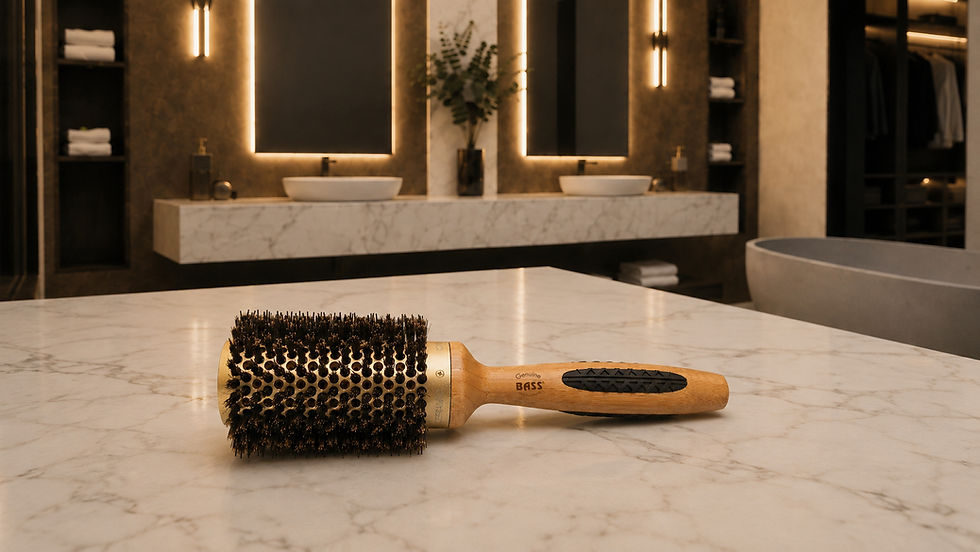
The better approach is to distribute the styling workload. Give the brush an amount of hair it can engage reliably. Remove excess moisture before detailed shaping. Choose a bristle or pin configuration that can work through the hair mass. Select barrel diameter for the shape you actually want. Establish the roots before the weight of the lengths pulls them down and avoid repeatedly reheating areas that are already finished.
Thick hair does not require a different set of round-brush mechanics. It requires those mechanics to be managed with greater attention to hair mass, access, drying efficiency, and cumulative work.
First, Distinguish Density, Strand Thickness, and Texture
“Thick hair” can describe several different characteristics, and they do not affect round-brush styling in exactly the same way.
High-density hair contains many fibers within a given area of the scalp. This increases the amount of hair the brush and dryer may need to control at once.
Larger-diameter strands increase the size of the individual fibers. Depending on their condition, texture, and structure, they may feel more substantial against the bristle field and may respond differently to tension and curvature.
Natural texture describes the existing directional pattern of the hair. Straight, wavy, curly, and tightly textured hair can all be thick, but the amount of directional change required during blow-drying will differ.
A person can have high-density hair with fine strands, relatively low-density hair with coarse strands, or both high density and large-diameter fibers.
That distinction matters because the correct response to thick hair is not simply “use more.”
More density does not automatically require more heat.
Larger strands do not automatically require more tension.
And neither condition automatically determines barrel diameter.
Instead, evaluate what the brush is being asked to manage in the specific area being styled.
Organize Thick Hair So the Work Is Distributed
A thick head of hair becomes easier to round-brush when it is treated as a series of controlled working areas rather than one large mass.
Separate unused hair clearly from the region being styled. This improves access to the roots, reduces the chance that neighboring strands will enter the brush, and keeps finished sections from becoming mixed back into unfinished hair.
The head does not need to be divided according to one rigid pattern. Density, length, haircut, texture, access, and styling objective may all change from one region to another.
The nape may contain shorter or more compact working lengths.
The crown may need greater elevation.
The face frame may require different direction.
The main lengths may contain more total hair mass and support broader shaping.
These differences justify changing how much hair is handled at one time, but they do not create fixed rules for every head.
The practical objective is to make each working area accessible enough that the brush and dryer can operate deliberately rather than constantly correcting hair that has escaped, crossed, or fallen back into the section.
Match the Brush's Engagement to the Hair Mass
With thick hair, brush engagement is especially important because not all bristle and pin configurations enter a dense hair mass in the same way.
A dense natural-bristle field creates many contact points and can provide strong grip and surface refinement. Depending on bristle length, tuft density, and the amount of hair being handled, much of that contact may occur closer to the outer layers of a very dense section.
Nylon pins or more open synthetic arrangements may penetrate more readily when their length, rigidity, and spacing suit the hair. Hybrid constructions that combine natural bristles with projecting nylon pins can provide deeper entry while maintaining broader surface contact.
The material name alone does not determine performance.
Useful engagement depends on the complete configuration:
bristle or pin length
rigidity
spacing
tuft density
surface contact
section mass
hair texture
desired tension
The correct brush should grip sufficiently to guide the hair without requiring the user to overpower the section.
If the hair repeatedly rides across the surface of the bristle field, slips before the intended shape is established, or tension becomes concentrated only in the outer fibers, improve engagement before increasing pulling force.
That may mean handling less hair at once, redistributing the hair across the barrel, changing the angle of entry, or using a configuration that reaches more effectively into the hair mass.
Do Not Use Barrel Diameter to Solve a Workload Problem
One of the most important distinctions in thick hair round brushing is the difference between barrel
diameter and working capacity.
Barrel diameter controls curvature.
A large diameter creates a broad radius, supporting straighter-looking lines, smoothing, broad movement, and softer bends.
A medium diameter creates more moderate curvature, making it useful for waves, movement, and balanced shaping.
A small diameter creates tighter turns and more concentrated curvature.
Thick hair does not change this geometry.
If a medium barrel creates the exact bend, you want but feels overloaded, moving to a larger diameter simply to accommodate more hair also changes the shape. The resulting curve becomes broader.
The better solution may be to reduce the amount of hair placed on the brush.
Barrel Length Is a Different Variable
Usable barrel length can affect how much section width the brush can accommodate without changing the diameter that creates the curve.
This distinction can be particularly useful with thick hair.
A longer working barrel may provide more lateral space for the hair while preserving the same approximate curvature. A larger diameter, by contrast, changes the radius of the shape itself.
So, when styling efficiency is the problem, ask two separate questions:
Is the barrel diameter correct for the desired shape?
Does the brush provide enough usable working length for the section width I want to control?
Keeping those decisions separate prevents thick hair from being pushed automatically toward broad, oversized barrels that may not create the desired result.
Remove Bulk Moisture Before Detailed Shaping
Thick hair can hold substantial moisture within the overall hair mass, and the outer layers often dry faster than protected interior areas.
Starting detailed round-brush work too early increases the amount of time each section must remain under tension and airflow.
The result is inefficient styling: exposed hair may receive repeated heat while less accessible hair is still losing its original moisture.
Pre-drying reduces that imbalance.
Remove substantial excess water before beginning the detailed shaping phase, but keep the hair organized as it dries. Blowing dense hair in many directions can create crossed fibers, expansion, and new tangles that the round brush later has to correct.
Check moisture with the hands rather than judging only from the visible surface.
The nape, roots, interior lengths, and dense areas near the back of the head can remain wetter than exposed hair around the perimeter.
The goal is to enter the round-brush stage when the dryer and brush can concentrate on shape formation and controlled finishing, rather than spending most of the styling pass removing bulk water.
Detangle Before Applying Blow-Dry Tension
Thick hair can conceal knots inside a section even when the surface appears organized.
Resolve significant tangles before the round brush becomes the primary styling tool.
A round brush is designed to shape hair while tension and airflow are being applied. If it encounters a hidden knot under working tension, resistance can become highly localized. Pulling harder does not improve the shaping process; it simply increases the force applied to the caught fibers.
After detangling, keep unused hair separated from the working area.
This is especially useful around the nape, sides, hairline, and shorter layers, where loose strands can enter a rotating brush from an unexpected direction.
The cleaner the entry path, the easier it is for the brush to guide thick hair without accumulating unnecessary resistance.
Use Distributed Tension Instead of Maximum Tension
Thick hair may require firm control, but firm control is not the same as maximum pulling force.
Useful tension should be distributed through the hair being shaped.
When the brush engages the section evenly, the fibers can travel along a common path and conform more consistently to the direction or curvature being created.
When engagement is incomplete, stronger pulling often concentrates force on only part of the hair.
The hand should therefore monitor the quality of resistance.
Smooth, mobile resistance generally indicates that the brush still has control.
Sudden tightening, localized pulling, increasing resistance during rotation, or a brush that begins to feel locked suggests that something has changed.
The section may be overloaded.
Hair may have crossed.
Neighboring strands may have entered the brush.
Too much wrap may have accumulated.
Or part of the hair may no longer be moving with the rest of the section.
When resistance changes abruptly, correct the cause rather than increasing force.
Hair condition also matters. Thick-looking hair can still be chemically treated, porous, weathered, or fragile. Strand size should never be used as a reason to ignore the actual resilience of the hair.
Make Airflow Do Its Share of the Work
Round brushing becomes unnecessarily difficult when the hand is trying to accomplish what coordinated airflow should be helping to accomplish.
The dryer should follow the part of the section being controlled by the brush. Focused airflow allows moisture removal and directional shaping to occur together.
On thick hair, this coordination is important because simply heating the visible surface does not guarantee that the rest of the hair has dried.
If one area repeatedly looks finished while hair beneath or behind it remains damp, increasing heat may only expose the already-dry fibers to more thermal load.
Instead, reassess access and working amount.
A vented round-brush construction can provide additional pathways for moving air through or around the barrel and may improve efficiency in some styling situations. Non-vented and differently constructed barrels may provide other handling characteristics.
Venting is therefore one variable within the system, not a universal requirement for thick hair.
The most efficient process is one in which brush engagement, airflow, moisture stage, and working amount are balanced well enough that repeated corrective passes are minimized.
Establish Root Direction Before the Lengths Become Heavy
Hair mass affects the root differently from the lengths.
If the desired style includes lift, body, or directional movement at the base, establish that root position before the weight of the remaining section begins pulling downward.
Place the brush so the root leaves the scalp in the intended direction. Elevate where lift is wanted or keep the base more controlled where a flatter result is preferred. Dry the root sufficiently in that geometry before moving fully into the lengths.
This is particularly useful with dense or long thick hair because the completed lengths can exert substantial downward weight.
A root that has been lifted effectively can still lose that lift if the warm section is immediately pulled sharply toward the floor.
The root and the lengths therefore do not always need identical treatment.
Set the base for its role in the finished silhouette, then allow the mid-lengths and ends to follow the shape intended for them.
Smooth Thick Hair Without Compressing All of Its Volume
Thick hair does not need to be made flat in order to look controlled.
Smoothing and compression are different outcomes.
Round brushing can organize the fibers, reduce irregular expansion, and create more consistent direction while still preserving lift, body, and movement.
Through the mid-lengths, distribute the hair across the usable barrel instead of allowing it to gather into one dense rope.
For a smoother, more elongated result, guide the section over a broad curve with controlled tension and limited rotation.
For greater body, maintain projection away from the head.
For waves or stronger movement, allow the hair to conform more clearly to the selected barrel diameter.
The aim is intentional volume.
Uncontrolled bulk develops when different parts of the hair dry in competing directions, retain uneven moisture, or settle without a coherent shape.
Controlled fullness occurs when the hair occupies substantial space but its direction, curvature, and relationship to neighboring sections have been deliberately established.
Thick Hair Accumulates Wrap Quickly
Rotation deserves particular attention when there is a large amount of hair in the working section.
Each turn around the barrel adds another layer of hair to the wrap.
On thick hair, that buildup can occur quickly.
More wrap may be useful when a pronounced bend or curl is intended, but additional rotation should always serve the desired geometry.
It should not be used merely to capture hair that is slipping or to compensate for weak engagement.
Too much wrap can increase resistance, reduce airflow access to inner layers, and make clean release more difficult.
For broad smoothing or gentle movement, partial barrel contact may be enough.
For stronger curvature, additional wrapping can be introduced deliberately as long as the hair remains organized, and the brush can still reverse or unwind cleanly.
The useful question is not, How many times should I rotate the brush?
It is, How much barrel contact does this shape require?
Avoid Reworking the Whole Section When Only One Area Is Unfinished
Thick hair often dries unevenly through its length.
The ends may finish before the roots.
The exposed surface may finish before the interior.
A face-framing piece may set correctly while the base still needs more direction.
Treat these differences locally.
If the root remains damp, work the root.
If the mid-length still needs moisture removed, focus on that area.
If the ends are already smooth and correctly curved, avoid repeatedly wrapping and heating them simply because another part of the section remains unfinished.
This local correction strategy reduces cumulative heat and manipulation while making the blowout more efficient.
It also gives greater control over the perimeter of thick hair, where repeated end work can create more bend, dryness, or visual weight than intended.
Let the Finished Shape Cool Before Adding It Back Into the Hair
Once a thick section has been dried into the intended geometry, give it time to cool before immediately stretching, compressing, or mixing it with surrounding hair.
This is especially useful when the style contains root lift, broad body, waves, bends, or more pronounced curls.
A lifted root can be weakened if the still-warm lengths are pulled downward.
A curved section can relax if it is stretched straight before cooling.
A finished bend may also appear softer while warm than it does after settling.
Allowing the section to stabilize before judging it can prevent unnecessary additional passes.
With thick hair, that matters because small inefficiencies multiply across a large number of sections.
Adapt the Technique to the Natural Pattern
Thickness and texture solve different styling problems.
A useful way to separate them is:
Hair mass affects how much work the brush and dryer must manage at once. Natural pattern affects how much directional change the hair must undergo.
Thick straight hair may require relatively little pattern correction but substantial organization because of density.
Thick wavy hair may need more consistent directional control to establish a smoother line or a deliberately reshaped wave.
Thick curly or tightly textured hair being elongated requires reliable engagement from the root through the lengths because the existing pattern must be redirected while the hair dries.
If the goal is to preserve or reform curvature rather than elongate it, diameter and wrap should support that intended shape instead.
The styling objective remains primary. Texture changes the path required to reach it.
Troubleshooting Thick-Hair Round Brushing
The Blowout Is Taking Too Long
Check whether too much bulk moisture remained when detailed styling began, whether the brush is handling more hair than it can engage efficiently, and whether the dryer is consistently following the active section.
Increasing heat is not the only way to increase efficiency.
The Brush Feels Buried in the Hair
The working amount may exceed the bristle or pin configuration's ability to engage and release cleanly. Reduce the hair load, redistribute it across the barrel, or evaluate whether a different bristle or pin structure would provide better access.
The Roots Go Flat Even Though They Look Lifted at First
The base may not have dried and cooled sufficiently in its elevated position, or the weight and subsequent direction of the lengths may be pulling the root downward.
The Surface Is Smooth but the Hair Expands Again Later
Protected areas may still contain moisture, or different parts of the hair may have dried in inconsistent directions. Check the hair mass rather than evaluating only the polished exterior.
The Ends Feel Overworked
Repeated full-length passes may be exposing finished ends to heat and tension while another area is causing the delay. Correct the unfinished area locally.
The Brush Creates Too Much Curl
Do not assume thick hair requires a different section strategy alone. The barrel may simply be too small, or the section may be receiving more wrap than the intended shape requires.
A Practical Round-Brush Method for Thick Hair
Begin by detangling the hair and removing substantial excess moisture. Keep the hair organized while pre-drying so the detailed styling phase begins with accessible, manageable working areas.
Separate the head into zones that make sense for the haircut, density, and desired result. Keep unused hair out of the active brush path.
Choose the barrel diameter according to the shape you want to create. If efficiency across a wider section is important, consider usable barrel length separately from diameter so working capacity does not accidentally change the intended curvature.
Take an amount of hair the brush can engage confidently. Distribute it across the working barrel rather than concentrating the full mass in one narrow bundle.
Set the root direction first when lift or directional control is required.
Bring the dryer into alignment with the area controlled by the brush and let airflow remove moisture while tension guides the hair.
Move through the mid-lengths according to the desired silhouette, preserving body where wanted rather than automatically pulling the entire section flat.
Use rotation only when additional barrel contact contributes to the intended bend, wave, curl, or end shape.
As the section approaches completion, check where moisture or shape correction is still needed.
Rework that area instead of automatically repeating the entire pass.
Finish the ends deliberately and allow the completed section to cool before blending it fully with surrounding hair.
Then move on.
The method is progressive: organize, engage, shape, diagnose, finish, and set.
Thick Hair Responds Best When the Work Is Managed, Not Forced
Using a round brush on thick hair is not primarily an exercise in applying greater force.
It is an exercise in managing a greater styling workload intelligently.
Density affects how much hair the brush and dryer must control. Strand characteristics affect how the hair interacts with the bristle field and curvature. Natural texture affects the amount of directional change required. Hair length and weight influence root lift and the behavior of the finished section.
The brush must respond to those variables without abandoning the basic geometry of round-brush styling.
Choose diameter for shape.
Consider usable barrel length separately when working capacity matters.
Use a bristle or pin configuration that can engage the hair effectively.
Remove bulk moisture before detailed shaping.
Build distributed tension instead of maximum tension.
Let airflow perform its share of the work.
Protect finished areas from unnecessary reworking.
And allow the shape to cool before deciding whether it needs correction.
Once the workload is distributed across these decisions, thick hair becomes easier to control without sacrificing the volume, movement, or curvature that make round-brush styling useful in the first place.
Frequently Asked Questions
Does thick hair need a bigger round brush?
Not automatically. Barrel diameter determines the scale of curvature. Choose a larger diameter when you want broader curves or straighter-looking movement, not simply because there is more hair.
Is a longer barrel useful for thick hair?
It can be. Greater usable barrel length can provide more working space across the width of a section without necessarily changing the diameter that creates the shape. Barrel length and barrel diameter solve different problems.
What type of bristles or pins work well on thick hair?
The best configuration is the one that provides enough penetration, grip, and release for the hair being styled. Pin or bristle length, spacing, rigidity, density, and overall construction matter more than relying on one material label alone.
Why does round brushing thick hair take so long?
Common reasons include beginning detailed styling with too much moisture, handling more hair than the brush can control efficiently, incomplete airflow access, or repeatedly reworking areas that are already finished.
Should I use more tension on thick hair?
Use enough tension to control the section, but do not equate thickness with a need for maximum force. Effective tension should remain distributed, smooth, and responsive. Sudden or localized resistance is a signal to correct the section rather than pull harder.
Can thick hair be smoothed without losing its volume?
Yes. Round brushing can organize the hair and reduce irregular expansion while preserving root lift, projection, broad curvature, and movement. Smoothing does not require flattening.
Why do my thick roots go flat after the blowout?
The root may not have dried or cooled completely in its elevated position, or the weight of the lengths may be pulling it down while the section is still warm. Establish and stabilize the root before letting the full weight of the hair settle.









