

How to Use a Hybrid Boar Bristle Brush for Oil Distribution
- Editorial & Publishing Team

- May 20
- 15 min read
Updated: Jun 15


This article expands on concepts from the broader textbook – “Boar Bristle Brushes: The Definitive Guide to Naturally Shiny, Conditioned Hair – A Comprehensive Hair Care Textbook by Bass Brushes.”
Key Takeaways
· A hybrid boar bristle brush improves oil distribution by helping the brush enter thicker, denser, longer, or more resistant hair fields.
· The longer pins create access into the section, while the boar bristles gather natural scalp oil and carry it through the lengths.
· A hybrid brush is still not a detangler, so hair should be dry or nearly dry and already released from knots.
· Sectioning remains important because better penetration does not replace the need for honest root access and complete root-to-end passes.
· The best results come from light pressure, manageable sections, and judging success by deeper balance rather than surface smoothness alone.
A hybrid boar bristle brush exists because some hair needs help entering the field before conditioning work can happen honestly. In the Bass system, that does not change the category of the brush. It still belongs to Shine & Condition. Its purpose is still to help redistribute the scalp’s natural oils through the lengths and refine the outer field of the hair into a calmer, more coherent condition. What changes is the architecture. The longer reinforcing pins help the brush move into hair that is too thick, too dense, too long, or too internally resistant for a pure boar field to reach easily on its own. The boar bristles remain the conditioning-distribution and surface-refining element. The longer pins are there to help the work reach farther, not to turn the brush into a detangler.
That distinction is one of the most important to preserve. People often see a hybrid brush and assume it is simply a more powerful brush, or a brush that can do everything at once. That is usually where the routine begins to go wrong. A hybrid boar bristle brush is not a detangling shortcut. It is not a rescue brush for wet, knotted, or compacted hair. It is a Shine & Condition brush made more accessible for hair that resists shallow contact. Used correctly, it can help move natural oil away from roots that are becoming concentrated and into lengths that remain under-supported. Used incorrectly, it can become just another brush being pushed through resistance while the user mistakes penetration for proper sequence.
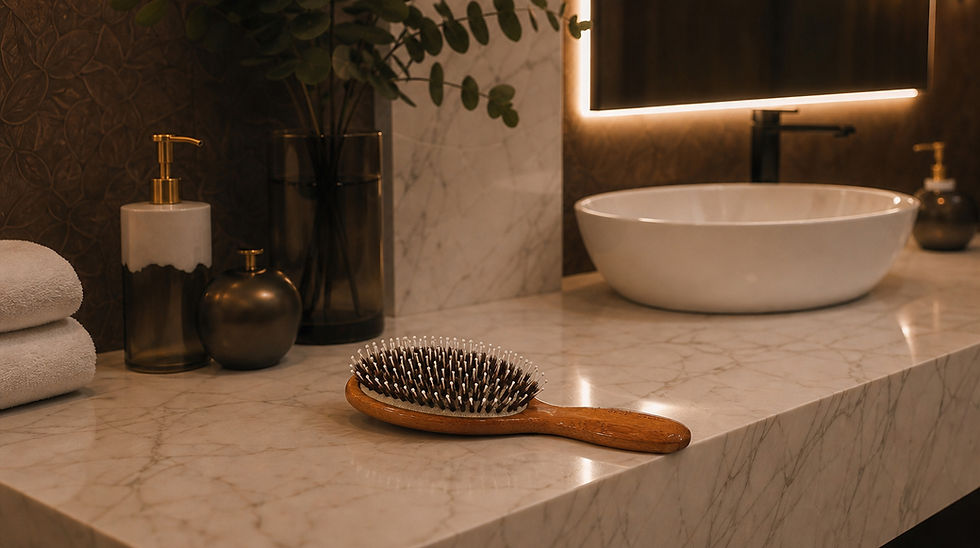
To use a hybrid boar bristle brush for oil distribution, the user has to understand that the brush is trying to complete a pathway. That pathway begins at the scalp, where sebum is produced, and continues through the lengths toward the ends, where the hair is usually older, drier, and more weathered. If that path is never honestly completed, the routine may still produce surface neatness, but it will not produce true oil redistribution. A hybrid brush is valuable because it helps make that path more possible in hair that otherwise tends to keep the work too close to the outside.
What a Hybrid Boar Bristle Brush Actually Is
A hybrid boar bristle brush combines two kinds of brushing contact in one head. The boar bristles remain responsible for the classical work of this category: close surface contact, natural-oil pickup, gradual oil transfer, and surface refinement. The longer pins, usually nylon or another firmer material, extend farther into the hair field and help the brush enter more of the section with less surface skimming. In practical terms, the pins create access, and the boar bristles use that access to perform conditioning work.
What matters is how these two elements cooperate during the pass. The longer pins help open a pathway through the outer density. They separate enough of the hair field that the boar bristles can touch more of the actual section rather than only the canopy. Once that path exists, the boar bristles can do their real work: gather some oil at the root area, carry it outward, and help settle the surface into a calmer pattern. The pins do not replace the boar bristles. They make the boar bristles more usable on hair that would otherwise keep them too shallow.
This is why a hybrid brush is so often useful in hair that is thick, dense, long, layered, or internally resistant. It expands the reach of Shine & Condition brushing without abandoning the purpose of the category.
Why a Hybrid Brush Helps Oil Distribution
Oil distribution becomes difficult whenever the hair field is large enough or resistant enough that the scalp’s natural oils remain concentrated near the root area. This is one of the most common conditions in longer, thicker, denser, or more layered hair. The scalp is producing enough oil to support the hair, but the oil is not traveling efficiently into the lower lengths. The roots begin to look oily while the mid-lengths and ends still feel dry. That imbalance is exactly what Shine & Condition brushing is meant to address.
A hybrid brush helps because the longer pins can enter the hair field more effectively and create a more honest pathway for the full pass. Once that pathway is open, the boar bristles can make better contact with more of the section, gather some oil at the scalp, and help carry it outward.
This is why a hybrid brush is often especially helpful in hair that has enough density or internal layering to make pure surface polishing misleading. It makes root access more possible and deep-field participation more likely.
This is also why a hybrid brush can be so effective for oily roots and dry lower lengths. It is not solving the problem by removing oil. It is helping move oil away from the place where it is concentrated and into the places where it is needed.
Why the Hybrid Brush Is Still Not a Detangler
One of the biggest misunderstandings around hybrid brushes is the belief that the longer pins turn the brush into a detangler. They do not. They help the brush enter the hair field more effectively, but entering the hair field is not the same as safely releasing knots. If the hair is still tangled, the hybrid brush will still meet resistance, and the pass will still become trapped tension. In some cases the user may feel the brush getting farther into the hair and think that means it is resolving the problem.
Very often it only means the brush is reaching the resistance more efficiently.
This is where the sequence matters. If the hair is still knotted, compacted, or catching through the lengths, the correct response is not to keep using the hybrid brush until it eventually gives way. The correct response is to stop, reduce the resistance, and use the correct detangling stage first. That may mean fingers, a wide-tooth comb, or a detangling brush designed to release knots with less concentrated strain. Once the hair is reasonably ordered, the hybrid boar bristle brush can enter the routine as a conditioning-distribution tool.
This is one of the deepest Bass principles. A hybrid brush is an access adaptation within Shine &
Condition, not a category shift into detangling.
Why the Hair Must Be Dry or Nearly Dry
A hybrid boar bristle brush generally works best on dry or nearly dry hair. This is not just habit. Oil distribution works best when the scalp’s natural oils can move along the hair in a more stable, predictable way, and that usually happens on dry hair. Wet hair creates a very different condition.
The strands are more stretch-prone, the hair field is less stable, and hidden resistance is harder to judge accurately. In that state, a hybrid brush may feel active because the longer pins can enter the wet mass, but that does not mean the brush is doing useful Shine & Condition work.
Dry or nearly dry hair makes the routine more honest. The user can tell whether the roots are truly being reached, whether the deeper field is being included, and whether the lower lengths are beginning to receive meaningful conditioning. The pass either works or it does not. That clarity matters. A hybrid brush can improve access, but it cannot change the state in which true oil redistribution works best.
This is why the brush belongs after detangling and after the hair is ready for conditioning and polishing work rather than rescue work.
Why Sectioning Still Matters
A hybrid brush can improve reach, but it does not eliminate the need for sectioning. This is one of the most important corrections to make early. People often assume that because the longer pins allow the brush to enter the hair field more easily, the whole head can now be brushed casually at once. Usually that only recreates the old problem in a new form. The outer shell becomes smoother, the brush feels busy, but the deeper field still does not receive honest full-path conditioning work.
Sectioning remains essential because oil distribution still depends on real scalp access, full root-to-end passes, and manageable resistance. The hybrid architecture helps the brush work better within a section. It does not remove the need for sections. Dense, long, or layered hair still benefits from being divided into honest working zones so the brush can begin at the root area, move through the true body of the section, and finish at the ends without needing force.
The best way to think about it is simple. Sectioning gives the brush a real field. The hybrid design helps the brush work more honestly in that field.
How to Think About Section Size
The correct section size is still determined by whether the pass remains honest from roots to ends. If the section is too large, the brush will usually tell the truth quickly. It may glide mainly over the surface. It may reach the scalp only at the outer edge. It may start well but lose continuity through the middle. It may technically touch the ends without really carrying conditioning through the whole section. Or it may begin to demand pressure.
A hybrid brush may allow somewhat fuller sections than a pure boar field would, but that does not mean large sections are automatically correct. The underlying rule does not change. The section should be small enough that the brush can begin meaningfully at the scalp, move through the actual interior of the section, and finish at the ends without strain. If the hand feels the need to push, or if the deeper field still feels dry after the session, the section is likely still too large.
Hair that is especially dense or very long often needs smaller sections than users expect, even with a hybrid brush. That is not inefficiency. It is honesty.
Why Root Access Is Central to Oil Distribution
Because the scalp is the source of the oil being redistributed, the work must begin there. A hybrid brush may make the surface behave better more quickly, and that can sometimes trick users into believing the full job is being done. But surface control is not the same thing as root access. If the brush is not meaningfully beginning at the root area across the real working section, it may smooth the lengths without truly redistributing much conditioning.
This matters especially in hair that tends to show oily roots and dry deeper lengths. The entire point of the routine is to begin where the oil exists and move some of it outward. A brush that only polishes the visible outer layer is not completing that task, no matter how smooth the top looks afterward.
This is why root access is more important than surface behavior when judging whether a hybrid oil-distribution routine is actually working.
Why the Root-to-End Pass Must Stay Complete
A hybrid brush can make the pass easier, but it does not change the need for a full pathway. Oil distribution still depends on the brush beginning at the scalp and continuing through the lengths to the ends in one honest movement. This matters because the ends are usually the driest, oldest, and most under-supported part of the hair. If they are never reached cleanly as part of the real pass, the roots remain the site of concentration and the lower lengths remain under-conditioned.
This is one reason hybrid brushes work best when the user remains disciplined about full passes.
The longer pins can help open the field and reduce canopy-only brushing, but they do not make partial success equivalent to real success. The pass still has to be completed.
In practice, this means the user should think less about how active the brush feels and more about whether the whole pathway is actually being honored.
Why Pressure Must Stay Light
The presence of longer pins often tempts people to use more pressure than they should. They feel the brush entering the hair more effectively and assume that pushing harder will produce even better results. Usually the opposite happens. The brush begins to compress too hard, the scalp contact becomes harsher, the section resists more, and the pass stops feeling like controlled transfer and starts feeling like strain.
A hybrid brush is valuable because it reduces the need for force. The longer pins are there to improve access, not to justify pressure. If the brush seems to require force, the usual problem is still one of section size, incomplete preparation, or attempting Shine & Condition work before the hair is ready for it.
A good hybrid pass should feel engaged and purposeful, not punishing. That is how the user knows the brush is helping the hair rather than fighting it.
How Oil Transfer Improves Once Access Improves
One of the most important things to understand about a hybrid brush is that better access does not merely improve control. It improves the conditions under which oil transfer can actually happen. If the brush is only skimming the canopy, the boar bristles are picking up and redistributing oil over too shallow a layer. The roots may still appear oily because the deeper field is not participating enough in the pathway. Once access improves, more of the section can receive contact that begins at the scalp and continues outward. That makes the movement of oil more meaningful, not just more visible.
This is why hybrid brushing often feels more successful over time in substantial hair fields. The brush is not adding more oil. It is finally able to move existing oil through more of the hair that needs it.
How to Tell If the Hybrid Brush Is Reaching the Deeper Hair Field
One of the most important questions in hybrid brushing is whether the deeper field is actually being included. There are some clear signs that it is. The scalp becomes easier to access across the full section rather than only at the outer edge. The pass feels cleaner through the body of the hair, not just smoother on top. The lower and interior lengths begin to feel less dry and less neglected. The hair field starts to feel more even overall rather than polished only on the outside.
If the deeper field is still being missed, the pattern usually remains familiar. The canopy improves, but the inner lengths still feel rough, dry, or prone to catching. The roots may hold visible oil while the deeper field continues to behave as though it is under-conditioned. This usually means the sections are too large, the passes are too surface-oriented, or the hair was not prepared well enough before the hybrid brush entered the routine.
How to Tell If the Longer Pins Are Helping or Dragging
The longer pins are helping when they improve entry without increasing strain. The brush enters the section more cleanly. The scalp becomes more accessible without the user needing more force.
The pass remains smoother through the body of the section. The brush feels as though it is opening a pathway rather than creating turbulence.
The pins are dragging when the opposite happens. The brush catches sharply instead of entering gradually. The hand feels the need to push. The section feels more stirred up than supported. The pass may reach farther physically while becoming less honest functionally. This is the point at which the user has to stop and reassess. The section may still be too large. The hair may not be detangled enough. Or the hair may simply not be ready for this stage yet.
This distinction is one of the most valuable things to learn with a hybrid brush. Penetration is useful only when it supports conditioning work. Penetration that creates strain is not progress.
Hybrid Brush Versus Porcupine Logic
A hybrid brush and a porcupine-style brush are closely related in purpose, but they are not always identical in feel or in the level of assisted penetration they offer. A hybrid brush is often enough when the hair needs better access than pure boar can easily provide, but does not need the stronger entry feel that some porcupine layouts are designed to offer. This makes hybrid logic especially useful for medium-thick, thick, layered, or moderately dense hair that still needs more honest root access and full-field participation for oil distribution.
When the hair field becomes especially dense, especially long, or especially resistant beneath the canopy, some users may find that porcupine architecture gives a more pronounced access advantage. But the category logic remains the same. Neither brush is a detangler. Neither removes the need for sectioning, dry-hair use, or complete root-to-end passes. The difference is in how much entry assistance the architecture provides before the boar field takes over.
Why Hybrid Brushes Can Be Excellent for Oily Roots and Dry Lengths
One of the most useful roles of a hybrid boar bristle brush is helping with the common contradiction of oily roots and dry lower lengths. This is exactly the situation in which the hybrid architecture can make a significant difference. The roots hold visible oil, but the hair field is substantial enough that the oil is not traveling where it needs to go. A hybrid brush can help the brush reach the scalp more honestly, gather some of that oil, and move it farther into the hair.
This is not instant correction. It is cumulative support. The roots usually become less sharply isolated from the rest of the hair, while the deeper and lower lengths gradually receive more natural conditioning. That is one reason the results can feel slow at first but increasingly satisfying over time.
How Often to Use a Hybrid Boar Bristle Brush for Oil Distribution
Hair that benefits from a hybrid brush often does well with relatively regular Shine & Condition work because the very reason the hybrid brush exists is that the hair field is substantial enough to resist easy natural-oil movement. For many people, once-daily use is an excellent rhythm when the passes are honest and the sections are real. Some especially long, dry, or very dense hair may benefit from a brief morning and evening rhythm, but only if the routine remains useful and does not collapse into repetitive surface brushing.
The critical issue is not frequency by itself. It is whether the routine is real enough to justify the frequency. If the underlayers are still being missed, brushing more often will not solve the problem.
Oil distribution improves through consistent honest work, not through repetition of partial work.
Conclusion
To use a hybrid boar bristle brush for oil distribution, the first thing to understand is that the brush is an adaptation within Shine & Condition, not a detangling loophole and not a different category of brush. It is still meant to redistribute natural scalp oils, calm the surface, and support the hair over time. What changes is that the longer pins help the brush enter a thicker, denser, or more resistant hair field more honestly so the boar bristles can do their work farther into the section.
That is why hybrid oil-distribution brushing still depends on sequence and structure. The hair should be detangled first, dry or nearly dry, and divided into sections that allow real root access and complete root-to-end passes. The pressure should stay light. The success of the routine should be judged not by whether the canopy looks smoother, but by whether the deeper field of the hair begins to feel more balanced and supported over time.
In the Bass system, that is what makes a hybrid boar bristle brush so valuable. It is not a force tool.
It is a more accessible way of bringing conditioning, continuity, and surface refinement into hair that otherwise resists honest Shine & Condition work.
FAQ
What is a hybrid boar bristle brush?
It is a brush that combines boar bristles with longer reinforcing pins, usually nylon, so the brush can
enter the hair field more effectively while still performing Shine & Condition work.
Is a hybrid boar bristle brush good for oil distribution?
Yes. That is one of its most useful roles. It helps the brush reach the scalp more honestly and move natural oil farther through the lengths.
Is a hybrid boar bristle brush better than pure boar for thicker hair?
Often yes, especially when thicker or denser hair needs more access for the conditioning work to reach beyond the canopy. But the right choice still depends on the hair field and how honestly the brush can complete full passes.
Is a hybrid boar bristle brush a detangler?
No. It may penetrate more effectively than pure boar, but it is still not a primary detangling tool.
Hair should be detangled first before the hybrid brush is used for oil distribution.
Should you use a hybrid boar bristle brush on wet or dry hair?
Usually on dry or nearly dry hair. Oil distribution and Shine & Condition work are generally more honest and more effective in that hair state.
Do you still need to section the hair with a hybrid brush?
Usually yes. The hybrid design improves access, but it does not remove the need for honest working sections.
Should a hybrid brush still go from roots to ends?
Yes. The hybrid design does not change the need for full root-to-end passes. That complete pathway is still central to the oil-distribution work.
How do you know if a hybrid brush is reaching the deeper hair field?
The deeper lengths begin to feel less dry and less neglected, the scalp becomes easier to access across the working sections, and the hair feels more balanced through the interior, not only smoother on top.
How can you tell if the hybrid pins are helping or dragging?
If they are helping, the brush enters the section more cleanly without needing force. If they are dragging, the brush catches sharply, the hand feels the need to push, and the pass stops feeling like honest conditioning work.
How is a hybrid brush different from a porcupine brush for oil distribution?
Both are Shine & Condition adaptations that use longer elements to improve access. Hybrid logic is often enough for hair that needs more reach than pure boar provides but does not need the stronger assisted entry some porcupine layouts can offer.
How often should you use a hybrid boar bristle brush for oil distribution?
Many routines do well with once-daily use. Some especially long, dry, or dense hair may benefit from a brief morning and evening rhythm if the brushing remains useful and not repetitive.
Can a hybrid brush help oily roots and dry lower lengths?
Yes. That is one of its most useful roles. It helps move some of the oil away from the scalp and farther into the lengths so the hair becomes more balanced over time.









