

How to Use a Boar Bristle Brush to Reduce Frizz
- Editorial & Publishing Team

- May 21
- 15 min read
Updated: Jun 15


This article expands on concepts from the broader textbook – “Boar Bristle Brushes: The Definitive Guide to Naturally Shiny, Conditioned Hair – A Comprehensive Hair Care Textbook by Bass Brushes.”
Key Takeaways
· Boar bristle brushing can reduce frizz by supporting better oil distribution, calmer cuticle behavior, and a more coherent outer hair surface.
· Frizz reduction should not mean flattening, because the goal is smoother, better-supported hair that still keeps natural body and movement.
· Hair must be detangled first and dry or nearly dry so the brush can refine the surface without dragging through resistance.
· Root-to-end passes, sectioning when needed, and light pressure help address deeper-field roughness instead of only smoothing the visible canopy.
· Results are usually cumulative, with the best frizz reduction coming from repeated useful brushing and stopping before heaviness or overhandling.
How to Use a Boar Bristle Brush to Reduce Frizz
Frizz is often treated as though it were one simple problem with one simple cause, but in practice it is usually the visible result of several conditions happening at once. The surface of the hair may be too dry. The cuticle field may be rough or uneven. The outer fibers may be lifting in slightly different directions instead of behaving like a calmer, more unified surface. The roots and lengths may be living in different conditions, with natural oil concentrated near the scalp while the lower lengths remain dry and under-supported. And once that imbalance exists, outside conditions such as humidity can exaggerate it even further. When these things combine, the hair begins to look fuzzy, swollen, dull, or visually unsettled. Many people respond by trying to press frizz down from the outside, but in the Bass system that is not the deepest solution. A boar bristle brush belongs to the
Shine & Condition category, which means its real value is not force-based control. Its value is that it can help redistribute the scalp’s natural oils through the lengths while refining the outer field of the hair into a calmer, more coherent condition.
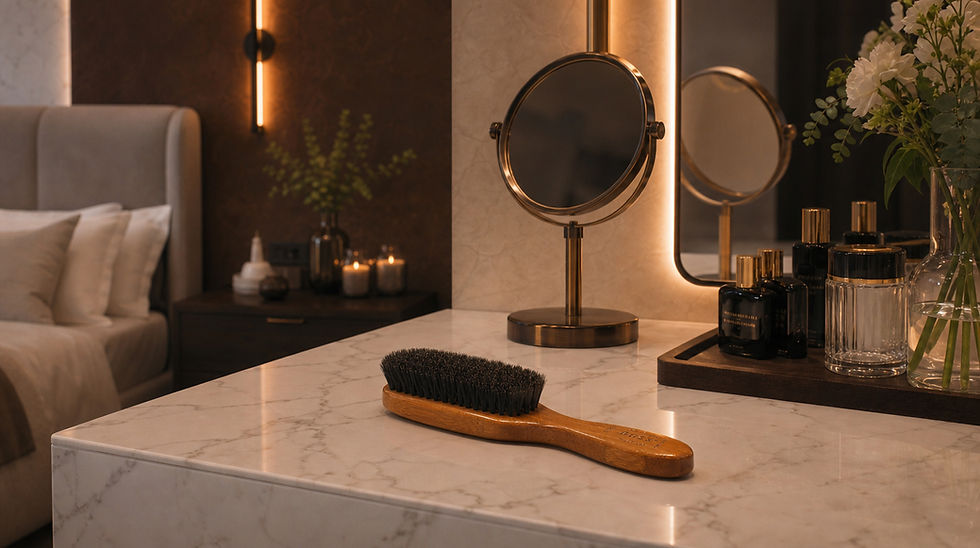
That distinction matters because frizz is not always solved by more product or more pressure. Very often, frizz is the visible expression of dryness, roughness, interrupted oil distribution, and incomplete surface coherence. A boar bristle brush can help address all of those at once, but only if it is used at the correct stage of the routine. It is not a detangler for resistant hair. It is not a rescue tool for wet, unstable hair. It is not a brush that should be driven through the hair in hopes of flattening disorder into silence. It is a refining tool. Once the hair is detangled, dry or nearly dry, and ready for Shine & Condition work, the boar bristle brush can help reduce frizz by creating better conditions in the hair itself rather than merely forcing the outside to behave.
To use a boar bristle brush well for frizz reduction, the user has to understand that the goal is not to erase every sign of texture or movement. The goal is to reduce roughness, scattered lift, and dryness-related disorder so the hair looks calmer, smoother, and more supported. Frizz reduction is therefore not the same as flattening. A good result still leaves the hair alive. It simply removes some of the visual noise created by an under-conditioned, under-refined outer field.
What Frizz Actually Is
Frizz is not just “hair sticking up.” It is usually the visible sign that the outer field of the hair is behaving in a scattered, inconsistent way. Some fibers are lifting away from the main body of the hair. Some are turning in slightly different directions. Some sections are rougher and drier than others. The cuticle field is not acting like a calm, coherent surface, so light reflects unevenly and the hair appears less smooth and less controlled.
This is why frizz is closely tied to dryness, rough friction, and surface disorder. When the hair lacks enough lubrication through the lengths, the fibers rub more harshly against one another. When the cuticle is not lying in a calmer pattern, the surface loses coherence. When the deeper field beneath the visible top remains rough or under-supported, the outside may keep losing order even if the top layer is repeatedly smoothed. Frizz is therefore not only about climate or texture type. It is often about the mechanical condition of the hair field itself.
A boar bristle brush can help because it works at this level. It is not simply pressing flyaways down from above. It is helping improve the conditions that allow the outer field to behave more uniformly in the first place.
Why a Boar Bristle Brush Can Help Reduce Frizz
A boar bristle brush is especially useful for frizz reduction because it does two important things at the same time. First, it helps move natural scalp oils outward through the hair. Second, it helps gather the outer field into a more orderly directional pattern through repeated, controlled contact.
These two effects support each other. Better lubrication helps reduce rough friction. Better alignment helps the hair behave as a more continuous surface.
This matters because frizz is often worst when those two supports are missing at the same time. The hair is dry enough to feel rough and disordered enough to scatter. A boar bristle brush can gradually improve both conditions. The result is not necessarily instant silence in every hair type, and it is not the same as strong product hold, but it is often a more natural and more durable reduction in roughness and scattered lift.
This is one reason boar bristle smoothing tends to look different from force-based smoothing. The finish often appears softer, calmer, and more integrated rather than overly slick or compressed. The hair is not simply being suppressed. It is being supported.
Why Frizz Reduction Is Not the Same as Flattening
One of the biggest mistakes in anti-frizz routines is treating every sign of lift or movement as though it should be crushed down. In reality, hair can be smooth and still have life. It can be polished and still have body. It can be calmer and still retain its character. Flattening becomes a problem when the user confuses reduction of roughness with elimination of shape.
This is especially important with a boar bristle brush because the tool is capable of creating a very refined surface when used well. If the user keeps brushing long after the useful work is done, the result may stop looking naturally calm and start looking overhandled. Fine hair may collapse. Roots may look too sleek. Thicker hair may appear controlled at the top while still lacking real support underneath. That is not the deepest version of frizz reduction. It is only compression.
A good frizz-reduction routine therefore aims for coherence rather than suppression. The surface should look calmer and less scattered, not lifeless.
Why the Hair Must Be Detangled First
A boar bristle brush cannot reduce frizz honestly if the hair is still tangled. This is one of the most important principles in the entire Shine & Condition system. If the hair contains knots, caught ends, or compacted underlayers, the pass becomes resistance work instead of refining work. The brush catches, drags, or skips. That kind of contact usually increases roughness rather than reducing it.
The user may think they are brushing away frizz, but they may actually be creating more of the same mechanical disorder that made the hair look frizzy in the first place.
That is why any needed detangling must happen first. Fingers, a comb, or a detangling brush suited to that labor should create enough order that the boar bristle brush can move through the hair honestly. Once that order exists, the brush can begin reducing frizz through oil distribution and surface refinement. Without that sequence, the brush is being asked to do the wrong job, and the result is often more drag, more disruption, and more visible disorder.
Detangling creates order. Shine & Condition brushing refines that order. Frizz reduction depends on respecting that sequence.
Why Dry or Nearly Dry Hair Is Usually Best
A boar bristle brush generally works best on dry or nearly dry hair, and that is especially important when the goal is frizz reduction. Wet hair is more stretch-prone, less stable, and more likely to conceal hidden resistance. In that state, a boar bristle brush cannot perform its true task very honestly. The pass may feel active, but the surface is not yet in the right condition for real refining work. What looks like anti-frizz brushing on wet hair often turns into unnecessary handling.
Dry or nearly dry hair is easier to read. The user can see where the roots are holding visible oil, where the lengths are rough, and whether the outer field is truly calming rather than simply being pressed downward. Natural oil also transfers more meaningfully along a dry shaft, which is central to how the brush reduces dryness-related frizz.
This does not mean the hair must be fully styled before boar bristle brushing begins. It means the hair must be stable enough for maintenance and refinement rather than rescue.
Why Frizz Often Means the Surface Is Dryer Than It Looks
One of the most important ideas in understanding frizz is that the hair is often drier than it appears.
A person may look at the roots and think the hair cannot possibly need more conditioning because there is already visible oil near the scalp. But the lower lengths may still be under-supported. In that state, the outer field remains rough enough to scatter and lift, even while the root area appears heavier.
This is why frizz and oiliness are not opposites. They can easily exist on the same head at the same time. The roots are concentrated with oil. The lengths are still dry enough to behave roughly.
A boar bristle brush is useful here because it does not simply remove oil from the roots or paste product over the lengths. It helps bring some of the existing conditioning farther down the shaft.
This is one of the most important reasons the brush can reduce frizz without making the hair depend entirely on external correction. It helps the hair use its own conditioning system more evenly.
Why Surface Coherence Matters More Than Surface Pressure
Frizz reduction is often attempted through pressure. People see scattered fibers and assume that stronger contact will press them into place. But pressure alone does not create coherence. It can create temporary submission, but if the surface remains dry, rough, or internally unsupported, the disorder often returns quickly.
Surface coherence is something different. It means the outer field is behaving as a more unified structure. The fibers are aligning more evenly. The cuticle is calmer. The surface is not fighting itself.
A boar bristle brush is good at encouraging this because it works through distributed contact and oil movement rather than through force alone.
This is one reason a boar bristle anti-frizz finish often looks more natural than a highly compressed finish. The hair behaves better because the conditions have improved, not just because the outside has been pressed.
Why Deeper-Field Roughness Keeps Pushing Frizz Back to the Surface
One of the reasons frizz can seem stubborn is that the visible top layer is not the whole story. Hair can look calmer on the outside for a short time while rougher, drier, or more internally disordered sections underneath continue influencing how the whole field behaves. As the hair moves, rubs against itself, or responds to the air around it, that unresolved deeper-field roughness can keep disturbing the surface again.
This is why frizz reduction that only addresses the canopy often feels temporary. The top layer may look smoother immediately after brushing, but the deeper field has not been supported enough to help maintain that calm. A boar bristle brush works best when it is helping more of the actual hair field receive oil distribution and directional refinement rather than only pressing down the visible outside.
Why Sectioning Often Helps Reduce Frizz More Honestly
Sectioning is often associated with styling or dense hair routines, but it can also be extremely useful in frizz reduction. When the hair is long, thick, dense, or layered enough that the brush otherwise works mostly on the canopy, frizz reduction becomes misleading. The top may look calmer while the underlayers remain rough and disorderly. Because those underlayers still influence how the hair moves and rubs against itself, the visible polish may not hold well.
Sectioning helps by allowing the brush to work through more of the actual field rather than only the outside. It improves root access, supports fuller oil distribution, and allows the pass to reach lengths and ends more honestly. This often makes the anti-frizz result more durable because the calmer surface is being supported by calmer deeper layers instead of sitting on top of unresolved roughness.
For hair that looks smooth at first but becomes frizzy again quickly, sectioning often reveals that the original routine was too surface-only.
Why Root Access Still Matters in Anti-Frizz Brushing
A boar bristle brush reduces frizz partly by redistributing natural oil, which means the work still begins at the scalp. This is easy to forget, because frizz is often most visible through the lengths and around the outer surface. But if the brush does not begin meaningfully at the root area, it is not fully engaging the conditioning source that helps support the anti-frizz effect.
This is especially important in routines where the roots are visibly oily but the lengths remain rough.
The user may feel tempted to avoid the root area and brush only the lengths, but that usually leaves the imbalance intact. The root is still the source. The brush has to begin there if it is going to move some of that support outward.
True frizz reduction with a boar bristle brush therefore depends on root access, not just length smoothing.
Why the Root-to-End Pass Must Be Complete
Frizz reduction is strongest when the pass is complete. A partial stroke may make the upper half of the hair look calmer, but it does very little for the lower lengths if they remain dry and rough. The ends are often the oldest and most weathered part of the hair, which means they are frequently some of the most frizz-prone as well. If the pass does not reach them honestly, the hair stays divided into a smoother upper field and a rougher lower one.
This is why the pass should begin at the scalp, continue through the lengths, and reach the ends as one real pathway. Frizz is not reduced most effectively by touching the outside of the hair with a brush. It is reduced when the conditioning and refining route is actually completed.
Why Pressure Must Stay Light
A boar bristle brush should feel present and useful, not punishing. Too much pressure usually works against frizz reduction rather than improving it. The roots can become flattened, the surface can look overworked, and the brushing can create more disturbance than calm. This is especially easy to do when the user mistakes scattered surface texture for a sign that the hair simply needs more force.
In reality, frizz is often better reduced through better sequencing, fuller passes, and lighter repeated support than through strong contact. If the brush seems to need force, the problem is usually that the hair is not yet ready, the section is too large, or the routine is trying to create refinement before the hair is stable enough to receive it.
A good anti-frizz pass feels controlled, not aggressive.
Why Humidity Makes Existing Roughness More Visible
Humidity often gets blamed for frizz as though it creates the entire problem by itself. In reality, humidity tends to reveal and amplify conditions that are already present. Hair that is already rough, under-lubricated, or uneven in its outer-field behavior often reacts more dramatically because the surface is less stable to begin with. When the hair is calmer, more evenly conditioned, and more coherent, it usually tolerates humidity better even if it is not completely immune to it.
This is one reason a boar bristle brush can help with so-called humidity frizz. The brush is not controlling the weather. It is improving the condition of the hair so the surface has less roughness for humidity to exaggerate. That makes the anti-frizz effect more truthful and often more durable than simply trying to flatten the hair harder on humid days.
Why Overbrushing Can Create More Frizz-Like Disorder
A boar bristle brush can be overused in the name of anti-frizz care. When that happens, the result often becomes self-defeating. The surface starts to look too handled. The roots become heavier.
Fine hair loses its air. And in some cases the user keeps repeating surface contact over the canopy while the deeper field remains unresolved. This can create a hair appearance that is simultaneously too sleek in one area and still rough in another.
Overbrushing also increases contact beyond usefulness. Once the hair has received the oil redistribution and surface refinement it can productively use, continued brushing stops improving coherence and starts becoming repetition. Good anti-frizz work therefore depends not only on technique, but on stopping at the right moment.
Why Oily Roots and Dry Ends Often Produce Frizz
One of the most common forms of frizz comes from imbalance, not from lack of care. The roots hold visible oil, the lower lengths remain dry, and the outer field behaves inconsistently because it is not equally supported along the shaft. Many people answer this with more product on the outside, but unless the underlying imbalance changes, the frizz often returns quickly.
A boar bristle brush is useful here because it helps address the contradiction directly. By moving some of the oil away from the scalp and farther into the lengths, it can gradually reduce the sharp division between heavy roots and frizzy lower sections. This is one reason the anti-frizz effect often feels more stable over time than a purely surface-level correction.
Why the Results Are Usually Cumulative
A boar bristle brush can reduce visible frizz in a single session, but the strongest results are usually cumulative. Hair that has been dry or rough for a long time does not become permanently calmer in one brushing. Ends that have been under-supported for a long time do not instantly behave like well-conditioned ends. The surface improves most durably when the routine is repeated correctly over time.
This is why anti-frizz brushing often feels subtle at first and stronger later. The hair begins to feel more balanced from roots to ends. The surface loses some of its random lift. The finish looks more integrated. The frizz reduction stops being a temporary top-layer event and becomes part of the normal behavior of the hair.
How Often to Use a Boar Bristle Brush to Reduce Frizz
The healthiest frequency depends on hair type, density, oil production, and how quickly the hair returns to a rougher state. For many people, once-daily use works very well, especially when the session is brief and honest. Some hair may do better with every-other-day use if the roots become heavy quickly. Some longer or drier hair may benefit from a short morning and evening rhythm as long as the brushing remains useful rather than repetitive.
The important point is that frizz reduction should remain Shine & Condition work, not ritual for its own sake. More brushing helps only when there is useful work still to do. If the surface is already calm and the routine has become repetition rather than improvement, more brushing is not reducing frizz more deeply. It is just creating more handling.
Conclusion
To use a boar bristle brush to reduce frizz, the first thing to understand is that true frizz reduction comes from support, not force. A boar bristle brush belongs to the Shine & Condition system because it helps redistribute natural scalp oils, reduce dryness-related roughness, and refine the outer field into a calmer, more coherent condition. The smoother result is not a cosmetic trick. It is the visible expression of better lubrication, better cuticle behavior, and better surface coherence.
That is why the routine depends on sequence. The hair should be detangled first, dry or nearly dry, and, when needed, divided into sections that allow real root access and complete root-to-end passes. The pressure should stay light. The user should judge success not by how flat the hair becomes, but by whether the surface looks less scattered, the roughness less visible, and the overall field of the hair more balanced from scalp to ends.
In the Bass system, that is what makes boar bristle brushing so valuable for frizz reduction. It does not simply suppress the outside of the hair for a moment. It helps build a calmer, better-supported surface that is less likely to frizz in the first place.
FAQ
Can a boar bristle brush help reduce frizz?
Yes. A boar bristle brush can help reduce frizz by redistributing natural scalp oils, reducing dryness-related roughness, and helping the outer field of the hair behave more uniformly.
Why does a boar bristle brush help with frizz?
Because frizz is often linked to dryness, rough friction, and surface disorder. A boar bristle brush helps improve lubrication and coherence at the same time.
Should you detangle before using a boar bristle brush to reduce frizz?
Yes. A boar bristle brush is not a primary detangling tool. The hair should be reasonably ordered first so the brush can perform true Shine & Condition work.
Should you use a boar bristle brush on wet or dry hair for frizz?
Usually on dry or nearly dry hair. Frizz reduction and oil distribution are generally more honest and more effective in that hair state.
Should the brush go from roots to ends when reducing frizz?
Yes. The complete root-to-end pass matters because the conditioning begins at the scalp and needs to reach the lengths and ends to support a calmer surface.
How hard should you brush when trying to reduce frizz?
Use light, controlled pressure. Too much pressure usually creates flattening and overhandling rather than better frizz reduction.
Why does my hair look flatter instead of calmer after brushing?
Usually because the routine is too forceful, too long, or too repetitive. A good anti-frizz result should look smoother and more coherent, not crushed.
Is sectioning necessary when using a boar bristle brush for frizz?
Sometimes yes, especially when the hair is long, thick, dense, or layered enough that the brush otherwise works mostly on the canopy. Sectioning can make the frizz reduction more truthful and more durable.
Can a boar bristle brush help frizz caused by oily roots and dry ends?
Yes. That is one of its most useful roles. It helps move some oil away from the scalp and farther into the lengths, which can gradually reduce the imbalance that often contributes to frizz.
Can a boar bristle brush help humidity frizz?
Yes, often. It cannot control humidity itself, but it can improve the condition of the hair so humidity has less existing roughness and dryness to exaggerate.
How do you know when to stop brushing for frizz reduction?
The useful work is usually done when the surface looks calmer, the roughness looks reduced, and the hair appears more balanced rather than more handled.









