How to Use a Boar Bristle Brush on a Sensitive Scalp
- Editorial & Publishing Team

- 3 days ago
- 9 min read


Key Takeaways
· On a sensitive scalp, improve root access through sectioning before adding pressure, because dense hair can block bristles and make extra force feel necessary.
· Brush only dry, detangled hair, place the bristles lightly near the roots, and use controlled root-to-end passes instead of scrubbing or forcing through resistance.
· Use the fewest effective passes, move on once each section is brushed, and finish through the lengths without repeatedly re-engaging the scalp.
· If sectioning and lighter technique still require force or feel sharp, reconsider bristle firmness, flexibility, length, or brush-base construction rather than pressing harder.
· If ordinary contact feels too intense, reduce pressure and passes; stop if brushing causes pain, burning, bleeding, worsening redness, or increasing irritation.
Using a boar bristle brush on a sensitive scalp is mostly a question of sequence. If the brush feels too intense, the first response should not be to press through the sensation or immediately assume the brush itself is wrong. The better response is to change how the bristles reach the root area, how much contact each stroke creates, and how often the same part of the scalp is revisited.
That makes sensitive-scalp technique different from ordinary brushing in one important way: access matters more than force. Dry, detangled hair should be opened into manageable sections so the brush can approach the roots without being driven through a thick mass of hair. The bristles should be placed lightly, guided in a controlled root-to-end direction, and allowed to move through the hair without scrubbing the scalp.
The goal is not to create the mildest possible brushing sensation at any cost. The goal is to use the least mechanical intensity needed for the brush to perform its normal Shine & Condition function: polishing the hair, smoothing the surface, and helping distribute natural scalp oils through the lengths.
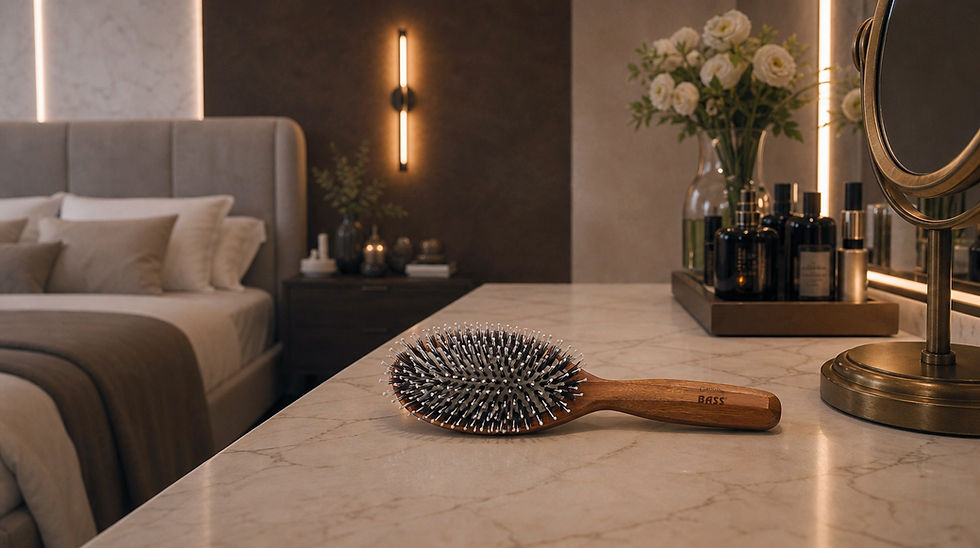
For a sensitive scalp, good technique is therefore built around a simple sequence: prepare the hair, create access, place the brush lightly, make deliberate directional passes, avoid unnecessary repetition, and stop before the scalp is asked to tolerate more contact than it comfortably accepts.
The Core Technique: Replace Pressure With Access
A boar bristle brush needs useful contact with the root area and hair surface, but useful contact does not require strong downward pressure. Problems often begin when the brush cannot reach easily through the hair and the user compensates by pressing harder.
That is especially common with dense, thick, or long hair. A deep layer of hair can keep the bristle field riding on the outer surface. Pressing harder may increase scalp force without creating a cleaner path through the hair.
Sectioning solves the problem more directly. By reducing the amount of hair between the brush and the root area, the bristles can engage closer to the scalp with less force. The hand no longer has to use pressure to overcome hair density.
This is the central mechanical rule for sensitive-scalp brushing: when the brush needs better access, change the pathway before changing the pressure.
Prepare the Hair Before the First Stroke
Begin with hair that is fully dry and already detangled. A boar bristle brush is a conditioning and polishing tool, not the tool that should be asked to work through knots.
Tangles create abrupt resistance. Abrupt resistance encourages pulling, tighter gripping, repeated attempts, and heavier pressure. Removing those tangles first allows the boar bristle brush to move through the hair in a smoother, more predictable way.
The brush itself should also be reasonably clean. Shed hair and heavy residue can change how freely the bristle field moves. Regularly removing trapped hair and maintaining the brush according to its construction helps preserve consistent contact from one session to the next.
Before beginning, notice how the scalp feels that day. If ordinary light grooming contact already feels unusually painful, raw, or difficult to tolerate, there is no reason to force a normal brushing session simply because it is part of a routine.
Step by Step: A Sensitive-Scalp Boar Bristle Brushing Routine
1. Divide the Hair Before Trying to Reach the Roots
Create sections small enough that the brush can approach the root area without being pushed through the full thickness of the hair.
The exact number of sections is not important. What matters is whether the bristles can enter the section with a light hand. If you find yourself pressing simply to make the brush reach, make the section smaller before changing anything else.
For fuller hair, this one adjustment often changes the entire feel of the session because it removes the need to use the scalp as the resistance point against which the brush is forced.
2. Place the Bristles; Do Not Drive Them In
Bring the brush to the root area gently. Think of placing the bristle tips where the stroke should begin rather than pressing the brush downward until the scalp sensation becomes strong.
A practical pressure check is your own hand. If your grip tightens, your wrist stiffens, or you feel yourself bracing the brush against the head, the stroke is probably becoming more forceful than it needs to be.
The bristles may be noticeable, but the contact should remain controlled and comfortable. Strong sensation is not required for oil distribution or polishing.
3. Move in a Slow Root-to-End Direction
Once the brush is positioned comfortably, guide it from the root area toward the ends in one continuous direction.
That directional pass keeps the brush aligned with its Shine & Condition purpose. It allows the bristle field to gather natural oils near the roots and progressively carry them through the hair while smoothing the surface in the same direction.
Avoid turning the beginning of the stroke into a short back-and-forth scrubbing motion. Repeated movement over one small scalp area concentrates friction without improving the basic root-to-end pathway.
4. Let the Brush Travel; Do Not Force Through Resistance
A good pass should feel smooth enough that the hand can keep moving without suddenly adding force. If resistance appears, stop the stroke and find the reason rather than pushing through it.
The problem may be a missed tangle, a section that is too large, or hair that has shifted into the brush path. Correcting the resistance keeps the boar bristle brush in its intended role instead of turning it into a pulling or detangling tool.
5. Move to the Next Section Instead of Repeating the Same Spot
Sensitive-scalp brushing should not be built around a target stroke count. Once a section has been brushed effectively, move on rather than repeatedly working the same path simply because more strokes feel more thorough.
Repeated passes increase cumulative contact even when each individual stroke is light. Fewer deliberate strokes are usually more useful than repeatedly revisiting the same scalp area.
The session should be judged by whether the hair has been adequately brushed and the scalp remains comfortable, not by whether a numerical target has been completed.
6. Finish the Lengths Without Reworking the Scalp
After the root area has received enough comfortable contact, the brush can continue polishing the mid-lengths, ends, and outer surface of the hair without every finishing pass beginning directly against the scalp.
This is a useful sensitive-scalp distinction. The scalp does not need to participate in every stroke for the hair itself to benefit from surface smoothing and continued oil distribution through the lengths.
If the hair needs additional refinement but the scalp has already had enough contact, let the brush work primarily through the hair.
7. End the Session While the Scalp Still Feels Comfortable
Do not wait for discomfort to prove that the session has gone too far. A sensitive-scalp routine works best when it ends while contact still feels neutral and controlled.
That may mean a shorter session on one day than another. The number of passes can vary with hair density, how easily the brush travels, and how the scalp responds during that particular session.
Consistency does not require identical brushing every day. It requires a repeatable technique that remains responsive to the scalp rather than overriding it.
If the Brush Still Requires Too Much Force
If careful sectioning, dry, detangled hair, and a lighter hand still do not allow the brush to work comfortably, the issue may no longer be technique alone.
A brush that cannot engage the hair unless it is pressed firmly may be a poor mechanical match for that combination of hair density and scalp tolerance. Conversely, a brush that reaches easily but feels sharp or overly assertive at very light pressure may also be mismatched.
At that point, reconsidering bristle firmness, flexibility, length, or brush-base construction can make sense. Those are selection questions rather than reasons to keep increasing hand force during the session. The practical rule remains the same: do not compensate for a poor brush-and-hair match by asking the scalp to absorb more pressure.
Modify the Technique When Contact Is Merely Too Intense
If the scalp is intact and the brushing sensation is simply stronger than preferred, ordinary technique adjustments may be enough.
Reduce pressure. Make the sections smaller. Use fewer passes. Avoid repeatedly starting in the same location. Keep finishing strokes in the lengths when additional scalp contact is unnecessary.
If the scalp tends to become more sensitive as a session continues, end earlier rather than trying to complete a predetermined routine.
These changes do not give the brush a new purpose. They simply reduce the amount and concentration of mechanical input while preserving its normal conditioning and polishing role.
Know When Technique Is No Longer the Answer
There is an important difference between brushing that feels a little too assertive and brushing that is producing a concerning reaction.
If brushing causes pain, burning, sharp discomfort, bleeding, worsening redness, increasing irritation, or another unexpected reaction, stop the session rather than continuing to experiment with lighter versions of the same contact.
Likewise, do not use the bristles to scratch, scrape, pick, or forcibly remove attached material from the scalp, and do not brush directly over open or bleeding skin. A boar bristle brush is a grooming tool, not a treatment device.
For this routine, the practical boundary is simple: ordinary sensitivity can often be managed by changing the mechanics; a scalp that is reacting negatively to the brushing itself should not be pushed through the session.
Common Technique Errors That Make a Sensitive Scalp Feel Worse
The first error is trying to improve reach by pressing harder. Better sectioning should come first.
The second is bringing the boar bristle brush into the routine before tangles are removed. A snag converts a smooth pass into a pulling event and often causes the hand to add force.
The third is scrubbing the root area with short repeated strokes. The brush is more useful when it travels directionally through the hair instead of concentrating friction in one spot.
The fourth is assuming that a sensitive scalp must eventually acclimate to unpleasant brushing. A routine can become more familiar over time, but pain, burning, or increasing irritation is not a skill threshold to overcome.
The fifth is continuing to involve the scalp after the scalp portion of the routine is already complete.
Once the roots have been addressed comfortably, finishing the hair does not require repeatedly starting every stroke at the skin.
The Routine to Remember
A sensitive-scalp boar bristle routine does not need to be complicated.
Start with dry, detangled hair. Open the hair into sections before trying to reach the root area.
Place the bristles lightly instead of driving them downward. Brush in deliberate root-to-end passes.
Resolve resistance instead of forcing through it. Move on when a section is finished. Let later polishing passes work through the hair without unnecessary scalp contact. End the session while the scalp still feels comfortable.
That sequence preserves the real purpose of the boar bristle brush while reducing the mechanical intensity of the process.
The most important principle is not "brush as softly as possible." It is more precise:
Make the pathway easier so the hand does not need to become heavier.
That is what turns sensitive-scalp boar bristle brushing from vague advice about being gentle into a controlled, repeatable technique.
Frequently Asked Questions
Where should I start a boar bristle brush on a sensitive scalp?
Begin near the root area only as close as comfortable contact allows. The bristles should be placed lightly rather than pressed into the scalp. If direct root-area contact feels too intense, reduce pressure and improve sectioning before trying to force the brush closer.
Do I need to press the brush against my scalp for it to work?
No. The brush needs useful access to the root area and hair surface, not strong scalp pressure. If pressing feels necessary, reduce the amount of hair in the section first.
What should I do if the bristles do not reach through my hair?
Make the section smaller. Dense hair can block the bristle field and tempt you to push harder.
Sectioning usually improves access more directly than increasing downward force.
How many strokes should I use on each section?
There is no required number. Use a small number of deliberate passes, then move on once the section has been adequately brushed and the scalp remains comfortable.
Can I keep brushing the lengths after I stop direct scalp contact?
Yes. Once the root area has been addressed, additional finishing passes can work primarily through the mid-lengths, ends, and outer surface without repeatedly re-engaging the scalp.
What if the same brush feels comfortable one day and too intense another day?
Adjust the session rather than forcing consistency. Use lighter contact, fewer passes, smaller sections, or less direct scalp engagement when needed. If brushing itself produces pain, burning, bleeding, worsening redness, or increasing irritation, stop the session.
Can a boar bristle brush treat scalp sensitivity?
No. A boar bristle brush is a mechanical grooming tool. Its technique can be adjusted according to scalp tolerance, but it does not diagnose, treat, cure, or medically manage a scalp condi