How to Clean a Boar Bristle Brush When You Have a Sensitive or Condition-Prone Scalp
- Editorial & Publishing Team

- 3 days ago
- 13 min read


Key Takeaways
For a sensitive or condition-prone scalp, brush hygiene is about controlling residue and keeping the tool predictable, not sterilizing it or washing compulsively.
Let actual residue load guide wet-cleaning frequency: remove trapped hair after use, then wash sooner when bristles clump, feel tacky, or carry visible buildup.
Clean with mild shampoo or gentle soap in lukewarm water, working only the bristle field while limiting moisture around the base, cushion, vent, and handle.
Rinse thoroughly, blot gently, and dry bristle-side down until completely dry; a clean boar bristle brush should feel flexible, not stripped or squeaky.
Replace the brush when structural wear, persistent matting, failing cushions, warped bases, or widespread tuft loss prevent cleaning from restoring a stable, predictable bristle field.
A boar bristle brush is designed to interact repeatedly with the same materials that make cleaning necessary: shed hair, natural scalp oil, loose surface debris, and whatever styling residue remains on dry hair. When the scalp is sensitive or condition-prone, brush care deserves more attention - not because cleaning a brush treats a scalp condition, but because a well-maintained tool gives you better control over what returns to the hair and scalp at the next brushing session.
That distinction is the governing idea for this article. A sensitive or condition-prone scalp does not automatically require stronger cleaners, daily wet washing, or a sterilization routine. It calls for tighter residue control and a more predictable brush. The aim is to remove accumulated material before it becomes heavy while avoiding cleaning methods that unnecessarily strip natural bristle, saturate the brush base, or leave cleanser behind.
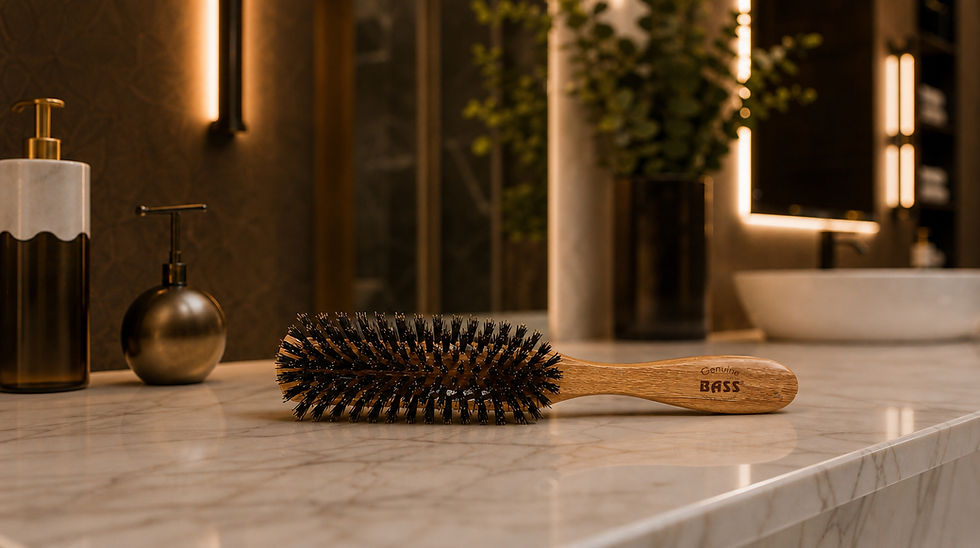
The result is a balanced maintenance routine: remove hair frequently, wash when residue warrants it, use mild cleanser and limited water, rinse thoroughly, protect the base and handle, and let the brush dry completely. For a sensitive-scalp routine, cleanliness should reduce variables rather than introduce new ones.
Why Brush Cleanliness Matters More When Scalp Tolerance Is Low
A boar bristle brush works partly by picking up and redistributing scalp oil through the hair. Some transfer back onto the brush is therefore normal. Shed hairs collect between tufts. Fine dust and loose surface material can settle near the bristle base. Styling products can coat the outer bristle field. With repeated use, the brush gradually carries a physical record of the routine in which it has been used.
For most users, that is simply a maintenance issue. When scalp comfort is already being monitored closely, it also becomes a consistency issue. If the brush carries a heavy film of old oil, product, or debris, the next brushing session no longer begins with a relatively clean tool. Bristles may cling together, the field may feel less responsive, and material collected during prior sessions may be redistributed instead of removed.
Cleaning therefore serves two separate purposes. First, it preserves the mechanical performance of the natural bristle. Second, it creates a cleaner and more repeatable starting point for the next session. Neither purpose should be confused with treating dandruff, psoriasis, seborrheic dermatitis, eczema, or another scalp condition. Brush maintenance can control the condition of the grooming tool; it cannot address the medical cause of a scalp problem.
Three Variables Matter: Residue Load, Cleaning Intensity, and Scalp Tolerance
The easiest way to understand condition-aware brush care is to separate three variables that are often collapsed into one decision.
Residue load is what the brush has actually collected. A brush used on product-light hair may stay relatively clean for longer. A brush exposed to dry shampoo, hairspray, oils, pomades, visible loose material, or frequent daily use may accumulate a film much faster. Residue load is the main reason to shorten the interval between wet cleanings.
Cleaning intensity is how aggressively the brush itself is washed. More cleanser, hotter water, longer soaking, and harder scrubbing do not automatically produce a better maintenance result. They increase exposure of natural bristle, tuft settings, cushions, finishes, and handles to the very things that can shorten brush life.
Scalp tolerance is the reason consistency matters. If you are already trying to understand which brushing pressure, contact, frequency, or routine feels comfortable, a heavily coated brush introduces another variable. Keeping the brush reasonably clean helps make each session more mechanically predictable. That is the sensitive-scalp advantage: not medical treatment, but better control of the tool and the residues it carries.
These three variables lead to a practical rule: clean sooner when the brush is collecting more, but do not clean more aggressively simply because the scalp is sensitive.
Start With Dry Hair Removal After Every Use
The most useful cleaning habit is also the simplest: remove shed hair before it becomes packed into the bristle field.
Boar bristle brushes are dense by design. If loose hairs remain, they can wrap around multiple tufts, trap oil and debris deeper in the brush, and make later washing more difficult. A few seconds of dry maintenance after brushing prevents that accumulation from turning into a larger cleaning problem.
Use your fingers, a brush-cleaning rake, a narrow comb, or another non-sharp cleaning tool to lift hair from between the tufts. Work gradually from one side of the brush to the other rather than pulling hard on a large mass at once. The objective is to free trapped hair without yanking, bending, or separating the boar-bristle tufts.
This dry step is especially useful when the brush has collected visible loose flakes or other surface material. Remove that material from the tool rather than allowing it to remain buried at the base of the bristles. Do not use the brush as a scraper to forcibly remove adherent scale from the scalp.
Cleaning the brush and brushing the scalp are separate tasks, and greater friction is not a substitute for better tool hygiene.
How Often Should You Wash a Boar Bristle Brush?
There is no single cleaning interval that fits every sensitive-scalp routine. For many personal boar bristle brushes, a light wash about weekly or every other week is a useful starting range when dry hair is removed regularly. The interval should then move according to what the brush is actually collecting.
Wash sooner when the bristles are clumping, the base is collecting visible residue, the brush develops an oily or tacky film, or product use is heavy enough that the bristle field no longer feels clean and flexible. A lightly used brush on relatively product-free hair may remain functional longer between wet cleanings.
This is where condition-aware maintenance differs from compulsive cleaning. Scalp sensitivity by itself is not a reason to wet-wash the brush after every session. The stronger signal is residue load.
Cleaning should remove an accumulating variable without creating another through repeated detergent exposure or unnecessary saturation of the brush.
A Gentle Step-by-Step Cleaning Method
For routine home care, clean the bristle field while keeping the handle, bristle base, and cushion as dry as reasonably possible.
1. Remove all trapped hair first
Begin with the brush completely dry. Lift out shed hair and any loose material you can remove mechanically. Wetting the brush while hair is still packed into it can make the trapped mass harder to extract and allows residue to remain concentrated around the base.
2. Prepare a mild cleaning solution
Use lukewarm, not hot, water with a small amount of mild shampoo or gentle soap. Dilution matters. The purpose is to loosen accumulated oil and product film from the bristles, not to saturate the brush with cleanser.
For a sensitive or condition-prone scalp routine, a simple cleaner that rinses cleanly is preferable to escalating detergent strength. The more relevant question is not how powerful the cleanser feels, but whether residue can be removed from the brush without leaving another residue behind.
3. Clean the bristle field without soaking the brush
Hold the brush so the bristles face downward. Expose the bristle tips and outer bristle field to the diluted solution while avoiding unnecessary immersion of the handle and base. Gently work the solution through the bristles with your fingers. If residue is concentrated near the base, a soft, unused toothbrush can help loosen it with controlled movement.
Do not scrub aggressively across the boar bristle. Natural bristle performs through its structure and flexibility; crushing, twisting, or repeatedly bending the tufts sideways adds wear without improving cleanliness.
The moisture caution changes slightly with construction. Direct-set brushes should not be submerged deeply enough for water to sit around the holes where the tufts enter the base. Cushioned brushes require additional care because water can enter around the cushion or air vent and remain trapped inside. In both cases, wet the bristles rather than the entire brush.
4. Rinse thoroughly but briefly
Rinse the bristle field with clean lukewarm water using the same downward orientation. Remove all visible foam and any slippery cleanser feel. Thorough rinsing matters more than choosing a stronger detergent: a mild wash that leaves the bristles clean is preferable to a powerful cleaner that remains trapped in a dense field.
Avoid prolonged running water over wooden handles, wooden bases, cushion edges, or vents.
Once residue has been loosened and the bristles rinse clean, more water does not improve the result.
5. Remove excess water and dry bristle-side down
Blot the bristles gently with a clean towel rather than twisting or wringing them. Then place the brush bristle-side down, ideally with the bristle field able to drain and receive airflow. This orientation helps limit the movement of residual moisture deeper into the base or handle.
Allow the brush to dry completely before using it again. A damp boar bristle brush should not go directly back into a dry-hair grooming session. Full drying restores the bristle field to the condition in which it is intended to work and protects the supporting construction from retained moisture.
Direct-Set and Cushioned Boar Bristle Brushes Need Slightly Different Care
The cleaning principle is the same for both constructions - clean the bristles while limiting moisture exposure to the supporting structure - but the risk points differ.
A direct-set brush anchors the bristle tufts into a firm base. The openings around those tufts are not places where water should be allowed to pool. Repeated soaking can affect natural wood, finishes, adhesives, or other internal construction depending on the brush.
A cushioned boar bristle brush adds a flexible pad beneath the bristle field. That cushion improves adaptability during brushing, but it creates an additional reason to control water. Moisture that enters around the cushion or vent may dry more slowly than moisture on exposed bristles.
Cushioned designs therefore deserve particular attention to keeping the pad and vent area out of the wash water.
Neither construction should be treated as an object that can simply be submerged in a sink. The bristle field is the part that needs routine wet cleaning; the rest of the brush should receive only the moisture required for careful surface wiping.
Do Not Try to Make Natural Bristle 'Squeaky Clean'
One of the easiest maintenance errors is to judge a boar bristle brush by the cleaning standard used for glass, dishes, or synthetic plastic tools. Natural bristle does not need to feel stripped or squeaky.
A faint conditioned quality in clean, dry bristle is not the same as heavy residue. The target is accumulated old oil, styling film, debris, and trapped material - not every trace of the natural conditioning that occurs through regular use.
Harsh cleaning can change how the bristle feels and behaves. Strong detergents, repeated soaking, very hot water, and aggressive scrubbing can make natural bristles drier or more brittle over time and can also affect handles, finishes, cushions, or tuft settings. A sensitive-scalp routine benefits more from a clean, stable brush than from a repeatedly stripped one.
What Cleaners Should You Avoid?
For ordinary home maintenance, stronger is rarely better. Bleach, alcohol-heavy cleaners, harsh degreasers, abrasive powders, and concentrated household detergents are unnecessary for routine boar-bristle cleaning unless the manufacturer of a specific brush expressly identifies a compatible procedure.
These substances can be difficult to rinse from dense natural bristle and may affect the bristle, finish, cushion, adhesive, or handle material. They also make it harder to control what remains on the brush before the next scalp-contact session.
A mild wash used sparingly and rinsed thoroughly is more consistent with natural-bristle maintenance. If unusually heavy product residue survives one gentle cleaning, repeat the mild wash after rinsing rather than immediately escalating to a stronger solvent.
Sensitive Scalp Hygiene Is About Residue Control, Not Aggressive Cleaning
The phrase "sensitive scalp" can tempt people to respond by cleaning everything more aggressively. That is usually the wrong maintenance logic.
A better approach is to reduce variables. Keep shed hair from accumulating. Wash before the bristle field becomes heavily coated. Use a mild cleaner. Rinse completely. Keep the base as dry as practical. Let the brush dry fully. Store it where air can circulate.
This makes the routine easier to interpret. If scalp contact feels different from one session to the next, you are less likely to be wondering whether the brush is carrying a thick layer of product, old oil, or debris. The brush becomes a more consistent mechanical tool.
Visible flakes on the brush should be treated only as material to remove from the tool. Their presence does not change the cleaning method. Removing loose material from the brush is grooming hygiene; it should not be interpreted as evidence that an underlying scalp condition has been improved, controlled, or treated.
How Product Use Changes the Cleaning Schedule
Styling products are often the factor that shortens the interval between brush washes. Dry shampoo, hairspray, texturizing products, leave-in oils, pomades, and similar materials can transfer onto boar bristles even when the brush is used only on dry, detangled hair.
Once product coats the bristle surface, the brush has less clean surface available to interact with natural scalp oil. Tufts can also begin to bind together, reducing flexibility and changing how the field moves through the hair.
If your routine includes substantial product use, inspect the brush more frequently and let visible or tactile buildup determine whether washing is due. A product-light routine may allow a longer interval. Again, the scalp modifier does not change the basic chemistry of brush cleaning; it makes residue monitoring more valuable because the aim is a predictable tool from session to session.
Storage, Personal Use, and Professional Context
Cleaning is not complete until the brush has dried and been stored in a way that keeps it clean.
After washing, give the bristles open airflow until they are fully dry. Avoid closing a still-damp brush inside a plastic bag, drawer organizer, or travel case.
Once dry, keep the brush in a clean, ventilated area where the bristle field is protected from bathroom splashes, cosmetic powders, and product overspray. Bristle-side up or on its side is appropriate for ordinary dry storage. For travel, remove trapped hair before packing and use a breathable or easily cleaned protective pouch.
A personal boar bristle brush should also remain personal. It gradually collects the oils, hair, and product residues associated with one person's routine. Keeping it individual makes maintenance more predictable and avoids mixing different residues in the same dense bristle field.
Professional settings have separate sanitation obligations that are not replaced by this home-care method. Professionals should follow the requirements of their setting and use only procedures compatible with the construction of the specific brush.
When the Brush Is Ready to Use - and When Cleaning Is No Longer Enough
A freshly cleaned boar bristle brush does not need to look new. It does need to be functionally reset. Before returning it to a sensitive-scalp routine, confirm that trapped hair has been removed, the bristle field is no longer visibly coated, there is no lingering foam or slippery cleanser residue, and the brush is completely dry. The tufts should separate naturally rather than remain stuck together in oily or product-coated clusters.
A light natural-bristle feel is normal. A heavy tacky film is not. The target is a clean, dry, flexible bristle field - not a chemically stripped one.
Maintenance can preserve a good brush, but it cannot reverse structural wear. Consider replacement when the cushion is cracked or separating, the base has warped, the handle has damage that prevents proper drying, large numbers of tufts are loosening, or the bristle field remains matted and unresponsive after careful cleaning. Persistent odor that returns immediately after a thorough wash can also suggest that residue has moved into areas that are no longer practical to clean.
For a sensitive-scalp routine, that structural point matters because a damaged brush may no longer transfer contact or pressure in the same way as the brush originally selected. Mechanical predictability is part of the hygiene decision.
The Governing Principle: Keep the Tool Clean Without Damaging the Tool
Cleaning a boar bristle brush for a sensitive or condition-prone scalp is not a special sterilization ritual. It is a more attentive version of good natural-bristle maintenance.
The key is to match cleaning frequency to residue load while keeping cleaning intensity modest.
Remove hair frequently. Wash before buildup becomes heavy. Use mild cleanser and lukewarm water. Keep the handle, base, cushion, and vent as dry as practical. Rinse thoroughly, dry bristle-side down, and wait until the brush is fully dry before using it again.
That approach preserves the two things that matter most: a cleaner surface for the next grooming session and a bristle field that still behaves the way a boar bristle brush is supposed to behave. In sensitive-scalp care, consistency comes from reducing unnecessary variables - not from using more force, more cleanser, or a more complicated maintenance ritual.
Frequently Asked Questions
Does a sensitive scalp mean I should clean my boar bristle brush more often?
Not automatically. Remove trapped hair while the brush is dry, then let residue load guide wet-cleaning frequency. A brush exposed to more oil, styling product, or visible debris may need washing sooner, while a lightly used product-free brush may not. Sensitivity is a reason to monitor the tool carefully, not a reason to wash it compulsively.
Can I soak a boar bristle brush in water?
It is better not to. Clean the bristles while keeping the handle, base, cushion, and vent as dry as reasonably possible. Full soaking can introduce moisture into parts of the brush that are slow to dry or vulnerable to damage.
Should I disinfect the brush with alcohol, bleach, or another strong cleaner?
Not for routine personal maintenance unless the manufacturer of the specific brush identifies a compatible method. Strong cleaners are unnecessary for ordinary residue removal and can affect natural bristle or other brush materials.
What if my scalp flakes and the brush collects visible flakes?
Remove the loose material from the brush and clean the bristle field as needed. Do not use the brush to scrape or forcibly lift adherent scale from the scalp. Brush cleaning removes material from the tool; it does not diagnose or treat the cause of flaking.
Does a cushioned boar bristle brush need different cleaning than a direct-set brush?
The bristle-cleaning method is similar, but cushioned brushes require extra care to keep water away from the cushion and vent. Direct-set brushes should also be kept out of soaking water so moisture does not sit around the tuft settings or penetrate the base.
How do I know the brush is clean enough to use again?
It should be free of trapped hair and obvious coating, rinsed until no cleanser residue remains, fully dry, and flexible enough that the tufts separate naturally. It does not need to feel stripped or squeaky.
Can I use the brush while it is still slightly damp?
Wait until it is completely dry. Boar bristle brushing is intended for dry hair, and complete drying also protects the brush structure before the next session.
When should I replace the brush instead of cleaning it again?
Replace it when cleaning no longer restores a usable bristle field or when structural damage - such as a failing cushion, warped base, damaged handle, or widespread tuft loss - changes the way the brush behaves.