


How to Blow Dry Bangs with a Round Brush
- Editorial & Publishing Team

- 10 hours ago
- 13 min read


Key Takeaways
Bang styling begins at the hairline, where root direction and elevation determine how the fringe falls before barrel curvature shapes the lengths.
Reset cowlicks or persistent splits while the roots remain responsive, then establish the final direction before shaping the rest of the bangs.
Choose round-brush diameter for the desired curve and available hair length, then control how much curvature appears by adjusting barrel wrap.
Straight-across, curtain, and side-swept bangs require different directional paths, with root placement and brush movement defining each finished shape.
Dry each section completely and let it cool before release, then diagnose problems from root to ends instead of simply adding more heat.
Bangs often go wrong before the round brush ever reaches the ends. A center split reappears.
One side kicks outward. Curtain bangs collapse toward the forehead. A short fringe suddenly looks much shorter because it has been rolled into too much curve.
These problems can look unrelated, but most begin with the same mistake: treating bangs as a small section of ordinary blow-dry hair rather than as a directional feature built directly from the hairline.
The front hairline is unusually sensitive to small changes in root position. Bangs are short enough that a few degrees of elevation can noticeably change their fullness, and a small amount of barrel wrap can create a large visible curve. Natural growth patterns also have less length in which to disappear. A cowlick that might blend into longer hair can dominate the shape of a fringe.
The most useful way to approach bangs is therefore not “How do I roll them around the brush?” but “Where should this hair leave the scalp, where should it travel, and how much curve should it have when it gets there?”
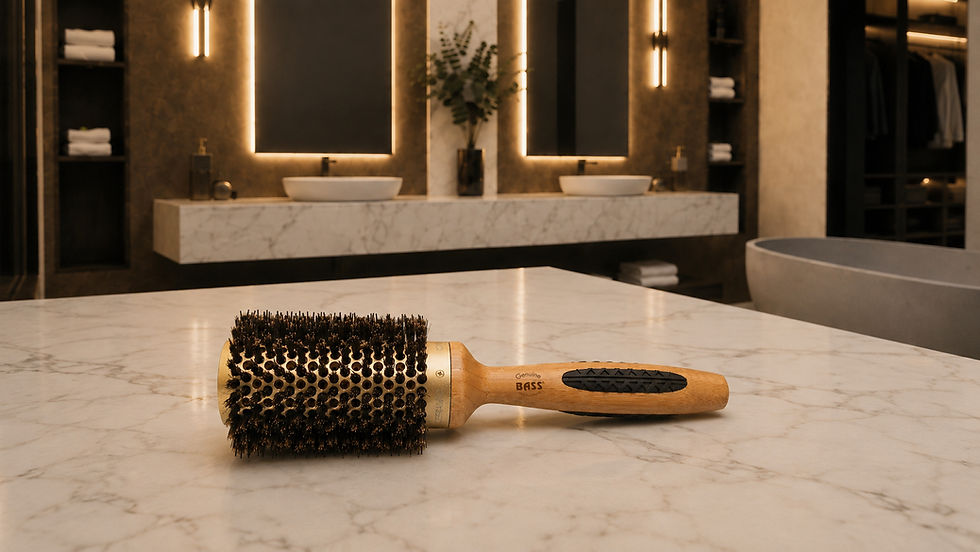
The round brush then becomes a precision shaping tool. Its job is to establish the root direction, carry the hair through a controlled path, and introduce only the amount of curvature the finished fringe needs.
Bangs Are Shaped from the Hairline Outward
With longer sections of hair, the eye often notices the overall silhouette first. With bangs, the root is exposed and sits directly within the visual frame of the face. That makes root placement unusually important.
Consider three bangs that have identical curvature through their ends.
If the first leaves the scalp downward, it can look flat.
If the second leaves the scalp with controlled elevation, it can look fuller and softer.
If the third begins by moving sideways, it may separate or sweep toward one side.
The barrel has not necessarily changed. The root geometry has.
This is why trying to repair bangs by concentrating only on their ends often fails. A center split cannot be solved by adding more undercurve. Flat curtain bangs do not become properly lifted simply because their tips flip outward. A cowlick cannot be erased by rolling the section more tightly.
The front section must first be placed on the correct path.
Only then should the barrel determine how that path bends.
Reset an Unwanted Root Pattern Before Building the Finished Shape
Bangs dry quickly, so natural growth direction can begin taking control while the rest of the hair is still being prepared.
If the fringe naturally separates, kicks upward, or falls strongly toward one side, work on that root pattern while the hair is still responsive.
This may require lightly rewetting only the fringe if it has already dried. The objective is not to saturate the hair again. It is to restore enough moisture for the root direction to be changed during drying.
For a center split, move the root area across its preferred direction while applying controlled airflow, then reverse the movement. This temporary back-and-forth redirection helps prevent either side of the split from immediately dictating the finished position.
A cowlick can be handled with the same logic. Move the hair against or across the direction in which it strongly wants to grow, concentrating on the root rather than curling the lengths.
Once the unwanted pattern has been reduced, stop neutralizing and begin styling.
That distinction matters. The movement used to disrupt a cowlick or split is not necessarily the movement you want in the finished bangs.
Think of the process as two separate actions:
Reset the root. Then establish the final direction.
For straight-across bangs, the final direction may be predominantly forward and downward.
For curtain bangs, the root may need lift before each side begins traveling outward.
For a side-swept fringe, the root must begin transitioning toward the intended side before the ends are shaped.
The final result becomes much easier to control when those two stages are not confused.
Match the Brush to the Amount of Curve the Bangs Need
Barrel diameter remains one of the main shape controls in round-brush work, but bangs create a special constraint: the brush must fit beneath a relatively short section.
A large barrel produces broad curvature and straighter-looking movement. A medium diameter creates more noticeable bend. A smaller diameter provides tighter curvature and can engage shorter pieces more easily.
The difficulty is that the brush that fits best is not always the brush whose full curve you want to reproduce in the hair.
A short fringe may physically require a smaller barrel because a larger brush cannot gain useful contact. If that small brush is then rolled deeply toward the forehead, the hair may take on far more curvature than intended.
The solution is not automatically to choose a brush that is too large to control the section. It is to distinguish barrel size from barrel usage.
A smaller brush can be used with shallow wrap.
A medium brush can be used with deeper or lighter wrap depending on the result.
A longer curtain fringe can often accommodate a broader barrel because more hair length is available to travel around the curve.
Desired shape remains the primary decision. Bang length and available working space determine which diameters can realistically create it.
Why Bangs Suddenly Look Too Short
Over-rounded bangs are partly a geometry problem.
When a short section bends strongly around a barrel, more of its length is redirected into an arc rather than extending downward. The physical hair has not become shorter, but its visible vertical length decreases.
That is why bangs can seem to jump upward after being round-brushed.
The shorter the fringe, the more noticeable this effect can become.
If the intended result is a soft natural bend, do not repeatedly roll the bangs tightly around the barrel. Let the hair travel across part of the brush surface while maintaining enough tension to organize it.
Near the ends, decide whether the section needs:
almost no additional turn;
a soft inward bend;
a broader outward movement;
or a clearly visible curve.
Then use only enough rotation to produce that result.
This is one of the most important controls in bang styling: the barrel offers a curve; the hair does not have to take all of it.
Straight-Across Bangs Need Restraint More Than Curl
A full straight-across fringe usually looks most controlled when the root distribution is even and the curvature is subtle.
Begin by correcting any unwanted separation at the hairline. Once the root lies more evenly, bring the fringe forward into its finished direction.
If the bangs are dense, divide them so the brush can control the full depth of each working section. A fringe may look small from the front while still containing enough hair for the outer layer to dry much faster than the interior.
Place the round brush beneath the section and establish light, even tension. Guide the bangs downward and slightly forward with the dryer following the working area.
As the ends approach the barrel, resist the instinct to keep rolling.
For a nearly straight finish, let the hair leave the brush with minimal additional rotation.
For a gentle undercurve, increase the contact only near the tips.
For a deliberately rounded fringe, allow more of the section to conform to the barrel.
The difference between those finishes can be surprisingly small at the wrist. That is why restraint matters more with bangs than with many longer sections.
A successful straight fringe should appear intentionally shaped without looking as though it has been rolled into a cylinder.
Curtain Bangs Are Built on Direction Before Curve
Curtain bangs are often described in terms of an outward flip, but that description focuses too far down the strand.
Their defining feature begins much closer to the scalp.
The two sides need enough separation and root position to open the center of the face. If the roots dry flat and forward, curling the tips outward may create turned ends without producing a true curtain shape.
Start by defining the intended part.
Work with each side according to the direction in which it should ultimately travel. Where lift is needed, place the brush beneath the root and elevate the hair away from its resting position.
Direct airflow into that controlled root area before moving farther through the section.
Once the base is established, guide the section outward.
The hair should transition gradually from root lift into lateral movement and then into a broad bend.
The barrel supplies the curvature, but the path of the brush determines where that curve points.
This distinction explains why two people can use the same brush diameter and get very different curtain bangs. One creates a lifted outward path; the other creates a curl that happens to point outward at the tip.
For a soft curtain effect, avoid winding the section into a tight roll. The movement should feel elongated and open.
Allow each side to cool briefly in that direction before pulling it downward or brushing through it.
The final release should preserve the sweep rather than immediately flattening it.
Side-Swept and Longer Face-Framing Bangs Need a Traveling Direction
Longer bangs introduce more working length, which means the curve can develop more gradually.
This makes them less sensitive to the concentrated roundness that affects very short fringe, but more dependent on directional consistency.
For a side-swept result, establish the root so the section begins traveling toward the intended side.
The brush should continue that directional path rather than pulling the hair straight down and trying to create the sweep only at the ends.
Longer face-framing pieces can often accommodate a broader barrel because there is enough length for a larger arc. This can create movement without concentrating the curve into a short area.
The exact diameter may also change within a fringe that combines short central pieces with longer outer sections. The goal is not to assign a fixed brush size to a particular zone. The goal is to choose the diameter that fits the local hair length and the shape required there.
A shorter central section may need a more compact brush for access.
A longer outer section may benefit from a broader barrel for an elongated sweep.
Both choices can belong to the same finished design.
Root Lift and Puffy Bangs Are Not the Same Thing
The easiest way to create excessive fullness is to treat the entire fringe as though it needs the same elevation.
If the goal is to prevent the bangs from collapsing against the forehead, elevate the hair where it leaves the scalp. Once that lift is established, the section can travel into a lower path through the mid-length and ends.
This creates a controlled transition rather than one large arch.
If the root, middle, and ends are all strongly elevated while the hair is deeply wrapped, the fringe can become inflated and overly rounded.
If the root receives no elevation but the ends are curled, the bangs may look curved yet remain flat.
Separate those objectives.
Use elevation to determine how the hair leaves the scalp.
Use barrel contact to determine how much it bends afterward.
That allows the fringe to have lift without becoming puffy.
Dense Bangs Often Fail from the Inside
When a fringe loses its shape soon after styling, the problem is not always inadequate heat or insufficient hold.
Sometimes the section was never completely dry.
Dense bangs can be deceptive because the exterior sits directly in the airflow and may feel finished while the interior remains damp. Once released, that hidden moisture continues moving through the section, allowing the hair to shift away from the geometry established on the brush.
The remedy is better section control, not simply hotter air.
Reduce the depth of the working section until the brush can engage the hair consistently and airflow can reach through it.
Dry the root and interior as deliberately as the visible surface.
Only then judge the finished shape.
This is especially important when the bangs need lift or when a natural split has been redirected.
Residual moisture at the base gives the original growth pattern another opportunity to reassert itself.
Fine Bangs Require Timing More Than Repetition
Fine fringe presents almost the opposite problem.
Because it contains relatively little mass, it may become dry very quickly. That creates a short window in which the roots can be redirected and the section shaped efficiently.
Repeated hot passes do not necessarily improve the result once the hair has already dried into its form.
Work early, use manageable tension, create the necessary direction, and stop adding heat when the section is dry.
If fine bangs have already dried incorrectly, lightly resetting them with moisture is often more effective than repeatedly trying to force dry hair into a new position.
Curly and Textured Bangs Need a Defined Styling Objective
With naturally curly or highly textured bangs, the first question should be what degree of pattern change is actually desired.
A round brush can elongate the section, smooth it, create a broad curve, redirect the root, or produce a more controlled blowout shape. It does not have to remove every trace of natural texture.
More tension and a straighter path can create greater elongation.
More barrel curvature can preserve or rebuild visible bend.
A softer approach may reduce irregularity while retaining movement.
The appropriate technique depends on the intended fringe rather than on an assumption that all bangs should finish with the same surface or degree of straightness.
The short working length again makes precision important. Small changes in tension and wrap can create large visible differences.
Keep the Dryer Working with the Direction You Have Chosen
Once the brush has established the correct root and travel path, the dryer should reinforce that movement.
A concentrator nozzle can make this easier by narrowing the airflow. Aim the air along the organized section rather than blowing across it from the side.
If the root is being elevated, support that elevated position.
If curtain bangs are traveling outward, let the dryer follow the outward path.
If a straight fringe is moving forward and downward, keep the airflow aligned with that movement.
The brush and dryer should not create competing directions.
Because bangs sit directly against the forehead and hairline, there is also little reason to hold concentrated heat stationary in one place. Keep the airflow moving with the section and use the coordination of brush position, tension, and direction to do the shaping work.
Let the Bangs Cool Before Deciding They Are Finished
The release matters almost as much as the shaping pass.
A section can look correct on the brush and then change when it is immediately pulled, touched, or redirected while still hot.
Once the bangs are fully dry, allow the shaped area to cool in or near its intended position.
This is particularly useful for root lift and curtain bangs because both depend on direction that can be weakened if the hair is immediately flattened or pulled somewhere else.
Cooling does not need to become an elaborate procedure. It simply completes the temporary shaping process before the hair is disturbed.
Then release the fringe and assess the actual result.
If the shape is wrong, identify which part is wrong before restyling.
A split returning at the scalp is a root-direction problem.
Excessive shortening or roundness is a curvature problem.
Flat curtain bangs may need more root elevation or a stronger outward travel path.
A fringe that looked correct but quickly collapsed may not have been fully dried or cooled.
Correct the specific variable rather than repeating the entire technique with more heat.
A Better Way to Diagnose Bang Problems
The fastest corrections come from identifying where along the short section the failure begins.
If the problem starts at the scalp, examine moisture timing, natural growth direction, elevation, and initial brush path.
If the root looks correct but the middle travels incorrectly, examine brush orientation and the direction in which the section was guided.
If the root and middle look correct but the ends are too curled, too straight, or pointing the wrong way, change the amount and direction of barrel wrap near the tips.
This root-to-end diagnosis is more useful than assuming every problem requires a different product, hotter dryer setting, or smaller brush.
Bangs make each shaping decision visible. That is what makes them challenging, but it is also what makes them precise once the logic is understood.
Conclusion: Control the Direction Before You Control the Curve
The defining challenge of round-brushing bangs is not their size. It is the concentration of styling decisions within such a short length of hair.
The root establishes where the fringe begins. Elevation determines how much it lifts away from the forehead. The brush path determines where it travels. Barrel diameter establishes the scale of possible curvature, while the amount of wrap determines how strongly that curvature appears.
Complete drying and cooling help preserve those choices.
That means the correct technique should begin at the hairline, not at the ends.
Reset unwanted splits or cowlicks while the hair is responsive. Establish the final root direction.
Choose a workable barrel for the desired shape. Then carry the section through the exact path and degree of bend required by the fringe.
Straight-across bangs, curtain bangs, side-swept fringe, and longer face-framing pieces all use the same underlying principle:
control the direction first, then control the curve.
Frequently Asked Questions
What size round brush should I use for bangs?
Choose the diameter according to the curve you want while making sure the brush can engage the available hair length. Smaller barrels can control shorter bangs and create tighter potential curvature. Larger barrels create broader movement but require enough hair length to work effectively.
How do I use a small round brush without making my bangs too curly?
Limit the amount of hair that wraps around the barrel. Let the fringe travel over part of the brush surface and release it before a deep curve forms. Small diameter creates the potential for tight curvature; it does not require you to use all of that curvature.
Why do my bangs split after I blow dry them?
The root may have dried in its natural growth pattern before the final shape was established.
Lightly rewet the root if necessary, redirect the split while the hair is responsive, and only then place the fringe into its finished direction.
Why do my bangs look shorter after using a round brush?
They have probably taken on too much curvature. A strong arc redirects some of the hair's visible length into the curve, making a short fringe appear even shorter. Reduce the amount of wrap or use a broader diameter when the hair length allows it.
How do I blow dry straight-across bangs without getting a rounded fringe?
Control the root first, guide the section mostly downward and forward, and use only a small amount of barrel rotation near the ends. Think of the brush as a curved guiding surface rather than something the bangs must be tightly rolled around.
How do I make curtain bangs stay away from my face?
Create the outward movement from the root and mid-length rather than flipping only the tips.
Establish root lift, guide each side outward, dry the section completely in that path, and allow it to cool before pulling it down.
Should bangs be wet before round brushing?
They should be responsive enough to reshape but do not need to be dripping wet. If the fringe has already dried into the wrong position, lightly rewetting the section can make root redirection and reshaping easier.
Why do my bangs fall flat shortly after blow-drying?
The root may not have received enough elevation, the section may still have contained moisture, or the bangs may have been disturbed before cooling. Identify which part of the shape collapsed before repeating the technique.
Can I use different round brush sizes on different parts of my bangs?
Yes. If the fringe combines shorter central pieces with longer outer or face-framing sections, different diameters may provide better access and more appropriate curvature. Choose according to the local hair length and desired shape rather than following a fixed zone rule.
What should I fix first when my bangs are not sitting correctly?
Look at the root first. If its direction is wrong, correct that before adjusting the curve through the lengths or ends. Many bang problems that appear to be curl problems actually begin as root-direction problems.









