

How Stylists Use Boar Bristle Brushes to Refresh Second Day Hair
- Editorial & Publishing Team

- Jun 12
- 15 min read


Key Takeaways
· Second-day hair often needs rebalancing, not washing, because natural oil may be present but unevenly placed near the scalp.
· Stylists assess roots, crown, part, hairline, mid-lengths, and ends before deciding whether to refresh the root, surface, or full length.
· Boar bristle brushes work best on dry, detangled hair, where they can redistribute oil, smooth the surface, and reduce visible disorder.
· The best second-day refresh preserves useful style memory instead of brushing everything flat or rebuilding the hair from the beginning.
· Brushing should stop once the hair looks balanced, because overbrushing can flatten volume, loosen waves, or make fine hair appear heavy.
Second-day hair asks a different question than freshly washed hair. The question is no longer,
“How should this hair be styled from the beginning?” It is, “What can still be preserved, and what needs to be quietly corrected?”
That difference matters. By the second day, the scalp has produced new natural oil, the original style has softened, and the outer surface has been changed by sleep, hands, collars, hats, weather, and movement. Some of the hair may actually be easier to work with than it was on day one because it has more grip and memory. Other areas may look less resolved because oil has collected near the scalp, the crown has compressed, the part has separated, or the hairline has lifted into small flyaways.
A stylist does not automatically treat this condition as dirty hair. Often, second-day hair is not ready for washing; it is ready for rebalancing. The natural oil is present but unevenly placed. The style is present but softened. The surface is not ruined, but it is no longer fully ordered.
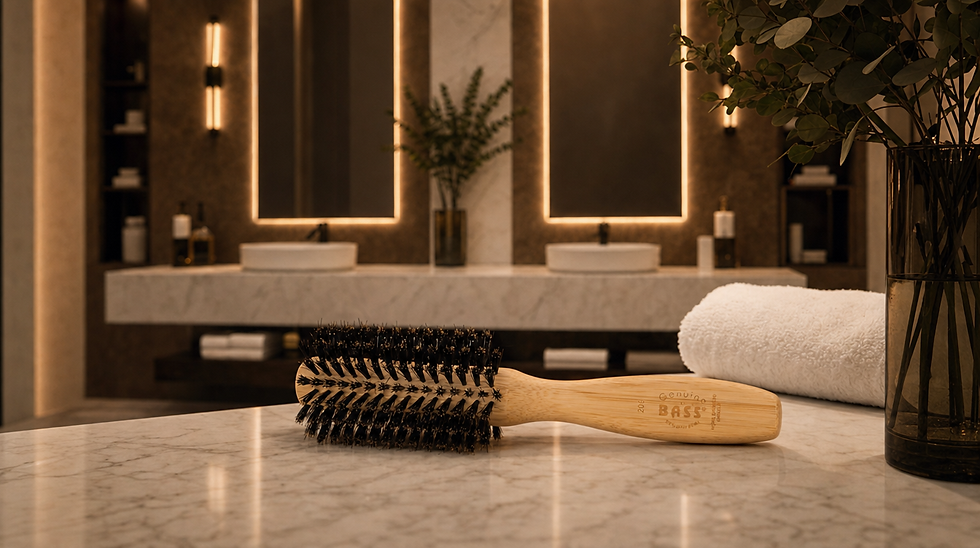
This is where a boar bristle brush can become one of the most useful refresh tools. It works on dry hair, interacts with natural scalp oil, smooths the visible surface, and helps restore enough direction for the remaining style to look intentional again. It does not rebuild the hair from scratch. It does not replace a blowout, redefine curls, or detangle knots. Its professional value is more precise: it helps decide whether second-day hair can be renewed through redistribution and refinement before cleansing, dry shampoo, or restyling becomes necessary.
Second-Day Hair Is Usually a Placement Problem First
The most common misunderstanding about second-day hair is assuming that any visible oil means the hair needs to be washed. Sometimes it does. But often the issue is not total oil level; it is oil placement.
Sebum is produced at the scalp. Unless it is moved, it remains concentrated near the root area.
This is why second-day hair can feel heavy at the scalp while the mid-lengths and ends still look dry. The hair may seem oily and under-conditioned at the same time because the natural oil is gathered in one zone instead of distributed through the hair fiber.
A boar bristle brush helps address this imbalance because its bristles can pick up a small amount of oil from the root area and carry it outward. The goal is not to make the hair oily from roots to ends. The goal is to reduce concentration at the scalp while giving the lengths a very light natural conditioning effect.
This is especially useful when the hair looks close to wearable but not quite finished. The root area may look slightly separated. The ends may look a little dry or piecey. The surface may look less reflective than it did the day before. In that state, brushing can often restore proportion. The roots look less heavy because oil is no longer sitting only at the scalp. The lengths look softer because they receive some lubrication. The overall finish looks cleaner because the contrast between root and end has been reduced.
That is the first professional insight: second-day refreshing is not always about removing oil. Sometimes it is about moving it.
The Stylist’s Assessment Before the Brush Touches the Hair
A professional second-day refresh begins with reading the hair in sections, not brushing automatically from top to bottom. The stylist looks for what has changed since the original style and what still deserves to remain.
The scalp and roots show how much natural oil has returned. The crown shows whether sleep has pressed the hair flat. The part shows whether oil has created visible separation. The hairline shows whether short fibers have lifted away from the shape. The mid-lengths reveal whether the previous styling direction is still present. The ends show whether the hair needs softening, separation, or minimal contact.
This assessment determines the type of refresh needed.
A root refresh is appropriate when oil has collected near the scalp but the rest of the hair still has enough shape. The brush is used lightly near the base and guided outward just enough to reduce root heaviness.
A surface refresh is appropriate when the visible canopy, part, hairline, or crown looks disturbed, but the body of the style remains intact. The brush stays mostly on the outer layer.
A full-length refresh is appropriate when the hair needs broader oil distribution and the existing shape can tolerate root-to-end brushing.
These are different decisions. Treating every second-day condition with the same broad brushing pattern can flatten volume, loosen waves, or over-distribute oil. A stylist chooses the least amount of brushing that solves the visible problem.
Detangle First, Then Refresh
Second-day hair often contains small hidden tangles, especially at the nape, underneath longer layers, or near the ends. These tangles usually come from sleep friction, clothing contact, or the movement of the previous day. They should be released before a boar bristle brush is used.
This order is essential because boar bristle is not a detangling system. When the brush meets a knot, the bristles cannot polish or distribute oil properly. They catch. The hand naturally adds pressure. The hair experiences more tension than the refresh requires.
A stylist removes resistance first with fingers, a wide-tooth comb, or a detangling brush suited to separation. Once the hair moves freely, the boar bristle brush can work the way it is meant to work: with light contact, dry hair, and a smooth path from the scalp or surface into the lengths.
The sequence is simple but important. Detangling frees the hair. Boar bristle brushing refines it.
Reversing that order turns a finishing tool into a force tool, which is exactly what second-day hair usually does not need.
Why Boar Bristle Works So Well on Dry Second-Day Hair
Second-day refreshing depends on dry hair. Oil does not distribute well across water-saturated strands, and wet hair is more elastic and vulnerable under tension. Dry hair allows the brush to interact directly with the scalp’s natural oil and the hair’s surface condition.
Boar bristle is especially suited to this work because it does not simply push hair into place.
Natural bristles have a fine surface texture that can collect small amounts of oil, hold them briefly, and release them gradually as the brush travels. This produces a softer and more integrated result than adding a visible layer of product too early.
The mechanism also affects appearance. Sebum reduces friction between strands. When friction decreases, the hair surface becomes less prone to catching, scattering, and looking rough. The outer layer lies more uniformly, and light reflects more evenly. That is why second-day hair can look cleaner and more polished after brushing even though it has not been washed.
The visible improvement comes from three changes happening together: oil becomes less concentrated at the root, the dry-looking lengths receive light lubrication, and the surface fibers are guided back into a more coherent direction. This is why a boar bristle refresh can be subtle in the hand but noticeable in the mirror.
Preserving the Previous Style Instead of Erasing It
Second-day hair often still contains the memory of the previous style. A blowout may still turn under at the ends. A side part may still have its sweep. Loose waves may still have their rhythm. A smooth style may still fall in the right general direction even if the surface has softened.
That remaining direction is valuable. The purpose of a refresh is to preserve as much of it as possible.
A stylist brushes with the existing shape rather than through it indiscriminately. If the ends still bend inward, the brush follows the fall and the hand can help return the end shape. If the hair has loose waves, the brush may only smooth the canopy rather than passing through every wave. If the style is intended to sit close to the head, the brush may use more controlled surface tension. If the crown needs height, brushing must be lighter and more lifted.
The mistake is treating second-day hair as though it has no remaining structure. Brushing everything straight down may make the surface look calmer for a moment, but it can also remove the lived-in softness that makes second-day hair useful. The better approach is selective editing: keep the shape that still works, correct the zones that no longer do, and avoid turning a refresh into a full restyle unless the hair truly requires it.
Refreshing Oily Roots Without Losing Lift
The root area is usually the most delicate part of a second-day refresh because it holds both oil and volume. If the brush removes the oily look but presses the hair flat, the result may be cleaner but less flattering.
A stylist avoids this by lifting sections slightly before brushing. Instead of placing the brush on top of the head and dragging downward repeatedly, the section is raised just enough to create space at the root. The brush then moves from the base into the mid-lengths with light contact. This allows some oil to travel outward without sealing the root flat against the scalp.
At the crown, this is especially important. The crown often becomes compressed overnight. Direct downward brushing can exaggerate that compression. A better refresh uses gentle lift, a short controlled pass, and then hand placement to let the hair fall back with some air still preserved.
At the part, the issue is usually separation. Oil can make the part look too sharp or slightly broken into lines. Light brushing on each side of the part can soften that separation. The part can then be reset with the fingers so it looks intentional rather than oily.
At the hairline, the brush should be used sparingly. Short hairs and face-framing pieces need directional control, not repeated pressure. A few small strokes are often enough to reconnect them to the larger shape.
A root refresh succeeds when the scalp area looks less concentrated with oil but the hair still has lift.
Smoothing the Second-Day Surface
The surface of second-day hair changes quickly because it is exposed to the most contact. It rubs against pillows, hands, clothing, and air. It also reflects light first, so small disturbances are visible even when the hair underneath remains in good condition.
A boar bristle brush can restore order to that outer layer. The bristles create many fine points of contact across the surface, guiding lifted fibers back toward the main fall of the hair. When a small amount of natural oil is carried across that surface, the cuticle receives enough lubrication to reduce the rough, dry look that often appears after sleep.
The stylist chooses the depth of contact carefully. Sometimes only the canopy needs a light pass. Sometimes the brush must work through a section because dryness or oil imbalance is not limited to the top layer. The difference depends on what the hair shows.
Surface smoothing is especially useful before a second-day ponytail, bun, tuck, or clipped-back style. In those cases, the brush can prepare the visible outer layer so the finished look appears deliberate without requiring heavy smoothing product. The hair does not need to be made stiff. It needs to be brought back into the same visual direction.
Direct-Set Versus Cushioned Boar Bristle for Refresh Work
Brush construction changes how a second-day refresh feels and finishes. A boar bristle brush is not defined by bristle material alone; the way the bristle field is supported affects the kind of contact it creates.
A direct-set boar bristle brush usually gives firmer, more linear contact because the tufts are anchored into a stable base. This can be useful when the stylist needs precise surface control.
Hairline flyaways, a clean part, close-to-the-head smoothing, and sleek second-day styles often benefit from that more direct contact. The caution is that direct contact can also flatten fine hair or root volume if used too heavily.
A cushioned boar bristle brush creates a softer and more adaptive contact because the bristle field moves with the cushion beneath it. This can be helpful for broader polishing, longer passes, fuller hair, sensitive scalps, and second-day refreshing where comfort and contour matter. The cushion helps distribute pressure so the brush can smooth without feeling overly rigid.
Neither construction is automatically better. The choice depends on the refresh objective. Direct-set contact is useful for controlled refinement in a specific area. Cushioned contact is useful for broader redistribution and softer polishing. A stylist chooses the brush structure according to how much control the hair needs and how easily it could be flattened.
When Sectioning Makes the Refresh Better
Second-day brushing can fail when the brush only touches the outermost layer. This is especially common on thick, dense, or long hair. The top may look smoother after brushing, but oil can still sit near the scalp underneath, and the ends may remain dry or separated.
Sectioning gives the brush access. The stylist may lift the top layer, brush lightly through the root and mid-length below it, then let the section fall back. On the sides, sectioning helps move oil away from the temples without overworking the face-framing pieces. At the nape, it helps locate hidden tangles or areas that feel heavy from friction and oil.
The purpose is not to create a long or complicated routine. Sectioning should be only as detailed as the hair requires. Fine hair may need almost none. Medium hair may need a few broad divisions. Dense hair may need more deliberate access so the brush can work through the interior rather than only polishing the canopy.
The guiding principle is access, not force. If the brush is dragging, the section is probably too large, the hair is not fully detangled, or the refresh is being attempted too aggressively.
How Boar Bristle Works With Dry Shampoo
Dry shampoo and boar bristle brushing are often used in the same second-day routine, but they do not solve the same problem.
Dry shampoo absorbs oil. Boar bristle redistributes oil. If the root area is only lightly oily, brushing first may be enough. The brush can move some of that oil into the lengths, soften the surface, and reveal that the hair did not need product at all.
If the root area is visibly oily, separated, or heavy, dry shampoo may be useful. In that case, it should be applied where the oil is concentrated and allowed to sit briefly before being blended. A boar bristle brush can then help soften the treated root area and reduce visible residue, but the brushing should remain light.
Overworking dry shampoo with a brush can create a dull, dusty finish. The hair may no longer look oily, but it may lose natural reflection and softness. That is why a stylist uses the least product needed and brushes only until the root area looks integrated.
Smoothing creams, oils, and shine products should be treated with even more restraint on second-day hair. Since natural oil is already present, added product can quickly make the finish heavy.
Brushing first gives the stylist a clearer view of what the hair can resolve on its own.
Adapting the Refresh to Hair Type
Fine hair usually needs the lightest touch. Because the strands are smaller in diameter, oil becomes visible quickly, and too much brushing can collapse volume. A stylist may focus on the root area, hairline, and surface rather than full-length brushing. The goal is to make fine second-day hair look fresher without making it look smaller.
Medium-density hair often allows a more balanced refresh. Light root-to-mid-length brushing, canopy smoothing, and a few full-length passes may be enough to restore softness and polish while preserving movement.
Thick or dense hair usually needs sectioning. Without it, the brush may only smooth the surface while leaving oil and friction underneath. Smaller sections allow the bristles to reach the scalp area and distribute oil more evenly without added force.
Straight hair can show root oil quickly, so lift at the base matters. Wavy hair often benefits from selective brushing because too much full-length brushing can loosen the pattern. Curly and coily hair require the most adaptation. A boar bristle brush may be used on stretched styles, gathered styles, sleek panels, the crown, the hairline, or the outer surface, but brushing through intact curls may disrupt definition. In those cases, the refresh should be targeted rather than complete.
The technique changes because the goal is not to make all hair types behave the same way. The goal is to refresh each texture without taking away the structure that should remain.
When Brushing Is Not Enough
A boar bristle brush is useful for many second-day conditions, but it is not a substitute for cleansing when the hair truly needs to be cleansed. A stylist knows the difference.
If the scalp feels heavily coated, if the hair has absorbed sweat, if product buildup is making the roots tacky, if odor is present, or if the style collapses immediately after brushing, a refresh may not be enough. In those cases, dry shampoo, a fuller restyle, or washing may be the more appropriate answer.
Brushing is most effective when the hair is dry, mostly clean, lightly oily, and still has some usable shape. It is less effective when the hair is overloaded, damp, tangled, or coated with too much residue. It should also be used carefully on curl patterns or styles that would be damaged by full brushing.
This distinction protects the integrity of the technique. Boar bristle refreshing is not meant to force one more day out of hair that is no longer in a refreshable state. It is meant to recognize when balance can still be restored.
The Professional Finish: Balanced, Not Rebuilt
The best second-day refresh has a recognizable character. It does not look freshly washed, and it does not need to. It looks balanced. The root area appears cleaner because oil is no longer concentrated in visible patches. The surface appears calmer because fibers have been guided back into direction. The ends appear less dry because they have received a trace of natural lubrication. The style still has movement because it has not been overbrushed.
That balance is the reason stylists use boar bristle brushes so effectively for second-day hair. The brush gives them a way to intervene before stronger steps are needed. It can reveal whether the hair needs redistribution, product absorption, targeted smoothing, or a true reset.
The result is not dramatic correction. It is professional restraint. The hair looks maintained rather than manipulated, refreshed rather than recreated.
Conclusion: Refreshing Second-Day Hair With Judgment
Second-day hair is often misunderstood because it sits between clean and ready-to-wash, styled and undone, polished and lived-in. A boar bristle brush helps navigate that middle ground.
Its role is not to detangle knots, create new shape, or disguise hair that truly needs cleansing. Its role is to redistribute natural oil, restore surface order, preserve useful style memory, and bring the hair back into visual balance. In professional hands, that makes it a diagnostic tool as much as a finishing tool.
The essential lesson is simple: second-day hair should not always be restarted. Sometimes it should be read, refined, and allowed to continue. A boar bristle brush gives stylists a precise way to do that, using the hair’s own natural oils and existing direction to create a finish that looks intentional between wash days.
Frequently Asked Questions
Is a boar bristle brush good for second-day hair?
Yes. A boar bristle brush is especially useful when second-day hair has light oil at the roots, dry-looking lengths, or a disturbed surface. It can help redistribute natural oil and make the hair look more balanced without immediately adding product or washing.
Should I brush second-day hair before using dry shampoo?
Often, yes. Brushing first helps reveal whether the hair simply needs oil redistribution. If the roots still look oily or separated after brushing, dry shampoo can be applied more precisely.
What is the difference between dry shampoo and boar bristle brushing?
Dry shampoo absorbs oil at the scalp. Boar bristle brushing moves natural oil from the scalp into the lengths and smooths the surface. One reduces oil concentration; the other redistributes and refines it.
Can boar bristle brushing make second-day hair greasy?
Yes, if too many passes are used or if the hair is already heavily oily. Fine hair is especially sensitive. Use light pressure and stop once the roots look less separated and the surface looks smoother.
Should I detangle before using a boar bristle brush on second-day hair?
Yes. Boar bristle brushes are not meant to pull through knots. Detangle first, then use the boar bristle brush for smoothing, polishing, and oil distribution.
How do stylists refresh oily roots without flattening the hair?
They usually lift small sections and brush lightly from the root toward the mid-lengths instead of pressing the brush straight down over the scalp. This moves oil outward while preserving lift.
Can a boar bristle brush help second-day hair look shinier?
Yes. By distributing natural oil and guiding the surface fibers in a more consistent direction, boar bristle brushing can improve light reflection and create a softer natural shine.
Is a direct-set or cushioned boar bristle brush better for second-day refreshing?
A direct-set brush gives more controlled surface contact for sleek areas, parts, hairlines, and flyaways. A cushioned brush gives softer, broader contact for polishing and comfort. The better choice depends on the refresh goal.
Can I use a boar bristle brush on second-day waves?
Yes, but selectively. Brushing through all the waves may loosen the pattern. Many second-day waves respond better to light canopy smoothing, crown refinement, and hand reshaping.
Can curly or coily hair be refreshed with a boar bristle brush?
Yes, when used selectively. It may be helpful on stretched styles, gathered styles, sleek panels, the hairline, crown, or surface layer. It should not be forced through intact curls if curl definition is the priority.
How many strokes should I use for second-day hair?
Use the fewest strokes needed to improve balance. Stop when the root area looks less oily, the surface looks calmer, and the hair still has movement. More brushing is not always better.
When is second-day brushing not enough?
Brushing may not be enough when the scalp is heavily oily, sweaty, coated with product buildup, damp, tangled, or carrying odor. In those cases, dry shampoo, restyling, or washing may be needed.









