


How Round Brush Construction and Wear Affect Professional Blowout Control


Key Takeaways
Round brush construction influences professional control through barrel geometry, bristle or pin engagement, venting, surface behavior, handle stability, and overall balance.
Wear often appears first as compensation, such as increased tension, smaller sections, repeated passes, harder gripping, slower release, or additional heat exposure.
Uneven bristle or pin wear can disrupt tension distribution and penetration, while barrel distortion or surface damage may alter rotation, glide, curvature, and release.
Stylists should distinguish buildup, hair variability, and technique issues from true structural wear by cleaning, inspecting, and comparing the brush’s behavior under similar conditions.
Replacement should be based on functional performance rather than age alone; a professional round brush should maintain predictable engagement, rotation, airflow, stability, and release.
A round brush can remain physically intact long after it stops behaving exactly as it did when it was new.
For a professional stylist, that distinction matters.
A familiar brush may gradually begin requiring slightly more hand pressure to maintain rotation.
One part of the bristle field may grip differently from another. Hair may release less cleanly from a section of the barrel. A handle connection may develop a small amount of movement. Vents may become partially obstructed. Bristles or pins that once distributed resistance evenly may bend, loosen, spread, break, or change position through repeated use.
None of these changes necessarily causes an immediate, dramatic failure. More often, the stylist compensates.
The hand grips harder. The section becomes smaller. Tension increases. The brush is rotated more cautiously. The dryer stays on the section longer. A pass is repeated because the first one no longer produces the expected control.
That ability to compensate is part of professional skill, but it can also conceal tool wear.
Round-brush control depends on a predictable relationship among the stylist's hand, the brush structure, the hair, airflow, heat, movement, and cooling. When the physical behavior of the brush changes, the stylist may still be able to produce a good blowout, but the technique required to produce it has changed.
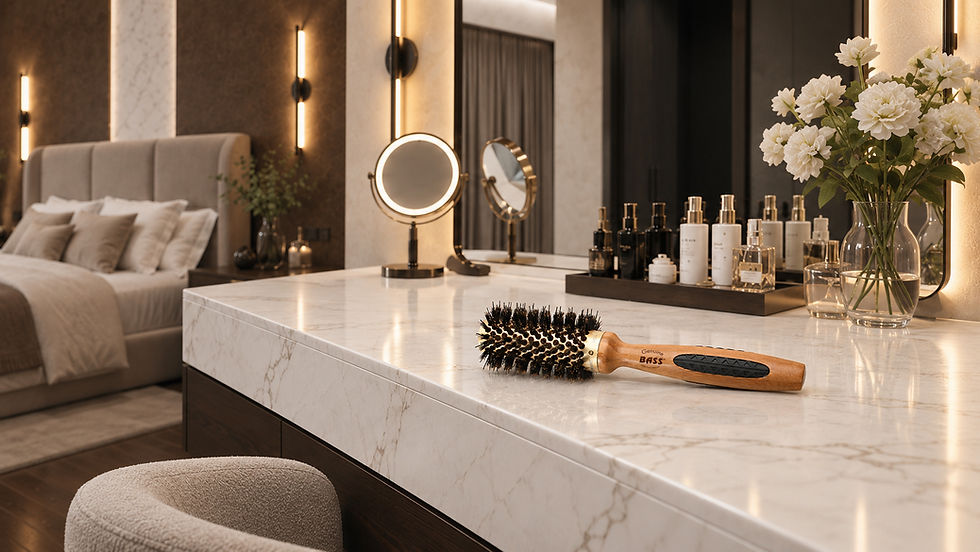
Understanding that difference is essential in professional work. Brush condition is not merely a maintenance issue. It is part of the control system.
Construction Establishes the Brush's Control Characteristics
Two round brushes of the same nominal diameter can behave very differently because diameter is only one part of construction.
Diameter establishes the basic scale of curvature. Larger diameters support broader, straighter lines, smoothing, softer movement, and broad curvature. Medium diameters support waves, bends, movement, and moderate curvature. Smaller diameters support tighter turns, curls, and more concentrated curvature.
Professional control within that geometry depends on additional features.
The usable barrel length determines how much section width can be carried comfortably. Bristle or pin length affects how deeply the working elements can enter the hair. Density and spacing influence how contact is distributed. Flexibility affects how those elements respond under load.
Venting changes how airflow can move through the brush. Core and surface construction influence heat behavior. Handle geometry and balance affect rotation, leverage, elevation, and directional accuracy.
These characteristics create the brush's working behavior before technique begins.
A stylist learns that behavior through repetition. The hand develops expectations about how much resistance the brush will create, how quickly it rotates, how firmly it engages a section, how easily the hair releases, and how the tool responds as additional hair accumulates around the barrel.
Professional control becomes efficient partly because those responses are predictable.
Wear matters when that predictability begins to change.
Professional Control Travels Through the Entire Brush
It is useful to think of a round brush as a chain of mechanical control.
The stylist applies movement through the handle. The handle transfers that movement through its connection with the barrel. The barrel establishes geometry. The bristles or pins engage the hair against that geometry. Airflow and heat act on the controlled section while the brush directs its path.
A change anywhere in that chain can alter what the stylist feels at the hand.
Handle and Joint Stability Affect Rotational Precision
Round-brush styling requires frequent changes in orientation. A stylist may elevate a section, roll the barrel partially, advance through the lengths, reverse rotation, adjust wrist angle, create a bend, or unwind the section during release.
The handle must transmit those movements accurately.
If the handle-to-barrel connection begins to loosen, even slightly, the stylist's hand can move before the barrel responds fully. That small amount of play may reduce the precision of partial rotations and make tension feel less direct.
The effect becomes especially noticeable when the brush is heavily loaded with hair. A loose or flexing connection can make the barrel feel less stable during elevation or directional changes, encouraging the stylist to grip harder to regain certainty.
A worn grip surface can create a different problem. If the handle becomes unusually smooth, damaged, or difficult to hold securely, the hand may increase gripping force. That does not change the hair directly, but it can reduce rotational fluency and increase fatigue over a full service.
Professional ergonomics and styling control are therefore connected. A brush that makes the hand compensate can gradually make the technique less efficient even when the barrel itself still looks usable.
Barrel Integrity Protects Predictable Geometry
The barrel is the form around which the hair is shaped.
Its nominal diameter may not change, but its working geometry can become less reliable if the structure becomes dented, warped, distorted, or otherwise irregular.
That matters because the section does not interact with the diameter printed on a package. It interacts with the actual surface presented beneath the hair.
A consistent cylinder allows the section to wrap and travel around a predictable curve. An irregular barrel can alter contact locally. Hair may sit more tightly against one area and more loosely against another. Rotation can feel uneven. A section that normally unwinds smoothly may hesitate at a particular point.
For broad smoothing, small geometric irregularities can disturb even tension across the section. For waves, bends, and curls, they can make curvature less uniform. During release, irregular contact may create drag where the stylist expects the hair to unwind freely.
This does not mean every cosmetic mark changes performance. A scratch or finish change that does not affect contact may have little practical consequence.
The professional question is whether the barrel still behaves as a stable shaping surface.
Surface Wear Can Change Glide
The outer surface of the barrel also contributes to how the section moves.
Different constructions may use exposed structural materials, coatings, finishes, or other surface treatments. Their thermal and friction characteristics vary, so wear must be interpreted according to the specific brush.
A surface that becomes rough, chipped, lifted, or damaged may no longer allow hair to travel across it as evenly as before. The stylist may notice that release feels less fluid, that a particular region catches more readily, or that rotation requires more force once the section reaches a certain position.
Again, the important distinction is functional rather than cosmetic.
A worn-looking surface is not automatically unusable. A surface that alters hair movement is a control problem.
Bristle and Pin Wear Changes the Distribution of Tension
The bristle or pin field is one of the most important interfaces in the entire round-brush system because it connects the hair to the barrel.
The working elements do not simply "hold" the hair. They determine how deeply the brush reaches into a section, how resistance is distributed, how the section stays organized during movement, and how readily the hair can leave the brush afterward.
Wear can change each of those functions.
Bristles may bend, break, spread, shed, or become uneven through repeated loading. Synthetic pins may become distorted or heat-damaged depending on their material and exposure. Individual working elements may loosen from their original position. A previously uniform field may develop areas with noticeably different density or projection.
The consequence is often uneven engagement.
Imagine that one portion of a brush has retained its original density while another has lost several working elements. The intact area may continue producing normal traction while the worn area allows greater slip.
The stylist now receives two different resistance patterns from one barrel.
Increasing overall tension may make the intact area grip too strongly while still failing to restore control in the worn area. Rotating farther may temporarily increase contact, but it also changes the amount of wrap and can create unintended curvature or make release more difficult.
This is why more force is not a reliable answer to bristle wear.
The underlying problem is not insufficient effort. It is inconsistent distribution of contact.
Penetration Can Decline Before the Brush Looks Severely Worn
Wear is particularly important in brushes whose working elements must penetrate substantial sections.
A pin or bristle can remain present while losing some of its effective projection because it has bent, splayed, softened, or shifted.
On dense hair, the change may become apparent as a brush that still grips the surface but no longer organizes the interior of the section as effectively.
The stylist may interpret this as unusually resistant hair or excessive density and begin taking smaller sections.
Smaller sections may indeed restore control, but they do not explain why the same brush previously managed a larger workload.
That comparison is useful.
When a familiar technique suddenly requires systematically smaller sections across similar working conditions, the brush itself belongs in the diagnosis.
Venting and Buildup Can Change Airflow Through the Tool
Vented construction introduces another performance variable.
The openings in a vented barrel allow airflow to pass through or around the brush structure, supporting moisture removal while the section is held in shape.
Over time, hair, dust, styling-product residue, and other debris can accumulate around bristles, at the base of the working elements, or within vent openings.
This is not necessarily structural wear, but it can imitate it.
Restricted venting can change how efficiently air reaches the section. If the brush no longer allows airflow to move as freely as expected, drying may become slower or less even. The stylist may compensate by holding the dryer on the section longer, increasing temperature, repeating passes, or moving more slowly.
Those adjustments can appear to solve a drying problem while leaving its actual cause untouched.
If performance returns after residue is removed appropriately, the problem was maintenance.
If airflow, engagement, rotation, or structural stability remains abnormal after proper cleaning, the brush may be experiencing genuine wear.
That distinction prevents premature replacement while also preventing buildup from becoming normalized as part of the tool's behavior.
Heat Exposure Can Reveal Weaknesses in Construction
Professional round brushes operate repeatedly in a heated environment.
The significance of that heat depends on the brush's materials, construction, airflow, dryer distance, working temperature, and duration of exposure. Different cores, coatings, bristle systems, adhesives, joints, and structural materials do not respond identically.
For that reason, heat-related wear should be assessed by observed change rather than by assuming that one construction always fails in one way.
A barrel may lose geometric stability. A coating may show functional deterioration. Synthetic working elements may distort. A joint may loosen. Components near the dryer stream may show signs of heat damage.
What matters professionally is whether the change affects the shaping process.
A brush should not be expected to compensate for excessive or poorly controlled dryer heat, but normal professional use also places repeated thermal demands on the tool. Construction quality determines how well the brush preserves its useful geometry and working relationships under that service load.
If a brush begins behaving differently only after it becomes very warm, that pattern also deserves attention.
The issue may not be technique alone. Temperature can expose movement, distortion, softening, or instability that is less noticeable when the brush is cool.
Wear Often Appears First as Compensation
One of the most useful professional indicators of brush condition is not what the brush looks like.
It is what the stylist has started doing differently.
A worn tool often creates compensation before it creates obvious failure.
The stylist may begin pulling harder because engagement has weakened.
More rotation may be used because the section no longer stays connected through a partial turn.
Smaller sections may become necessary because penetration has declined.
The dryer may remain on the section longer because venting or thermal behavior has changed.
The wrist may grip more firmly because the handle feels less stable.
A section may be brushed again because the first pass produces less consistent smoothing or curvature.
Release may become slower because the hair no longer unwinds cleanly.
Each adjustment can be reasonable in isolation. The concern is the pattern.
When several compensations begin accumulating around one familiar brush, professional troubleshooting should include the tool itself.
This is particularly important for experienced stylists because automatic technique can hide gradual change. A highly skilled hand may unconsciously adapt for weeks or months before the stylist consciously recognizes that the brush is demanding more work.
Professional skill should make a tool easier to diagnose, not allow deteriorating performance to disappear indefinitely inside better technique.
Separate Hair Variability From Tool Variability
Not every difficult blowout means the brush is worn.
Hair changes from client to client and even from section to section on the same head.
Density can change between the nape, crown, sides, and hairline. Length changes the amount of available barrel contact. Texture influences how the section approaches the brush. Hair condition changes the level of resistance that can be used appropriately. Product residue on the hair can change glide. Moisture distribution can make a surface feel dry while deeper fibers remain wet.
Professional diagnosis therefore requires comparison.
If resistance appears only in one damaged area of hair, the hair may be the controlling variable.
If a brush struggles only when a section becomes too deep, section load may be the problem.
If short hair repeatedly escapes a very large barrel, available hair length may be limiting contact.
But if the same brush begins creating irregular grip across many clients, or the same point on the barrel repeatedly catches regardless of where it is used, the evidence points increasingly toward the tool.
A second brush can sometimes make this distinction obvious.
If another brush of comparable diameter and appropriate construction immediately restores predictable engagement or rotation on the same section, the original brush deserves inspection.
The goal is not to blame the tool quickly.
It is to keep the diagnostic field wide enough that technique does not receive responsibility for a mechanical change it did not create.
Cosmetic Wear and Functional Wear Are Not the Same
Professional tools rarely remain visually pristine.
Handles can develop surface marks. Finishes may lose some original appearance. Bristle fields can become less visually perfect without losing their working behavior.
Replacement should therefore not be based on appearance alone.
Functional wear is more important.
A brush becomes professionally questionable when its physical condition interferes with predictable control.
That may include:
a barrel that no longer maintains stable geometry;
a surface defect that catches or drags hair;
a bristle or pin field with substantially uneven engagement;
working elements that have become distorted enough to change penetration or release;
vent structures that remain damaged or obstructed;
a handle-to-barrel connection that moves during styling;
components showing significant heat damage;
or any structural change that repeatedly requires additional force, heat, manipulation, or correction to produce the intended result.
The standard is not perfection.
It is predictable function.
Cleaning Can Restore Performance, but Cleaning Cannot Repair Wear
Maintenance and wear should remain separate concepts.
Hair and product accumulation can make a sound brush behave poorly. Removing that buildup can restore bristle movement, improve access between working elements, reopen vent pathways,
and make the actual condition of the brush easier to evaluate.
But cleaning cannot reverse structural deterioration.
It cannot straighten a permanently distorted barrel, restore missing bristles, rebuild a damaged coating, tighten every type of failed internal connection, or return deformed working elements to their original construction.
Cleaning methods themselves should also respect the materials used in the brush. Different handle,
barrel, coating, bristle, and attachment systems may tolerate moisture and cleaning agents differently. Excessive soaking, aggressive scraping, harsh chemicals, or inappropriate heat can damage some constructions rather than preserve them.
Professional maintenance therefore has two purposes.
The first is to keep a sound brush performing as designed.
The second is to make genuine wear easier to see.
The Condition of the Hair Changes How Much Brush Wear Matters
The same degree of brush deterioration does not create the same consequence on every head of hair.
Strong, resilient hair may tolerate a small increase in friction that would be inappropriate on fragile, weathered, lightened, or otherwise compromised lengths.
Dense hair may reveal lost penetration quickly because the brush needs substantial reach to organize the section.
Low-density hair may reveal uneven grip because a small number of fibers provide less material over which to average inconsistent contact.
Short sections may expose barrel irregularity because there is little extra length available to stabilize the wrap.
Long hair can place greater cumulative load around the brush, making rotational instability or release problems more apparent.
Professional tool assessment should therefore consider not only whether the brush can still be used,
but whether it remains appropriate for the sensitivity of the current service.
A marginal brush may appear manageable on resilient hair while becoming unnecessarily demanding on vulnerable ends.
The safest professional response is not to determine how much deterioration can be tolerated.
It is to preserve a tool condition that allows control without requiring avoidable compensation.
Adjust Technique Temporarily, but Do Not Make Technique Repair the Tool
There are situations in which a stylist notices a brush problem during a service and must respond immediately.
The first priority is to protect control.
If the brush begins gripping unpredictably, reduce tension.
If penetration is poor, reduce section depth rather than forcing the brush farther into the hair.
If rotation becomes unstable, avoid deep wrapping and use a more conservative motion.
If the hair starts catching during release, stop pulling and unwind carefully.
If airflow through the brush appears restricted, correct any removable obstruction and avoid compensating with excessive heat.
If the handle or barrel feels structurally unstable, discontinue using that brush when continued use would make accurate control difficult.
These are professional adaptations, but they should remain temporary.
Technique can accommodate normal variation in hair.
It should not become a permanent workaround for deteriorated equipment.
When the tool itself is the source of instability, replacing it restores the control relationship more effectively than continually redesigning the blowout around its limitations.
Evaluate the Brush Before the Service Becomes the Test
The best time to discover meaningful brush wear is not while hair is fully wrapped around the barrel.
A brief pre-service inspection can reveal many changes before they enter the styling process.
Rotate the brush in the hand and notice whether the barrel tracks smoothly or appears unstable.
Check that the barrel retains its intended cylindrical form.
Inspect the working surface for damage that could interfere with glide.
Look across the bristle or pin field rather than only at individual elements. The pattern should still provide coherent, reasonably even working contact.
Check for missing, severely bent, melted, loosened, or distorted elements.
Inspect vents for accumulated debris or physical deformation.
Test the handle-to-barrel relationship for movement.
Then consider the brush dynamically.
Does it still turn in the hand the way it should?
Does the grip remain secure?
Does the tool feel balanced?
A static visual inspection can identify obvious defects, but professional round brushing is a moving process. The relevant condition of the tool includes how it behaves in motion.
Replacement Should Be Based on Function, Not a Universal Calendar
There is no meaningful single replacement interval for every professional round brush.
Service frequency differs. Dryer temperatures differ. Hair density differs. Section loads differ.
Cleaning methods differ. Materials and construction differ. Some brushes may spend most of their working life on light finishing services, while others experience repeated high-load blowouts every day.
Age alone therefore tells the stylist very little.
A newer brush can be damaged prematurely.
An older brush can remain mechanically sound.
The useful replacement question is:
Does this brush still reproduce its intended control characteristics reliably enough for professional work?
If it maintains stable geometry, predictable engagement, appropriate airflow, smooth rotation, secure construction, controlled release, and suitable heat tolerance, visible age by itself is not a reason to retire it.
If those relationships have changed materially, continued physical existence is not proof of continued professional usefulness.
Professional Tool Management Preserves Technique
A professional kit is not simply a collection of brush sizes.
It is a working set of controlled mechanical interfaces.
That perspective changes maintenance from housekeeping into performance management.
Brushes should be kept clean enough that buildup does not disguise their true behavior. They should be stored in ways that do not unnecessarily deform the barrel or working elements. Heat damage should not be normalized. Structural changes should be compared against the brush's previous behavior rather than judged only by appearance.
When multiple brushes of the same type are used heavily, their condition should also be considered individually. Two brushes purchased at the same time do not necessarily experience identical service loads or wear.
A stylist who recognizes this can preserve a more consistent relationship between intention and result.
The objective is not to keep every brush looking new.
It is to keep the tools predictable.
Conclusion: A Professional Brush Must Preserve the Relationship Between Hand and Hair
Round-brush construction determines how professional technique reaches the hair.
The handle transfers movement. The barrel establishes geometry. Bristles or pins create engagement. Venting supports airflow. Structural materials and surfaces influence how the brush behaves under heat, rotation, tension, moisture, and repeated use.
Wear changes that system gradually.
The first sign may not be a broken brush. It may be a stylist applying slightly more tension, using slightly more heat, shrinking sections, repeating passes, rotating farther, or slowing release to compensate for a tool that no longer behaves exactly as expected.
That distinction is important because professional blowout control should come primarily from deliberate technique, not from constant correction of equipment instability.
A useful round brush does not merely survive repeated services. It preserves the mechanical relationships that allow the stylist to predict what will happen when the brush enters the section.
When those relationships remain stable, construction supports technique.
When wear changes them, the professional response is to diagnose the change, separate maintenance problems from structural deterioration, adjust safely in the moment, and replace the tool when its condition begins interfering with reliable control.
The governing principle is simple: a professional round brush should make control repeatable.
Once the stylist must routinely compensate for the brush itself, the tool has begun changing the blowout.
Frequently Asked Questions
How can a worn round brush affect a professional blowout?
Wear can change grip, penetration, tension distribution, rotation, airflow, heat behavior, or release. The stylist may then need more force, smaller sections, additional passes, or more correction to create the same result.
Does a round brush need to look damaged before it should be replaced?
No. Functional changes can appear before severe visual damage. Repeated slipping, uneven grip, rough release, barrel instability, distorted bristles or pins, or movement at the handle connection may be more important than cosmetic appearance.
How do I know whether a round brush needs cleaning or replacement?
Clean removable hair and residue appropriately first. If normal engagement, airflow, rotation, and release return, buildup was likely contributing to the problem. If structural instability or inconsistent performance remains, the brush may be worn or damaged.
Can missing bristles or pins affect blowout control?
Yes. Enough missing or displaced working elements can create uneven contact around the barrel. That can produce areas of greater slip or resistance and make tension less consistent across the section.
Can a warped round-brush barrel change the styling result?
Yes. Barrel geometry is part of the shape-forming system. Distortion can alter contact, tension, wrapping, curvature, rotation, and release even if the brush's nominal diameter has not changed.
Why does an old round brush sometimes feel harder to rotate?
Several conditions can contribute, including changed bristle or pin alignment, buildup, surface wear, barrel distortion, handle or joint instability, excessive wrap, or changes in the hair itself.
Compare the brush under clean, controlled conditions before assuming the cause.
Should a stylist compensate for worn bristles by using more tension?
Generally, no. More tension cannot recreate an even bristle field and may increase mechanical stress on the hair. If engagement is inadequate, reduce the section load or change brushes rather than relying on force.
Can clogged vents affect a blowout?
Yes. On a vented brush, significant obstruction can interfere with the airflow pattern the brush is designed to support. This may increase drying time or encourage the stylist to compensate with slower passes or additional heat.
How often should professional round brushes be replaced?
There is no universal replacement schedule. Replacement should be based primarily on condition and performance: barrel stability, bristle or pin integrity, vent condition, surface quality, handle security, rotational control, and the brush's ability to produce predictable engagement and release.
Is cosmetic wear enough reason to discard a round brush?
Not necessarily. Cosmetic wear and functional wear are different. A brush can show signs of age while remaining mechanically reliable. The important question is whether its condition has changed the way it controls hair during blow-drying.
Why might an experienced stylist notice brush wear later than a beginner?
Experienced stylists often compensate automatically for small changes in resistance, grip, rotation, or section control. That adaptability can preserve the finished result while masking the fact that the brush itself has become less predictable.
What is the clearest sign that a round brush has reached the end of its professional service life?
The clearest sign is persistent loss of predictable control. If a properly cleaned brush repeatedly requires unnecessary compensation because its geometry, engagement, airflow, surface, or structural stability has deteriorated, replacement is generally the more reliable professional solution.









