


How Hair Texture Changes Boar Bristle Brushing on a Sensitive Scalp
- Editorial & Publishing Team

- 1 day ago
- 12 min read


Key Takeaways
Hair texture changes the direction and shape of the brushing path, while density changes how much hair the bristles must penetrate to reach the root area.
Straight hair usually permits more continuous strokes, while waves, curls, and coils may require smaller sections, shorter passes, or a different styling state.
On textured hair, surface polishing can be a successful endpoint; deeper scalp penetration is unnecessary when achieving it would require added pressure or root tension.
Brushing can temporarily soften wave, curl, or coil definition, so the scope and timing of the session should match the desired finished texture.
For a sensitive scalp, change the path, scope, timing, or construction before increasing force, and stop if brushing causes pain, burning, bleeding, or increasing irritation.
A boar bristle brush does not travel through every texture along the same path. On straight hair, the bristle field can often move from the root area through the lengths with little change in direction.
Waves make the stroke negotiate bends. Curls ask the brush to reorganize repeated arcs. Coils can make the difference between surface contact and scalp contact much larger, especially when the pattern is compact or strongly shrunken. For a sensitive scalp, those differences matter because the hair can absorb, redirect, or delay the force coming from the hand before the bristles reach the skin.
The practical question is therefore not whether one texture is "better" for boar bristle brushing. It is how the shape of the hair changes the stroke. A texture that lets the brush travel freely may require very little adaptation. A texture that repeatedly changes direction may call for smaller sections, shorter passes, a different styling state, or a narrower goal such as surface polishing rather than deep root access. The scalp should not be asked to tolerate more pressure simply because the hair makes the route more complicated.
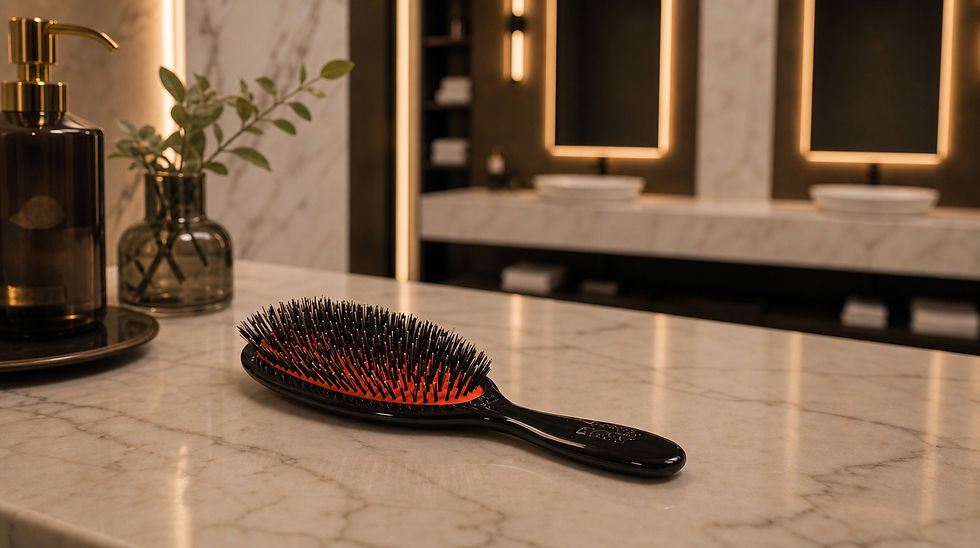
That is the texture-specific lesson. Boar bristle brushes are Shine & Condition tools: they polish, smooth, and help move natural scalp oils through dry, already-detangled hair. Hair texture changes how that work is reached. On a sensitive scalp, good technique comes from adjusting the path, scope, and timing of the stroke before increasing force.
Texture Changes the Shape of the Stroke
Hair texture describes the shape or pattern of the fiber: straight, wavy, curly, or coily. It is different from hair density, which describes how much hair occupies an area of the scalp, and from strand diameter, which describes how fine or coarse an individual fiber is. Those variables overlap, but they do not create the same brushing problem.
Density mainly changes depth: how much hair stands between the bristle field and the root area.
Texture mainly changes direction: how many bends, arcs, turns, or compact changes in orientation the brush must negotiate as it moves through the hair. A person can therefore have low-density coily hair, high-density straight hair, fine curls, coarse waves, or almost any other combination. The brushing response should follow the actual resistance in the section rather than a texture label by itself.
This distinction becomes especially useful on a sensitive scalp. If the brush feels difficult to move, the resistance may be occurring in the hair long before the bristles reach the skin. Pressing harder can then solve the wrong problem. A texture-aware approach asks first what the hair pattern is making the brush do, then changes that pathway so scalp contact remains predictable.
Straight Hair: Use the Direct Path to Reduce Mechanical Work
Straight hair usually gives a boar bristle brush the most continuous route. Once the hair is dry and detangled, the bristle field can often enter near the roots and continue through the lengths without repeatedly changing direction. That makes long polishing passes mechanically efficient.
For a sensitive scalp, the advantage is not that straight hair should be brushed more. It is that less corrective work may be necessary. When the brush already reaches the root area easily, there is little reason to add pressure, over-section the hair, or repeat the same path simply to create a stronger sensation. The direct route should make the session simpler.
Straight hair can still be dense, coarse, or locally uneven in coverage, so texture does not eliminate other variables. But when the path itself is uncomplicated, the texture-specific goal is to preserve that ease: let the brush travel rather than turning a naturally efficient stroke into a more forceful one.
Wavy Hair: Each Pass Temporarily Reorganizes the Bends
Wavy hair introduces directional change without completely interrupting stroke continuity. As the brush moves through a wave, the bristles meet the strand at changing angles. A long pass may temporarily draw part of the wave straighter before the pattern settles again. That creates more resistance through the lengths than the same stroke would encounter on similarly dense straight hair.
On a sensitive scalp, this matters because tension can travel back toward the roots even when the bristle tips are not pressing firmly into the skin. If a wave pattern makes the stroke feel heavy, the useful adjustment is to reduce how much pattern the brush must reorganize at once. A smaller section or shorter pass can lower the pull transmitted toward the scalp without changing the brush's basic root-to-end direction.
The desired finish also matters. Full-length boar bristle brushing naturally smooths and aligns the surface, so it can soften visible wave definition. If the goal is a polished, smoother finish, that may be useful. If the goal is to preserve a freshly formed wave pattern, fewer or more selective passes may make more sense. Texture therefore changes not only resistance, but whether a full polishing session serves the styling objective at that moment.
Curly Hair: The Stroke Becomes a Pattern-Management Decision
With curly hair, repeated arcs create a more pronounced difference between brushing the surface and moving through the full section. Even after tangles are removed, the brush must temporarily reorganize multiple curves as it travels. The more of that pattern a single pass is asked to straighten or align, the more resistance can build before useful scalp contact occurs.
This is why reduced penetration should not automatically be treated as brush failure. If the session is intended to polish the canopy, the brush may accomplish useful Shine & Condition work without reaching the scalp deeply through every section. If the goal is broader root-to-length distribution, the hair can be worked in manageable sections so each pass has less curl structure to reorganize at one time.
Timing is especially important because full dry brushing can visibly loosen or stretch curl definition.
Many curly-haired users will find the brush more compatible when the hair is already stretched, loosely arranged, or being prepared for a smoother finish. If the curl pattern is meant to remain highly defined, limiting the scope of brushing may be the more logical choice. The sensitive-scalp benefit is that the technique can be adapted to the styling state instead of forcing the brush through a pattern that is actively resisting the intended finish.
Coily Hair: Surface Polishing Can Be the Correct Endpoint
Coily hair can create the largest separation between the outer hair surface and the scalp when the pattern is compact, strongly shrunken, or densely packed. The bristle field may engage the canopy effectively while much of the scalp remains physically separated from the brush by the shape and arrangement of the hair.
That does not mean a useful session has failed. A boar bristle brush can still smooth the surface and move oils through accessible portions of the hair. If deeper penetration would require pressing, compressing the hair mass, or creating strong root tension, accepting a surface-polishing role may be the better mechanical decision for that session.
For fuller root-to-length use, coily hair may be more accessible when it is already stretched or loosely organized. Even then, density, strand diameter, shrinkage, section size, and brush construction can matter as much as texture. A lower-density coily section may be easier to reach through than very dense straighter hair. The useful measure is the resistance in the actual section, not the category name.
Three Texture Questions to Ask Before You Change Pressure
Texture-aware brushing becomes much clearer when the user separates three questions that are often collapsed into one.
1. How much pattern is the brush being asked to reorganize?
A straight section may require almost no directional reorganization. A wave, curl, or coil asks progressively more of the stroke as the bristles cross changing angles. If the brush starts to drag through the lengths, reduce the amount of pattern inside the pass before adding force. That may mean a smaller section, a shorter stroke, or brushing when the hair is arranged in a more accessible state.
2. Do you want the brush to change the visible pattern?
Boar bristle brushing is a polishing action. On textured hair, polishing and alignment can soften wave, curl, or coil definition. That is not automatically a technique error. It is an outcome that should match the user's goal. If smoothing is desired, a fuller session may be appropriate. If preserving definition is the priority, a more limited surface pass or a different time in the styling cycle may be the better choice.
3. Is scalp contact arriving predictably?
Hair resistance and scalp contact are separate events. A brush can feel heavily resisted in the lengths while barely reaching the scalp, then suddenly make firmer contact when it moves through a resistant area. On a sensitive scalp, that unpredictability matters more than achieving maximum penetration. If contact becomes abrupt, change the route or accept less depth rather than driving the brush farther.
These three questions keep the adjustment centered on texture. They also prevent the common mistake of using pressure as the universal answer to every difficult stroke.
Texture and Density Are Different Brushing Problems
Texture and density often appear together, but they should not be treated as interchangeable.
Density changes how much hair the bristles must pass through. Texture changes the direction of that passage. High density can make a straight section deep; strong curl or coil can make a lower-density section directionally complex. Either can reduce scalp access, but they do so for different mechanical reasons.
That difference changes the first adjustment. A mainly density-driven problem often responds to shallower sections because the goal is to reduce hair depth. A mainly texture-driven problem may also respond to sectioning, but the reason is different: the brush is being asked to reorganize fewer bends or turns at once. In practice the same technique can solve both problems, yet understanding why it works keeps the user from assuming that every difficult stroke requires a firmer brush or heavier hand.
Brush Construction Changes How Texture Resistance Is Felt
Hair texture does not dictate one ideal boar bristle construction. It changes how construction variables are experienced while the brush negotiates the pattern.
All else equal, softer boar bristles deflect more readily. That can make contact feel lower in intensity, but the same flexibility may cause the bristles to bend through the upper layers of a resistant texture before they reach the root area. Firmer or longer bristles may travel farther, yet the useful choice remains the one that works through the section without requiring the scalp to absorb unnecessary force.
A cushioned base can add movement beneath the bristle field, while a direct-set base transmits hand movement more immediately. Those differences may become more noticeable when the hair itself is already redirecting the bristles. They do not create a universal texture ranking; they simply change how the brush responds to resistance.
Mixed boar-and-nylon systems add another tradeoff. Longer synthetic pins may enter thicker or more resistant hair before the boar field reaches the same depth, which can improve access.
Depending on pin rigidity, length, spacing, tip geometry, and overall construction, those pins can also create more direct scalp contact. For a sensitive scalp, extra penetration is useful only when the resulting contact remains controlled.
The texture-specific selection principle is therefore modest: choose enough structural reach for the hair pattern and styling state, but do not treat deeper penetration as the goal in itself. Detailed firmness and construction comparisons deserve their own selection decisions; here, the important point is simply that texture changes how those designs behave in real use.
Root-to-End Direction Does Not Require One Unbroken Stroke
The Shine & Condition direction remains root toward ends because the brush is intended to move natural scalp oils outward while smoothing the hair surface. Texture does not reverse that logic. It changes how the route is divided.
On straight hair, a single long pass may be easy. On wavy, curly, or coily hair, the same directional logic can be maintained through controlled sectional passes rather than one sweeping stroke that forces the entire pattern to reorganize at once. If resistance rises sharply, stop, reset the section, and continue along the same general direction instead of converting a directional principle into a test of force.
This distinction is particularly useful on a sensitive scalp because it separates the purpose of the stroke from its size. A shorter pass can still serve the same grooming direction while reducing root tension and making scalp contact easier to predict.
Read the Stroke, Not the Texture Label
Texture categories are useful starting points, but the brush gives more precise information during the session. Three signals matter: whether the bristles travel smoothly through the hair, whether the scalp contact remains comfortable and predictable, and whether the visible pattern is being changed in a way the user actually wants.
If the hair resists but the scalp feels fine, adjust the path through the hair. If the brush moves easily but scalp contact feels too direct, reduce the contact rather than changing the texture strategy. If the scalp is comfortable but the brushing removes more wave, curl, or coil definition than desired, change the scope or timing of the session. These are different problems and should receive different corrections.
That is what makes texture-aware brushing more precise than a rule such as "curly hair needs a firmer brush" or "coily hair must be sectioned heavily." The real decision is made section by section: what is the pattern asking the brush to do, what finish is intended, and how much contact can the scalp comfortably accept?
When Scalp Comfort Ends the Texture Experiment
Texture can explain why a stroke is mechanically demanding, but it does not make pain or escalating irritation an acceptable part of the process. If brushing produces pain, burning, bleeding, sharp discomfort, or increasing irritation, stop the session rather than continuing to experiment with more pressure, another pass, or deeper penetration.
That boundary is intentionally simple. Ordinary texture resistance is solved by changing the hair pathway, brushing scope, timing, or construction. A scalp that is reacting poorly to the brushing itself is not another texture problem to solve.
Conclusion: Texture Changes the Route and the Intended Finish
Hair texture changes boar bristle brushing in two ways at once. It changes the physical route the bristles must travel, and it changes what a full polishing stroke may do to the visible hair pattern.
Straight hair usually allows a continuous path. Waves add bends. Curls add repeated arcs. Coils can make surface polishing a more realistic endpoint unless the hair is arranged for fuller access.
For a sensitive scalp, the practical response is not to rank textures from easy to difficult or to compensate for resistance with more force. It is to decide how much pattern the brush must reorganize, whether that reorganization serves the desired finish, and whether scalp contact remains predictable along the way.
The most useful texture rule is therefore specific: change the path, scope, or timing before changing the force. Hair texture determines how the brush must travel. Scalp comfort determines how far that travel should be allowed to go.
Frequently Asked Questions
Does hair texture or hair density matter more for boar bristle brushing?
They affect different parts of the mechanics. Density changes how much hair the brush must penetrate, while texture changes the direction and shape of the route through that hair. Either can dominate in a particular section, so judge the actual resistance rather than relying on one label.
Does straight hair need to be sectioned for a sensitive scalp?
Not automatically. If the brush reaches the root area easily and travels smoothly, broad sections may work well. Sectioning becomes useful when density, length, tangles, or local resistance prevent controlled access; straight texture by itself does not require extensive sectioning.
Can a boar bristle brush still be useful on curly hair if it does not reach the scalp deeply?
Yes. It can still polish the canopy, smooth the surface, and help move oils through accessible portions of the hair. Deep scalp penetration is not required for every useful pass, especially when obtaining it would require force or would disrupt a curl pattern the user wants to preserve.
Is stretched hair a better time to use a boar bristle brush on curls or coils?
It can be more mechanically compatible because stretching reduces some of the directional resistance the brush must negotiate. It is not a requirement. The useful timing is the one that lets the brush perform the intended polishing or distribution work without forcing the hair or scalp.
Will boar bristle brushing loosen waves, curls, or coils?
A full dry brushing session can temporarily smooth, stretch, or loosen visible definition because the bristle field aligns and reorganizes the surface. If preserving definition is the priority, reduce the scope of brushing or choose a time when a smoother finish is already desired.
Does coily hair automatically need a mixed boar-and-nylon brush?
No. Longer synthetic pins can improve penetration in some resistant or deeper sections, but they also change the scalp-contact profile. Texture alone does not determine the choice; section depth, shrinkage, density, desired reach, and scalp comfort all matter.
Can I use shorter strokes and still follow root-to-end boar bristle technique?
Yes. Root-to-end describes the overall direction of the conditioning pathway, not a requirement that every section be crossed in one uninterrupted sweep. Controlled shorter passes can preserve the same directional logic when a long stroke creates too much resistance.
Why can the same brush feel more intense when my curly or coily hair is stretched?
When the hair is stretched, the brush may encounter less pattern resistance and reach the root area more directly. That can make scalp contact arrive sooner than it did when the hair was more compact. Use the easier access to reduce pressure rather than assuming the session should feel equally forceful in both states.
What should I do if texture-related brushing starts to hurt or burn?
Stop the brushing session. Pain, burning, bleeding, sharp discomfort, or increasing irritation are not signs that the brush needs a stronger or more persistent technique. Reassess the route, section size, styling state, construction, and scalp condition before another session.









