


How Brushing Pressure and Angle Affect Boar Bristle Brush Performance


Key Takeaways
· Pressure controls depth, angle controls how bristles meet hair, so performance depends on contact geometry rather than brushing harder.
· Effective boar brushing shifts between scalp contact, hair-shaft contact, and surface contact depending on oil distribution, polishing, or finishing needs.
· Too much pressure can compress bristles, irritate the scalp, flatten roots, increase friction, and reduce the brush’s intended refining effect.
· The brush angle should change from roots to mid-lengths to ends, allowing oil pickup, smooth distribution, and gentle release.
· Fine, dense, wavy, curly, and coily hair each require adjusted pressure, sectioning, angle, and expectations for effective Shine & Condition brushing.
The performance of a boar bristle brush is not determined by the bristle alone. It is determined by the meeting point between bristle, scalp, hair fiber, and hand.
This is where pressure and angle become so important. They decide whether the brush is collecting natural oil or merely rubbing the scalp. They decide whether the bristles are gliding through the hair or compressing it. They decide whether the stroke smooths the cuticle-facing surface or disturbs it. They also explain why the same brush can feel refined in one person’s hand and disappointing in another’s.
Boar bristle brushing is a contact-based practice. The brush does not perform best when it is used harder. It performs best when the bristles are introduced to the hair at the right depth, with the right orientation, for the specific result being asked of the stroke. A conditioning pass, a surface-polishing pass, a scalp-engaging pass, and a finishing pass should not all feel the same.
Pressure controls depth. Angle controls presentation. Together, they create the contact geometry of the brush.
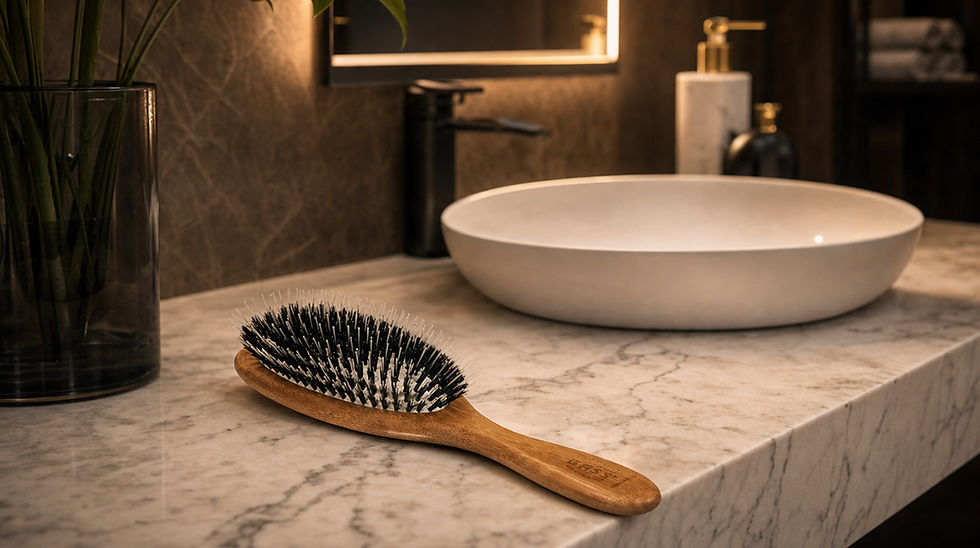
That geometry matters because a boar bristle brush belongs to the conditioning and surface-refinement side of hair care. Its work is to help move natural scalp oils through the hair, reduce dry friction, support smoother cuticle behavior, calm lifted fibers, and improve natural shine over time. It is not a tool for forcing tangles open or reshaping hair under heat. Its best results come from a more precise relationship between the tool and the hair.
Understanding pressure and angle gives the user a more intelligent hand. Instead of asking, “Why is this brush not working?” the better question becomes: “How is the brush meeting the hair?”
Pressure and Angle Are Not Small Technique Details
Pressure and angle are sometimes treated as minor adjustments, but with boar bristle brushes they are central to performance.
A pin brush can often tolerate a wider range of handling because its job is to separate and organize strands. A round brush can tolerate firmer tension because it is designed to shape hair under airflow. A boar bristle brush is different. Its bristle field is dense, flexible, and surface-oriented. It needs enough contact to engage the hair, but not so much force that the bristles collapse into the scalp or drag through the fiber.
The brush performs through controlled friction. That phrase may sound contradictory, but it is the key to the category. Some friction is necessary. Without it, the bristles would simply skate over the surface and fail to collect or distribute oil. Too much friction, however, turns the stroke into abrasion or compression. The art of boar brushing is finding the narrow middle: enough traction to move oil and organize the surface, not enough to overload the roots, scratch the scalp, or roughen the lengths.
Pressure and angle create that middle.
Pressure determines how deeply the bristles enter the hair field. Light pressure may touch only the surface. Moderate pressure may allow the tips to reach the scalp. Heavy pressure may crush the bristle field and create drag.
Angle determines which part of the bristle field does the work. A more upright brush concentrates contact at the tips. A flatter brush spreads contact across more of the bristle length and surface. A slightly lifted working angle can enter the hair without scraping; a flatter finishing angle can settle flyaways without digging into the style.
This is why pressure and angle should be understood together. A light stroke at the wrong angle can still feel scratchy. A moderate stroke at a better angle can feel smooth and controlled. A flat angle may polish beautifully with a light hand but flatten the hair when paired with too much pressure.
The hand is not just moving the brush. It is shaping the brush’s relationship to the hair.
The Three Forms of Contact in Boar Bristle Brushing
Most boar bristle brushing problems become easier to understand when the user separates three forms of contact: scalp contact, hair-shaft contact, and surface contact.
Scalp contact is used when the goal is to collect natural oil and begin a conditioning pass. The bristles should touch the scalp lightly enough to feel present but not sharp. This contact should be brief and controlled. The scalp is the source of sebum, but it is also living tissue; it should be engaged, not challenged.
Hair-shaft contact happens as the brush moves through the lengths. This is where oil transfer and cuticle-facing smoothing become more visible. The brush should have enough traction to carry a small amount of oil outward, while still moving smoothly through the prepared hair. If the stroke becomes broken, noisy, or resistant, the contact is too aggressive, the section is too large, or the hair has not been prepared well enough.
Surface contact is used for polishing the outer layer. This is the lightest form of contact. It is valuable near the canopy, hairline, crown, part line, and visible surface of finished hair. The bristles do not need to reach deeply. They need to catch lifted fibers and encourage them to rejoin the surrounding direction.
Many users run into trouble because they use one kind of contact for every purpose. They press deeply when the hair only needs surface polish. They skim lightly when the goal is oil distribution.
They brush the ends with the same pressure used at the roots. They treat a final smoothing pass like a full conditioning stroke.
A boar bristle brush becomes more effective when the hand can move between these three contact levels intentionally.
How Pressure Changes Boar Bristle Brush Performance
Pressure changes the way the bristles flex.
A boar bristle is not meant to remain rigid through the stroke. It should bend slightly, move with the hair, and release as the brush travels. That flex is part of how the brush softens contact and distributes oil gradually. When pressure is controlled, the bristle field behaves like many small points of responsive contact. When pressure is excessive, those points collapse into a denser, less responsive mass.
That collapse changes the outcome.
With balanced pressure, the bristles can collect oil at the scalp and spread it thinly through the hair. They can reduce dry friction without dragging. They can encourage the outer surface to lie more uniformly. The brush feels connected to the hair but not stuck in it.
With too much pressure, the brush begins to compress. The scalp may feel scratched or overstimulated. The roots may look heavy. Fine hair may lose lift. Dense hair may become compacted at the surface while the underlayers remain untouched. The lengths may feel rougher because friction has increased instead of decreased.
With too little pressure, the brush may feel pleasant but underpowered. It may skim the top layer without picking up oil from the scalp. It may make the canopy look neater without improving dryness through the mid-lengths and ends. It may create cosmetic smoothing rather than true distribution.
The right pressure is therefore not the strongest pressure the scalp can tolerate. It is the lowest pressure that gives the brush meaningful contact for the purpose of the pass.
For a full conditioning stroke, that means enough pressure for light root engagement and steady movement through the lengths. For surface finishing, it means much less. For the ends, it means the gentlest contact of the entire stroke.
How Angle Changes Boar Bristle Brush Performance
Angle changes the way the bristle field presents itself to the hair.
When a brush is held too upright, the bristle tips lead the stroke sharply. This can be useful only in very small, careful moments when the user needs light scalp engagement at the beginning of a section. If that upright angle continues through the stroke, the brush can feel pointed, scratchy, or disruptive.
When a brush is held too flat too early, the bristles may not enter the hair enough to collect oil or reach beyond the surface. The stroke may look smooth from the outside but fail to condition the lengths meaningfully. This is especially common on thick or dense hair, where the top layer accepts the brush while the interior receives very little contact.
The most useful working angle is usually between these extremes. The brush should be tilted enough for the bristles to enter the section, but not so vertical that they scrape. As the stroke moves away from the scalp, the angle can gradually soften so more of the bristle field glides through the hair.
This shifting angle matters because the root, mid-lengths, and ends are not asking for the same kind of work.
At the root, the brush is looking for oil and scalp contact. Through the mid-lengths, it is distributing and aligning. At the ends, it is depositing lightly and releasing. The angle should change as the job changes.
Angle also affects how the brush interacts with the direction of the cuticle. Hair’s outer cuticle scales lie from root toward tip. Brushing in that direction supports smoother surface behavior. A poorly angled stroke that lifts, reverses, or scrubs against the strand can increase roughness instead of reducing it.
The brush should not attack the surface from above. It should join the direction of the hair and guide it.
The Root Zone: Use Enough Angle to Enter, Not Enough Force to Scrape
The root zone is where many boar brushing mistakes begin.
Because natural oil is produced at the scalp, users often assume the brush must be pressed firmly into the roots. But oil pickup does not require aggressive pressure. It requires accurate contact. The bristle tips need to meet the scalp lightly, then move away from it in a clean path.
A good root pass begins by placing the brush into the section with control. The brush should not be slammed into the hair or pushed downward until it reaches the scalp. Instead, the section should be small enough that the bristles can find the root area without force. The brush is then angled slightly so the tips can touch the scalp and begin the stroke.
The feeling should be clear but gentle. If the scalp feels scratched, the brush is too upright, too firm, or being pressed too hard. If the brush never seems to reach the scalp, the section may be too large, the angle may be too flat, or the brush may not be suited to the density of the hair.
This is especially important around the hairline, temples, crown, and nape. These areas have different sensitivities and growth patterns. A single fixed angle will not serve all of them equally.
The wrist should make small adjustments so the brush follows the head rather than forcing the head to accept one motion.
When root contact is correct, the scalp feels lightly awakened, not irritated. The roots look refreshed, not flattened. The stroke begins with oil pickup but does not stay trapped at the scalp.
The Mid-Lengths: Let the Brush Glide, Carry, and Align
The mid-lengths are where pressure and angle reveal whether the stroke is truly working.
This part of the hair often needs the most conditioning support because it sits between the oil-producing scalp and the fragile ends. It has lived through repeated washing, styling, friction, and environmental exposure. It may feel dry even when the roots are oily. It may look dull because the cuticle surface is not lying evenly.
As the brush moves into the mid-lengths, the hand should soften. The brush no longer needs to seek the scalp. The angle should lower slightly, allowing the bristles to carry oil along the hair rather than concentrate pressure at the tips. The stroke should become smoother and more continuous.
If the brush drags through the mid-lengths, the user should not simply press through. Drag is information. It may mean the hair is not fully detangled. It may mean the section is too thick. It may mean the brush is too upright. It may mean the hair is carrying product residue or dryness that is increasing friction.
A clean mid-length pass feels like guidance. The hair moves with the brush rather than resisting it.
The bristles maintain enough traction to organize the strands but not so much that they pull.
This is where shine begins to build over time. Not as a coating, but as a surface condition: less dry friction, more even oil distribution, and better directional alignment of the hair fibers.
The Ends: Reduce Pressure Before the Stroke Finishes
The ends of the hair need the lightest touch.
They are the oldest part of the strand and usually the least lubricated. They may also contain splits, roughness, old mechanical damage, or dryness that makes them more likely to catch. If the brush is forced through the ends, the stroke can undo much of the benefit created above.
As the brush approaches the final inches, pressure should decrease. The angle should soften. The hand should complete the pass without snapping the brush away or pulling through resistance.
If the ends catch, the correct response is not to continue the boar bristle stroke. The correct response is to pause and remove the resistance separately. Boar bristles are not designed to open knots. They are designed to polish and condition hair that is already prepared enough to accept a continuous pass.
Long hair often benefits from supporting the section with the opposite hand near the lower lengths.
This reduces tension at the scalp and gives the user more control as the brush reaches the ends.
The stroke can then finish gently, allowing a small amount of natural oil to reach the most vulnerable part of the hair without adding stress.
A good boar bristle stroke does not end with force. It ends with release.
Hand Position and Wrist Movement Matter More Than Most People Realize
Angle is not controlled by the brush alone. It is controlled by the wrist.
A stiff wrist tends to create uneven contact. The brush may press too firmly at the crown, skim along the sides, and scrape near curved areas of the head. A responsive wrist allows the bristle field to stay in better relationship with the scalp and hair as the surface changes.
The hand should hold the brush securely but not tightly. A clenched grip often leads to excessive pressure because the arm begins to drive the stroke. A more relaxed grip allows the user to feel resistance early and adjust before the brush drags.
The wrist should make small rotations as the brush travels. Around the crown, the angle may need to lift slightly to avoid flattening volume. Along the sides, the brush may need to follow the natural fall of the hair. Near the nape, the angle may need to open just enough for the bristles to enter without scraping.
This is why boar brushing should not feel mechanical. The motion is consistent, but it is not rigid.
The user is constantly reading the hair through the brush: where it accepts contact, where it resists, where it needs less pressure, and where the stroke has already done enough.
The more responsive the hand becomes, the less force the brush needs.
How Brush Construction Changes Pressure and Angle
A direct-set boar bristle brush and a cushioned boar bristle brush can both support Shine & Condition brushing, but they translate pressure differently.
A direct-set brush places the bristles into a firmer base. This creates a more immediate feel. The user receives clear feedback from the scalp and hair because there is less cushioning between hand and bristle. This can be excellent for controlled surface refinement, sleek finishing, and precise directional work. It also means the user must be more disciplined. A heavy hand becomes noticeable quickly.
With a direct-set brush, angle is often the main way to soften contact. A slight tilt can prevent the bristle tips from feeling too pointed while still preserving control. The user should avoid driving the brush straight down into the scalp unless the contact is extremely light and localized.
A cushioned boar bristle brush diffuses pressure. The cushion gives slightly as the brush moves, helping the bristle field adapt to the contours of the head. This can make longer brushing sessions more comfortable and can help sensitive scalps tolerate repeated contact.
But cushioning does not remove the need for technique. If the pad collapses deeply with each pass, the user is pressing too hard. The cushion should move slightly, not become a license for force. A cushioned brush works best when its flexibility is allowed to support gentler contact, not when it is compressed into the scalp.
Construction changes how forgiving the brush feels. It does not change the underlying rule: pressure and angle still have to match the purpose of the stroke.
Fine Hair: Reduce Depth Before You Lose Lift
Fine hair responds quickly to boar bristle brushing because each strand is light and easily influenced. That responsiveness can be helpful, but it also means pressure and angle must be restrained.
On fine hair, deep contact can move too much oil too quickly and reduce the separation that gives the hair visual fullness. The hair may become smoother but smaller. It may look shinier but flatter.
This is not necessarily a failure of the brush; it is often a sign that the stroke was too deep, too repeated, or too concentrated at the roots.
Fine hair usually benefits from lighter pressure and a more selective angle. The brush may only need to touch the surface or lightly engage near the roots. Full root-to-tip brushing can still be useful, but it should be done with restraint and stopped before the crown loses lift.
For fine hair, the user should watch the result after the first few passes. If the hair already looks refined, more brushing may not improve it. It may simply compress it. The hand should stop when the surface is resolved, not when an arbitrary number of strokes has been completed.
The goal is polish without collapse.
Thick or Dense Hair: Improve Access Before Increasing Force
Dense hair often makes users press harder because the scalp feels difficult to reach. But pressure alone rarely solves density. It may only compress the outer layer while the interior remains untouched.
The better answer is access.
Smaller sections allow the brush to enter the hair field without force. A slightly more open root angle can help the bristles reach the scalp, while a softer angle through the lengths prevents the stroke from becoming a plowing motion. The hand should work in deliberate paths rather than trying to brush the entire mass at once.
Dense hair may need more time, but not more aggression. When the brush reaches the scalp through proper sectioning, oil pickup becomes more even. When each section receives a complete pass, the lengths receive more meaningful distribution. When the angle is adjusted as the brush moves, the stroke remains smoother.
If a boar bristle brush consistently cannot reach the scalp even with sectioning and good technique, the issue may be brush structure rather than user effort. Longer bristles, firmer bristles, or a hybrid design may be more appropriate for that hair field. But even with a more penetrating brush, pressure should remain controlled.
Dense hair rewards preparation and access, not force.
Wavy, Curly, and Coily Hair: Match the Angle to the Desired Finish
Wavy, curly, and coily hair require careful interpretation because the strand does not travel in a straight path. The more the hair bends, the more selective boar bristle brushing should become.
For wavy hair, pressure and angle can help calm surface frizz and improve luster, but brushing too heavily through the wave pattern may stretch or blur natural movement. A lighter angle that follows the direction of the wave is usually more useful than a forceful downward pass.
For curly hair, boar bristle brushing is often most useful when the hair has already been detangled, stretched, set into a smoother style, or prepared for surface refinement. A flatter finishing angle can polish the canopy or refine a gathered style without requiring the brush to break through every curl grouping.
For tightly coiled hair, the brush should be used with the clearest purpose. It may support smoothing, edge refinement, stretched styles, pre-wash oil movement, or polished updos. It should not be forced through compact curl structure in pursuit of a result the brush is not designed to create.
In textured hair, resistance should be respected. If the brush catches, the answer is not more pressure. It is a smaller section, a different angle, better preparation, or a different tool before the boar bristle brush enters.
The goal is not to erase texture. The goal is to use the brush where its contact can refine, condition, and polish without disrupting the hair’s intended form.
Diagnosing Common Pressure and Angle Problems
A boar bristle brush often reveals technique problems through the result it leaves behind.
If the scalp feels sore or itchy after brushing, pressure was likely too high, the angle was too upright, or the brush was too firm for the scalp. The next session should use smaller sections, a softer angle, and less downward force.
If the roots look greasy immediately after brushing, the stroke may have spent too much pressure near the scalp or repeated too many passes at the root. The solution is lighter root engagement and more complete movement through the lengths.
If the brush only smooths the top layer, the angle may be too flat or the section too large. The brush is polishing the canopy but not reaching the interior. Sectioning and a slightly more open root angle can help.
If the hair becomes frizzy after brushing, the stroke may be too fast, too forceful, moving against the hair’s direction, or passing through unresolved tangles. Frizz after boar brushing usually means the surface was disturbed rather than refined.
If fine hair looks shiny but limp, pressure, pass count, or root contact was probably excessive. The brush achieved alignment but removed too much lift.
If thick hair feels unchanged at the ends, the brush may not be completing the oil pathway.
Smaller sections and slower root-to-end passes can improve distribution.
These signs help the user correct technique without immediately blaming the brush. The question is not only whether the brush is good. The question is whether the contact is appropriate for the hair in front of it.
A Simple Calibration Method for Better Boar Bristle Brushing
The easiest way to find the right pressure and angle is to calibrate the brush in a small section before brushing the whole head.
Begin with dry, detangled hair. Choose a section that is easy to observe, such as one side of the head or a small area near the crown. Place the brush near the roots with very light pressure. Tilt it slightly so the bristle tips can touch the scalp without scraping.
Make one slow pass from root through the lengths. As the brush moves downward, soften the angle. Let the bristles glide rather than dig. Reduce pressure further as the brush reaches the ends.
Then read the result. The scalp should feel comfortable. The hair should look a little calmer, not flattened. The brush should not have snagged. The roots should not look oily from one pass. If the stroke felt too shallow, reduce the section size before adding pressure. If it felt scratchy, soften the angle before changing brushes. If it dragged, detangle more thoroughly or slow down.
This method trains the hand to adjust based on feedback. It also prevents the most common mistake: using the entire head as a testing ground and overbrushing before the technique has been understood.
Boar bristle brushing improves when the user learns to observe small changes early.
Conclusion: Better Performance Comes from Better Contact
Boar bristle brushing is not a force practice. It is a contact practice.
Pressure determines how deeply the bristles engage. Angle determines how that engagement is presented. Together, they decide whether the brush collects oil, distributes it, smooths the surface, calms flyaways, preserves volume, or creates unnecessary drag.
The best technique is responsive. It begins with light root contact, moves through the mid-lengths with controlled glide, and finishes through the ends with restraint. It changes for fine hair, dense hair, textured hair, sensitive scalps, direct-set construction, cushioned construction, conditioning passes, and finishing strokes.
When pressure and angle are used intelligently, the brush can perform its real function: helping the hair use its own natural conditioning system more effectively while refining the surface into a smoother, calmer, more reflective condition.
The hand does not need to make the brush work harder. It needs to help the brush meet the hair more accurately.
Frequently Asked Questions
How much pressure should I use with a boar bristle brush?
Use the lightest pressure that creates meaningful contact. The bristles should engage the hair and lightly touch the scalp when oil distribution is the goal, but the brush should not feel sharp, scratchy, or difficult to move.
Should a boar bristle brush touch the scalp?
Yes, but only lightly. Scalp contact helps the brush pick up natural oil, but the bristles should not scrape or press aggressively into the skin.
What angle should I hold a boar bristle brush?
Use a slightly tilted angle near the roots so the bristles can enter the hair without scratching. As the stroke moves through the lengths, soften the angle so the brush glides and distributes oil more evenly.
Why does my boar bristle brush feel scratchy?
A scratchy feeling usually means the brush is too upright, the pressure is too heavy, the scalp is sensitive, or the bristle firmness is not well matched to the user. Start by reducing pressure and softening the angle.
Can pressing harder help the brush reach thicker hair?
Usually no. Pressing harder often compresses the outer layer without improving access. Thick or dense hair usually needs smaller sections, slower strokes, and a brush structure suited to the hair field.
Why does my hair look greasy after boar bristle brushing?
The brush may be using too much root pressure, too many repeated passes near the scalp, or not carrying oil far enough through the lengths. Use lighter pressure at the roots and complete the stroke more evenly.
Why does my boar bristle brush only smooth the top layer?
The section may be too large, or the brush may be held too flat. Smaller sections and a slightly more open angle near the roots can help the bristles reach beyond the canopy.
Can the wrong brush angle cause frizz?
Yes. If the brush is too upright, too fast, or moving against the hair’s natural direction, it can disturb the surface instead of refining it. Frizz can also appear when the brush is forced through tangles.
Should I use the same pressure from roots to ends?
No. The roots may need light engagement, the mid-lengths need controlled glide, and the ends need the softest contact. Pressure should usually decrease as the stroke moves downward.
Is a cushioned boar bristle brush easier to use?
It can be more forgiving because the cushion diffuses pressure and follows the head more comfortably. However, the user still needs controlled pressure. The cushion should flex slightly, not collapse under force.
Is a direct-set boar bristle brush better for precise smoothing?
Often yes. A direct-set brush gives a more stable contact plane, which can be useful for sleek surface refinement and controlled finishing. It also requires a lighter, more precise hand.
How do I know if I am brushing too hard?
Signs include scalp soreness, scratchiness, flattened roots, greasy-looking sections, drag through the lengths, or hair that looks disturbed rather than smoother after brushing.
How do I know if I am brushing too lightly?
The brush may skim the surface without changing the hair’s feel, the roots may remain oily while the ends stay dry, or only the top layer may look polished. Try smaller sections and a slightly more engaged angle before increasing pressure.
Should fine hair use less pressure?
Yes. Fine hair usually needs lighter pressure, fewer passes, and more selective brushing because it responds quickly to oil movement and compression.
Should curly or coily hair be brushed differently?
Yes. Boar bristle brushing should be used selectively on textured hair, often for smoothing, stretched styles, pre-wash oil distribution, edge refinement, or polished finishing. It should not be forced through tight curl structure when curl definition is the goal.









