Brush Material Guide for Professional Stylists

Updated: Jun 10


This article expands on concepts from the broader textbook – “Hairbrushes: The Definitive Encyclopedia of History, Types, Materials, and Functional Systems – A Comprehensive Educational Textbook by Bass Brushes.”
Key Takeaways
• Brush materials influence performance characteristics such as flexibility, durability, heat response, and maintenance requirements, making material selection an important professional consideration.
• Different materials interact with hair in different ways, affecting factors such as tension, airflow, smoothing ability, and overall styling control.
• No single brush material is ideal for every service, as hair type, styling objectives, and salon workflows often determine the most appropriate choice.
• Understanding how materials respond to repeated cleaning, heat exposure, and daily salon use helps professionals evaluate long-term tool performance.
• Comparing brush materials based on service requirements rather than trends allows stylists to select tools that support consistent results and efficient salon operations.
Brush materials matter because the material changes what the tool is allowed to do. It changes contact, reach, flexibility, drag, heat behavior, pressure feel, and the way the section responds during the pass. In professional use, material choice is never just a build-quality detail. It is one of the main reasons a brush either matches the service or fights it. A stylist may describe that problem in practical terms by saying a brush feels too soft, too grabby, too hot, too shallow, too harsh, or too vague. Underneath those impressions is material behavior.
That is why a serious brush material guide cannot be reduced to a simple natural-versus-synthetic conversation. In professional work, material is a behavior system. A brush material is not interesting because it sounds premium. It is important because it changes what the section experiences. The governing rule is simple: choose the material that solves the real service problem without creating a larger one.
The most useful way to understand brush materials is to stop asking which one is best in the abstract and start asking what kind of contact the service needs. Does the hair need surface polish or deeper entry? Does it need lower-friction refinement or stronger control? Does the service need heat-responsive shape building or a calmer grooming pass? Once those questions are clear, material choice becomes much more honest.
Material is best understood as behavior, not branding
Many brushes can sound similar when they are described broadly. They may all promise shine, smoothness, control, or manageability. But material determines how those outcomes are pursued.
Two brushes may both claim to smooth the hair while doing it through completely different mechanics. One may smooth by creating softer surface contact and helping align the outer layer. Another may smooth by entering more deeply, exerting stronger directional control, and imposing more structure on the section. The result may look related, but the pathway is not the same.
This distinction matters because professional work depends on pathway, not only outcome. If the hair is fine and already cooperative, a softer-contact material may create a cleaner result with less disturbance. If the hair is dense, resistant, or still structurally unresolved, that same material may fail to enter honestly. A stylist can then mistake the problem for poor technique when it is really a material mismatch.
So when evaluating a brush, it helps to think in layers. Bristle or pin material usually controls contact behavior most directly. Barrel material matters most when the service uses heat as part of shape formation. Cushion construction affects how pressure is distributed. Handle material affects grip, rhythm, and repeated-use control. All of those material choices matter, but they do not matter in the same way.
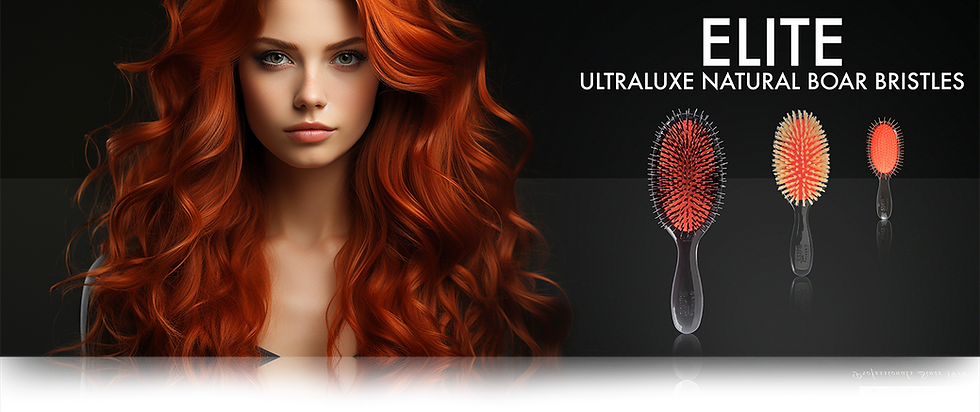
Boar bristle is strongest when the service needs surface polish, shine, and calmer contact
Boar bristle is most useful when the goal is smoothing, polishing, distributing natural oils through the hair, and refining the outer surface of the section. Its behavior is generally associated with softer, more surface-oriented contact than a stiffer synthetic pin or bristle. That makes it especially useful when the service needs calmer finish behavior rather than aggressive entry.
This is why boar bristle is so often strongest in shine and condition work, flyaway control, grooming passes, and finish-stage refinement. The material can help organize the outer layer of the hair without behaving like a more force-driven detangling tool. On hair that is already mostly cooperative, that difference is important. The brush does not need to fight its way into the section.
It needs to improve what is already there.
That is also why boar has a clear limit. It is usually less effective when the real problem is deep penetration through dense, resistant, or heavily tangled hair. If the section still needs maximum opening power, boar is often too polish-oriented to be the best first answer. It may make the outer layer look more controlled while failing to solve the deeper structural problem underneath.
So the first practical rule is simple: use boar when the service needs calmer surface behavior, not when it needs maximum opening power.
Nylon is strongest when the service needs reach, penetration, and stronger control
Nylon behaves differently because it usually provides firmer, more assertive entry into the section.
Where boar often works at the level of surface refinement and polish, nylon is more often chosen when the hair still needs to be entered, separated, directed, or controlled more actively. That makes nylon especially useful in detangling, thicker-hair penetration, and styles where the brush has to move beyond the outer shell of the section.
This difference is one of the most practical material distinctions in salon work. If boar glides and polishes, nylon reaches and controls. That does not make nylon universally better. It makes nylon more appropriate when the section still needs stronger brush authority. A dense or resistant section often does not respond honestly to a softer-contact material. It needs a brush that can enter more decisively and create a more active relationship with the hair.
That extra reach has to be understood correctly, though. Stronger material entry is useful when the service needs it. It becomes excessive when the section does not. On hair that is fragile, fine, or already mostly resolved, a more assertive material can introduce more force than necessary. So nylon is strongest not because it is strong in the abstract, but because it is right when stronger entry is the real requirement.
So the second practical rule is this: use nylon when the service still needs deeper reach and more directed control.
Mixed boar-and-nylon is strongest when the hair needs both polish and penetration
Mixed bristle constructions are some of the most practically useful in salon work because they combine two different material behaviors in one working surface. A mixed boar-and-nylon brush is often chosen when the section needs deeper entry than pure boar can provide, but the stylist still wants more finish polish than pure nylon alone would emphasize.
This is one of the clearest dual-function material systems in brush design. The tool is not acting purely as a detangler and not purely as a polisher. It is bridging the space between entry and finish. That makes mixed boar-and-nylon especially useful on hair that needs both visible refinement and enough penetration to move beyond the outer shell honestly.
This matters because many real salon sections do not present a pure problem. The hair may not be deeply tangled, but it may still be too dense or resistant for boar alone. Or the hair may be penetrable with nylon, but the stylist may still want a more polished, finish-aware result than a pure nylon construction tends to emphasize. Mixed bristle systems answer that middle-ground problem.
So one of the strongest professional rules is this: when the hair needs both control and visible finish, mixed boar-and-nylon is often the clearest material answer.
Metal and aluminum barrels are strongest when the service uses heat as part of shape-building
Barrel material matters most in round-brush work, where heat and airflow are part of the service design. A metal or aluminum barrel is not just a structural choice. It changes the thermal behavior of the brush. That matters because a thermally active barrel affects how quickly the section takes shape, how firmly it sets, and how responsive the brush feels during blow-drying.
This is why metal or aluminum barrels are strongest when the service is blow-dry driven, heat retention is part of the shaping goal, and the stylist wants more responsive thermal behavior from the brush. When heat is being used not just to dry the section but to build bend, hold, curve, or straighter lines with intention, barrel material becomes a major part of the result.
But the material boundary matters. The more heat-active the barrel, the more intentional the stylist has to be about hair type, tension, airflow, and exposure time. A thermally responsive brush can support beautiful shape building, but it also asks for more deliberate handling. Heat-active barrel logic belongs in services that intentionally use heat as a shaping partner, not in situations where the stylist only needs a calm grooming or detangling pass.
So the practical rule is this: choose metal or aluminum barrels when the service deliberately uses heat as part of shape formation.
Ceramic and similar heat-reactive materials belong in the thermal-styling family
Ceramic and similar heat-reactive barrel surfaces are best understood as part of the same larger family of intentional blow-dry styling tools, though their exact behavior depends on the design around them. Barrel diameter, venting, airflow exposure, and the hair’s starting condition all influence what the material does in practice.
The clearest practical point is that ceramic-style materials do not belong to the same behavioral category as a non-thermal grooming brush. They belong in the heat-styling family. A stylist chooses them when the service needs blow-dry responsiveness, smoother thermal rhythm, and more deliberate styling behavior than a simple grooming pass requires.
That does not mean every ceramic-style brush behaves identically. It means the professional should read the material as part of a thermal system rather than as a cosmetic coating detail. If the goal is shape building under airflow and controlled heat response, ceramic-style materials belong in the decision set. If the goal is grooming, polishing, detangling, or calm finish work without thermal intent, they do not occupy the same functional space.
So the safest professional reading is that ceramic belongs to the heat-styling material family and should be chosen when thermal behavior is part of the service logic.
Handle materials matter less for direct hair behavior than for control, rhythm, and fatigue
For most services, handle material is not as function-defining as bristle or barrel material. It usually does not decide whether the brush polishes, penetrates, detangles, or builds heat-responsive shape. But it still matters because it changes the relationship between the tool and the hand.
A professional repeats the same brush motions all day. Grip comfort, balance, tactile confidence, surface texture, and control under repeated use all affect rhythm. A handle that feels stable and trustworthy can improve speed, rotation control, and hand comfort over time. A handle that feels slippery, awkward, or tiring can weaken precision even if the brush head itself is mechanically appropriate.
That is why handle material belongs lower in the hierarchy of direct hair behavior, but not outside the hierarchy entirely. Bristle material affects contact behavior most. Barrel material affects thermal behavior most. Handle material affects ergonomics and repeated-use control most. A strong stylist reads those levels differently rather than collapsing them into one general idea of quality.
Cushion construction changes how pressure is distributed
Cushion behavior is often overlooked because it seems secondary beside bristle or pin material, but it changes the force path in an important way. A cushion changes how the brush yields under pressure, how the contact field meets the scalp or section, and how evenly the pressure spreads during the pass.
This matters because pressure distribution affects both feel and function. A more forgiving cushion can change how harsh or disciplined the brush feels during grooming or detangling. It can alter scalp comfort, section compression, and the way the tool responds when the hair resists. A firmer system may feel more direct and exacting. A softer system may feel calmer and more adaptive.
Neither replaces bristle logic, but both change how that logic is delivered into the section.
That is why cushion construction should be understood as part of the force system. It does not decide everything by itself, but it can meaningfully change whether a brush feels severe, forgiving, vague, or controlled in repeated professional use.
So one of the quieter professional rules is this: cushion behavior does not replace bristle or pin behavior, but it absolutely changes how the force reaches the hair.
Material choice should change by texture, not just by brush category
A material guide is incomplete if it only sorts by brush type. Material has to change by texture too.
A brush that is structurally correct for one kind of hair can be materially wrong for another, even within the same broad category.
For fine, thin, or more fragile hair, boar often makes sense because the section usually benefits more from polish-oriented contact than from force-heavy entry. For thicker or denser hair, nylon often becomes more useful because the section needs more honest penetration. For medium-to-thick hair that still needs visible finish control, mixed boar-and-nylon often becomes the stronger compromise. In blow-dry work, metal or aluminum barrels become more relevant when heat responsiveness and hold are part of the goal.
That is why the strongest material decision is not based on category label alone. It is based on texture plus service plus desired finish. A stylist who ignores texture will often misread the material.
A brush can seem wrong when the real problem is that the material was chosen for the wrong kind of section.
The biggest professional mistake is choosing material by description language instead of behavior
One of the most common professional mistakes is choosing brush material by how it sounds instead of by what it does. Material language can easily become flattened into broad ideas like natural, gentle, professional, smoothing, or high-performance. Those descriptions are often too vague to help. They do not tell the stylist what kind of contact the brush will create, how deeply it will enter, or whether it will behave honestly for the real service problem.
A nylon brush that reaches into dense hair is not functionally the same as a pure boar brush that polishes the outer shell. A heat-active round brush is not functionally the same as a flat grooming brush just because both can smooth the hair in some sense. The material itself changes the mechanics of the pass.
So one of the strongest professional habits is to read material as behavior, not language. Ask what kind of contact it creates. Ask how it changes force, heat, or pressure distribution. Ask what problem it solves. That is the level at which brush materials become truly useful.
What strong professionals actually do
Strong professionals do not ask which material is best in the abstract. They ask what the section needs. If the service needs shine and calmer surface refinement, they often move toward boar. If the service needs penetration and stronger control, they often move toward nylon. If the service needs both, they often move toward mixed boar-and-nylon. If the service needs heat-responsive shape building, they move toward thermal barrel logic. And they do not confuse comfortable feel, luxury presentation, or price point with actual functional behavior.
That habit matters because it keeps material choice honest. Instead of selecting by image, the stylist selects by contact, force, heat response, and texture fit. That is what makes a material guide professional rather than merely descriptive.
Conclusion
A serious brush material guide for professional stylists begins with one principle: material determines behavior. Boar is usually chosen for softer contact, polish, and oil-distribution support. Nylon is usually chosen for penetration, detangling, and stronger control. Mixed boar-and-nylon often serves as the dual-function middle ground. Metal, aluminum, and other heat-reactive barrel systems belong to intentional blow-dry shape building. Cushion construction changes pressure behavior, and handle material matters mainly for ergonomics, rhythm, and repeated-use control.
The broader principle is simple: choose the material that solves the real service problem, not the one that sounds best on the box. Once material is read as behavior, brush choice becomes much more precise.
Frequently Asked Questions
What is the main difference between boar and nylon bristles?
Boar usually creates softer, more polish-oriented contact, while nylon usually creates stronger penetration and more active control.
Is a mixed boar-and-nylon brush the best choice?
It is often a strong choice when the hair needs both deeper entry and a more polished finish rather than only one of those behaviors.
When should a stylist choose a metal or aluminum round brush?
When the service intentionally uses heat as part of shape building and the stylist wants a more thermally responsive blow-dry tool.
Are natural materials always better for hair health?
Not universally. A material is only better when its behavior matches the section’s real need. Softer contact is not always better than deeper reach, and deeper reach is not always better than surface polish.
Does cushion construction really matter?
Yes. Cushion behavior changes how pressure is distributed, how the brush gives under force, and how disciplined or forgiving the pass feels.
What is the simplest professional rule for brush materials?
Read material as behavior. Choose the one that creates the kind of contact, control, pressure feel, or heat response the service actually needs.