The Beard Brush by Bass: Conditioning, Training, and Styling Your Beard—A Complete Guide
- Bass Brushes

- Sep 15, 2025
- 4 min read
Updated: Mar 5


There’s a moment in every beardsman’s journey when balm and oil aren’t enough. The beard still looks patchy, feels rough at the edges, or refuses to lay the same way twice. That’s where a purpose-built beard brush changes everything. With the right bristles and the right motion, you can condition each whisker, train direction, and create a natural, barbershop-clean finish—daily.
For nearly fifty years, Bass Brushes has refined natural-bristle grooming tools that deliver professional results at home. The standout hero is The Beard Brush by Bass Brushes | Pure Natural Boar Bristle Beard Brush—a compact, focused instrument designed specifically for facial hair. Alongside the R.S. Stein Heirloom beard line (Club, Palm, 8-Row, 9-Row, and Soft variations), Bass gives you a complete system to soften, shape, and polish any beard.
Why a Beard-Specific Brush (Not Just Any Brush)
Beard hair isn’t scalp hair. It’s thicker, more wiry, and it grows over delicate facial skin. A beard brush must:
Distribute oils (both natural sebum and applied beard oils) evenly from root to tip.
Exfoliate gently beneath the beard to lift dry skin and reduce itch and flakes.
Train direction so growth patterns align and lines look intentionally clean.
Tame volume without leaving a glossy, product-heavy sheen.
Natural boar bristle excels at this—its fiber structure grips the hair lightly, carries oils along the shaft, and smooths the cuticle for softness and natural luster.
Meet the Lineup: Finding Your Best Bass Beard Brush
The Beard Brush by Bass Brushes (Pure Boar)A focused workhorse for most beards. Compact enough for control along the cheeks and neckline, firm enough to train growth and distribute oils uniformly.
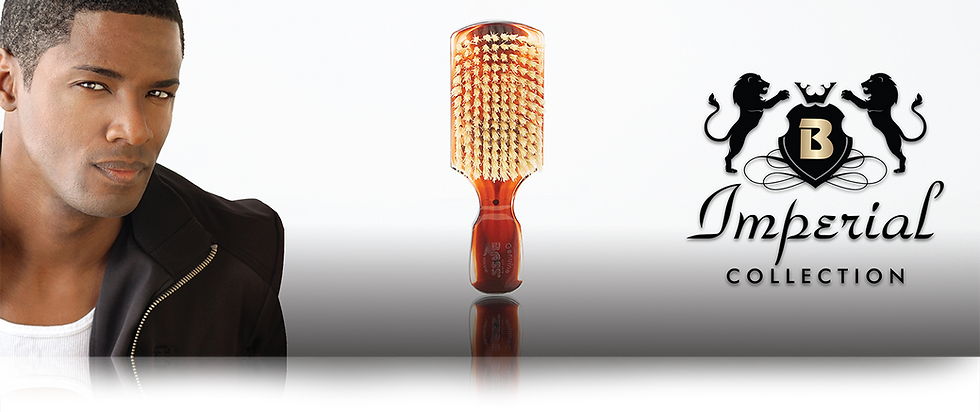
R.S. Stein Heirloom | Club Style (Boar / Soft Boar)The rectangular “club” profile offers leverage and clean, linear strokes—great for medium to longer beards. Choose Soft Boar for sensitive skin or shorter beards; standard boar for fuller density.
R.S. Stein Heirloom | Palm Style (Boar / Soft Boar)An ergonomic oval that nests in your palm, ideal for circular polishing motions and quick daily touch-ups.
R.S. Stein Heirloom | 8-Row & 9-Row (Boar / Soft Boar)Rowed layouts give you predictable coverage and “lane control.”
8-Row = slightly firmer feel and faster bulk management.
9-Row = a touch more surface contact for fine finishing on longer beards.
Tip: If your beard is coarse or dense, start with standard boar in Club or 8-Row. For shorter, newer, or sensitive beards, choose Soft Boar or The Beard Brush for comfort and precision.
The Technique: A 3-Minute Daily Routine
0:00–0:30 — Prep(Optional) Warm a few drops of beard oil between your palms. You want slip—not saturation.
0:30–1:15 — Upward Pass (Lift & Exfoliate)With The Beard Brush or your chosen Heirloom model, brush upward from neck to jaw and from chin toward cheeks. This lifts hairs, loosens trapped skin, and distributes oil at the roots.
1:15–2:30 — Downward Pass (Shape & Train)Now brush downward in smooth, measured strokes. Work sideburns to jaw, then chin to neckline, and finally the mustache area outward from center. You’re aligning growth and setting the lay.
2:30–3:00 — Edge Polish Final light passes along the cheek line and under the jaw. Use shorter, slower strokes to “set” your preferred outline before you apply any balm/wax for hold.
Advanced: For dense beards, begin with a wide-tooth Bass comb to detangle, then brush to condition and finish. (We’ll cover combs vs. brushes in a dedicated pillar.)
Troubleshooting Common Beard Challenges
Itch & Flakes → Increase gentle upward passes to exfoliate; choose Soft Boar if your skin is reactive.
Bulk & Puffiness → Use Club or 8-Row for firmer tension, then seal shape with a pea-size balm.
Patchy Areas → Consistent daily brushing improves uniform lay and visual density by aligning neighboring growth.
Oily Mustache, Dry Chin → Start with upward strokes through the chin/under-beard first to get oil where it’s needed, then finish the mustache last with minimal product.
Care & Cleaning (So Your Brush Keeps Working)
After use: Tap out loose hairs; don’t leave product clumps in the bristles.
Weekly: With a mild shampoo, spot-clean the bristles only (avoid soaking wood or cushion). Rinse lightly and dry bristle-side down.
Storage: Keep it dry and ventilated. Avoid steamy shelves or sealed, wet travel pouches.
Well-kept boar bristles stay springy and effective for years, which is why durable Bass construction (handles, bristle setting, row layout) matters.
When to Add a Comb
A beard comb is the precision partner to your brush: detangle after the shower, distribute balm evenly, and refine the mustache line. Pair The Beard Brush (for conditioning and training) with a wide-tooth Bass comb for longer or curl-pattern beards, and a finer tooth for mustache detailing.
The Bass Difference
From the dedicated The Beard Brush to the R.S. Stein Heirloom Club, Palm, and Rowed variations, Bass builds beard tools with the same professional DNA as its salon brushes—thoughtful ergonomics, natural bristles, and layouts that make daily results repeatable. The result isn’t a glossy, product-heavy beard; it’s a healthier one that feels soft, looks fuller, and holds its shape.
Bottom Line
If you own only one beard tool, make it The Beard Brush by Bass. Add an Heirloom variant for your density and a wide-tooth Bass comb for detangling, and you’ve got a complete, barbershop-quality system—at home, in minutes, every day.